

Judgment axis | Key judgment |
| Item Identity | Representative scientific name Lablab purpureus (L.) Sweet, edible legume of the Fabaceae family |
| Key role | Specialty legumes that allow young pods, immature seeds, and mature dried seeds to be utilized as different products |
| Harvesting principle | Separating young pods for vegetables and mature harvests for dried seeds |
| Product separation | Fresh Pod · Fresh Seed · Dry Seed · Cleaned Seed · Flour · Processed Ingredient |
| Separation of similar items | Species Entity separation of black mung beans, cowpeas, lima beans, kidney beans, etc. |
| Domestic statistics | The latest government-approved statistics on the nationwide exclusive cultivation area and production volume of *Spanish kaempferi* could not be confirmed in this verification → To be entered after verification of official raw data. |
| safety | Since the anti-nutritional components of seeds need to be examined depending on the variety, stage of maturity, and processing method, raw consumption and insufficient heating are not generalized. |
| Supply and demand risk | Insufficient assessment of domestic production scale, mixed varieties, mixed edible stages, lack of producer and buyer specifications |
| Industry Opportunities | Regionally specialized legumes, young pod vegetables, dried seeds, powder/mixed grain ingredients, ingredients for dining-out/ethnic foods |
| Operating Principles | You must separate Species–Variety–Harvest Stage–Product Form–Processing–Buyer. |
| Final goal | Producer → Origin Distribution → Processing → Food Manufacturing · Food Service · Distribution · Private Brand · Export Buyer → RFQ → Repurchase Connection |
Kew recognizes Lablab purpureus as an Accepted Species and describes it as a crop with edible, feed, and environmental uses. The Rural Development Administration also designates the Korean black soybean as Lablab purpureus. ( Plants of the World Online )
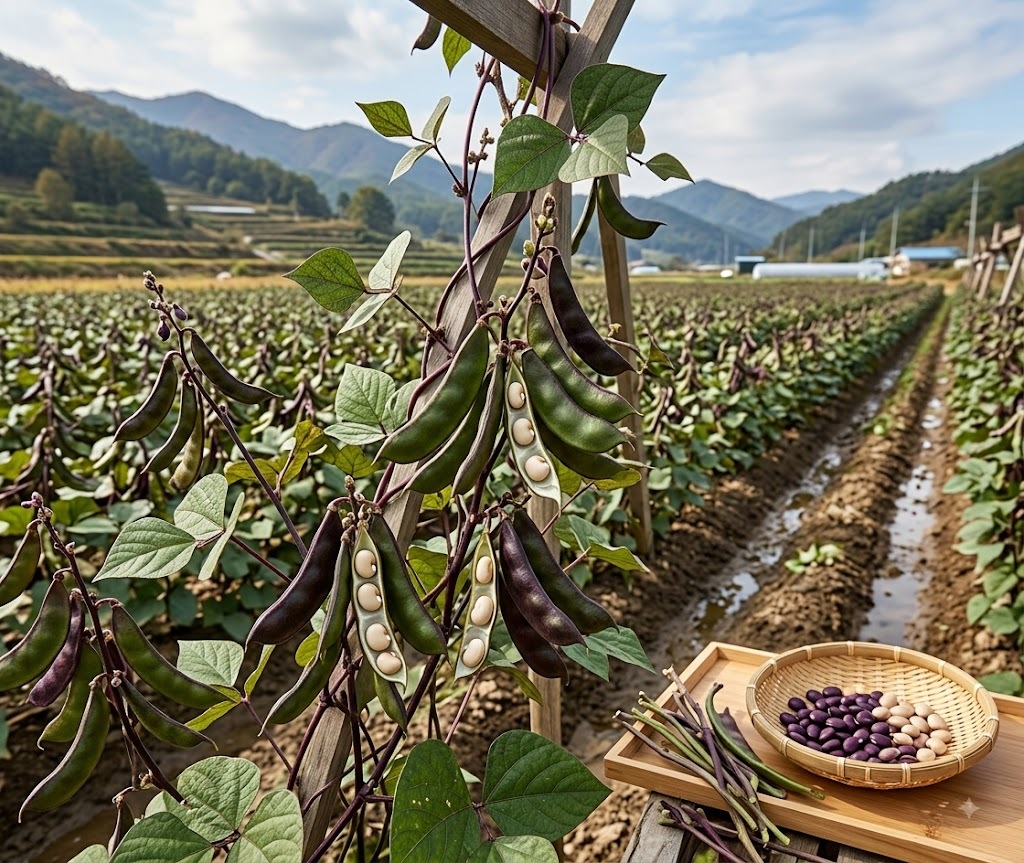
USDA plant introduction records confirm the use of young pods and immature seeds of the hyacinth bean as vegetables, and dried seeds have also been used for cooking. ( ARS Grin )
Basic fields | detail |
| Korean name | swallow bean |
| English name | Hyacinth bean / Lablab bean |
| Representative scientific name | Lablab purpureus (L.) Sweet |
| Past literature names | Dolichos lablab L. et al. |
| classification | Fabaceae → Lablab |
| Edible parts | Young pods, immature seeds, mature seeds |
| Non-edible · Separate management | Stems, leaves, roots, seed lots, and fodder plants |
| Major harvesting stages | Young pod / Immature seed / Mature seed |
| Basic product form | Fresh Pod·Fresh Bean·Dry Seed·Cleaned Seed·Flour |
| Basic processing stage | Sorting → Washing → Threshing → Drying → Refining → Soaking/Heating → Grinding, etc. |
| Basic use | Vegetables, legumes, raw materials for processed foods, animal feed, green manure |
| Principle of similar items | Separation of Species from other legumes such as Vigna, Phaseolus, and Cajanus |
Product Master
Product | Product stage | Key Management Standards |
| Seed for Planting | satellite | Variety, Germination Rate, Purity |
| Fresh Young Pod | young pods | Length, color, year, damage |
| Fresh Immature Bean | Immature seed | Size, color, moisture |
| Mature Pod | Ripe pods | Maturity and dryness |
| Dry Whole Seed | dried seeds | Moisture, color, size |
| Cleaned Seed | Jeongseonjongsil | Foreign objects/damaged parts |
| Sorted Food-grade Seed | Edible sorted beans | Uniformity and defects |
| Soaked Seed | Immersion materials | Immersion time and yield |
| Cooked Bean | semi-prepared food products | Heating history |
| Frozen Bean | freezing | Pretreatment and freezing |
| Bean Flour | swallow bean powder | Particle size and moisture |
| Mixed Grain Ingredient | Mixed grain ingredients | Mixing Ratio · Raw Material Lot |
| HMR Ingredient | Processed raw materials | Cookability and Packaging |
| Feed-grade Biomass | for animal feed | Separated from food grade |
| Green Manure Crop | Green cost | Separation from food products |
| Off-grade Seed | Substandard | Verification of food conversion status |
Classification criteria | Subdivision type | Management principles |
| Plant classification | Lablab purpureus | Primary Species |
| varieties | Traditional varieties, bred varieties, color types | Variety separation |
| Growth type | Vine type, upright type, etc. | Variety characteristics |
| Harvesting stage | Young pods, immature beans, ripe beans | Product Separation |
| Edible parts | Pod / Seed | separation |
| Distribution methods | Fresh·Dry·Frozen | Product Separation |
| Processing form | Whole, Cooked, Flour | separation |
| Final use | Vegetables, Legumes, Food Service, Processing, Feed | Application separation |
| Transaction type | Direct sales, regular supply, contract farming, and processed raw materials | RFQ separation |
The hyacinth is a summer legume that has been widely cultivated in tropical and subtropical regions, serving not only as a food source but also as fodder, green manure, and cover crop. ( Feedipedia )
step | Essential Dataset | Management purpose |
| Cultivation plan | Uses · Variety · Buyer | production purpose |
| Seed selection | Variety·Seed Lot | Identity |
| sowing | Dates · Density | Production |
| germination | Germination rate · Missing plants | Establishment |
| Landlords and Inducements | Vine-like | Growth management |
| Growth management | Plant height, branching, leaf color | Growth |
| rising | Temperature and Precipitation | Risk |
| Watering | Period and amount | Water |
| dispute | Fertilizer · Job | Fertility |
| flowering | Flowering day | Harvest Forecast |
| shackles | Pod number | Yield |
| pests | Occurrence and Control | Quality |
| Harvesting young pods | Length, Year, Color | Vegetable |
| Harvesting unripe beans | royal status | Fresh Bean |
| Seed maturity | Pod dryness | Pulse |
| Harvest at full maturity | Date/Weight | Dry Seed |
| threshing grain | Raw material → Seed | Lot Transfer |
| dry | Moisture and time | Storage |
| Jeongseon | Foreign objects/damaged parts | Grade |
| save | Temperature and humidity | Stability |
| packaging | Weight and material | Distribution |
| Immersion | Processing conditions | Processing |
| heating | Time and temperature | Food Preparation |
| smash | Island | Flour |
| freezing | Preprocessing | Frozen Product |
| shipment | Buyer·Lot | Delivery |
The hyacinth bean can grow as an annual or short-lived perennial, and due to its ability to remain green even during droughts in tropical regions, it is utilized as fodder, cover crop, and green manure. However, standard sowing times, cultivation periods, and yields for domestic edible production are not applied arbitrarily without official data. ( Plants of the World Online )
For edible seeds, appropriate pretreatment and heating processes are important, considering anti-nutritional components based on variety and maturity. Since relevant FAO legume data also addresses the anti-nutritional factors of Lablab seeds, raw seeds are not registered as products suitable for immediate consumption. ( Open Knowledge )
Quality items | young pods | dried seeds | Powders and processed products | finished product | Public rating |
| Species | essential | essential | succession | tracking | Public/Verified |
| varieties | essential | essential | succession | tracking | Verified |
| farmhouse | essential | essential | succession | tracking | Verified |
| mountainous district | essential | essential | succession | origin | Public/Verified |
| Lot | essential | essential | succession | succession | Verified |
| Sowing date | record | record | succession | tracking | Verified |
| Harvest day | essential | essential | succession | tracking | Verified |
| Harvesting stage | young pods | Hard-boiled | Raw material inheritance | tracking | Verified |
| color | core | core | By product | By product | Verified |
| size | Length and width | Seed size | Island | standard | Verified |
| weight | standard | 100 grains, etc., when necessary | Product weight | Product weight | Verified |
| break | appearance | Broken lip | powder | By product | Verified |
| pests | check | check | Raw material inheritance | — | Verified |
| decay and mold | core | core | core | core | Verified |
| alien substance | core | core | core | core | Verified |
| moisture | Fresh | Storage Core | core | By product | Verified |
| pesticide residues | test | test | succession | Conformity to standards | Verified/NDA |
| microorganism | By product | During storage and processing | core | Conformity to standards | Verified/NDA |
| Preprocessing | — | necessary | Immersion and heating | tracking | NDA |
| packaging | Fresh | moisture-proof | By product | By product | Verified |
| save | When refrigeration is required | Dry storage | By product | By product | Verified |
| Shipment | essential | essential | essential | essential | Verified |
| Returns and Claims | record | record | record | record | NDA |
| Repurchase | Buyer Connection | Buyer Connection | Buyer Connection | Buyer Connection | NDA |
Lot Master Required Field
Lot ID · Item/Product Type · Scientific Name · Variety · Harvest Stage · Edible Parts · Origin/Cultivation Area · Producer · Cultivation Method · Sowing Date · Flowering Date · Harvest Date · Quality Indicators · Weight/Specifications/Grade · Pest/Disease/Appearance Check · Pesticide Usage Records · Pesticide Residue/Microbiological Test Reports · Drying/Storage History · Raw Material Lot · Threshing/Sorting/Immersion/Heating/Freezing/Grinding History · Packaging Date · Best Before Date · Shipper · Returns/Claims · Repurchase
Domestic production indicators | treatment |
| National cultivation area | Input after official verification of raw data |
| National production volume | Input after official verification of raw data |
| National production value | Input after official verification of raw data |
| Production volume by province/city | Input after official verification of raw data |
| Wholesale price | Verification of the existence of separately distributed raw materials |
| Import volume | Input after HS product classification verification |
Data from the Rural Development Administration includes the hyacinth bean in the legume classification and explains its scientific name and cultivation history, but this cannot be interpreted as current domestic production statistics. ( Nongsaroo )
Customers | Purchase criteria | Cooperation opportunities |
| Seed company | Variety and Germination Rate | Seed RFQ |
| local farms | Seeds and cultivation adaptability | contract farming |
| local food | Young Pods · Fresh | local sales |
| Wholesale distribution | Specifications and Quantity | Fresh Supply |
| food service companies | Pod and bean size | Ethnic Food |
| school meals | Safety and ease of processing | Trial Supply |
| Food manufacturing | Dried seeds and powder | Ingredient |
| Mixed grain company | Jeongseonjongsil | Grain Mix |
| HMR companies | Cooked Beans · Frozen | Processing |
| vegan food companies | legume ingredients | Product R&D |
| PB | Specialty legume products | Private Label |
| online | Small packaging · Origin | D2C |
| importer | Species·Origin | Import |
| exporters | Product type and specifications | Export |
| feed companies | Forage/Seed Grade | Feed RFQ |
| Research Institute | Genetic resources, cultivation, and processing | R&D |
step | Key variables | Operational judgment |
| satellite | Species · Variety | production base |
| Farm production | Sowing, growth, and harvesting | Supply |
| young pods | Leading standards | Fresh Market |
| fully ripened seeds | Dryness and moisture | Pulse Market |
| Collection at the production site | Lot · Weight | Aggregation |
| Jeongseon | Size, color, and foreign matter | Food Grade |
| save | Moisture and pests | Inventory |
| Preprocessing | Immersion and heating | Food Safety |
| process | Frozen, Powdered, and HMR | Value Add |
| Domestic distribution | Place of consumption · Price | Demand |
| import | Species·HS·Country of Origin | Supplement |
| export | Country·Product | Trade |
| RFQ | Specifications, form, and period | Procurement |
| Repurchase | Delivery time and quality | Supplier Score |
Since the hyacinth bean is used internationally under various trade names such as Hyacinth bean and Lablab bean, and its historical scientific name, *Dolichos lablab*, has also been commonly used, both the Scientific Name and Commodity Synonym must be managed together in trade searches. ( Plants of the World Online )
Trade Dataset
item | v1.0 processing |
| Swallowtail bean exclusive HS | Input after verification of current Korea Customs Service HSK detailed classification |
| Dried seeds HS | Check if other dried legumes are included |
| Fresh Pod HS | Fresh vegetable classification verification |
| Frozen Product HS | Verification by processing state |
| Flour HS | Verification of whether it is powder or legume flour |
| Korea's import volume | Input after official verification of raw data |
| Korea's import value | Input after official verification of raw data |
| Korea's export volume | Input after official verification of raw data |
| Korea's export value | Input after official verification of raw data |
| Major countries of origin | Enter after verifying HS raw data |
| Customs clearance unit price | Calculated using raw data in the formula: Amount ÷ Actual Weight |
| FTA | Check by HS, Country, and Origin Standards |
Since there is a possibility that the statistics for the hyacinth bean alone may be included in an HS combined with other legumes, the import volume of the higher HS is not considered as the volume of hyacinth beans.
Products and processes | Key conditions | RFQ conversion |
| young pods | Year, Color, Size | Fresh RFQ |
| Unripe beans | Size and color | Vegetable Bean |
| dried seeds | Moisture and uniformity | Pulse RFQ |
| Jeongseonjongsil | Foreign objects/damage | Food Ingredient |
| Soaked beans | Immersion time and yield | HMR |
| Cooked beans | Heating conditions | Ready-to-cook |
| frozen beans | Pretreatment and freezing | Foodservice |
| powder | Moisture content and particle size | Ingredient |
| Mixed grains | Blending/Origin | PB |
| HMR | Formula Shelf-life | OEM |
| Unranked royal family | safety | Review of Powder and Feed |
| Pod by-products | Non-food utilization | Feed and Compost Review |
| plant body | fodder and green manure | Separated from Food Supply |
| Residue | Processing by-products | Review of resource circulation |
Kew explains that hyacinth beans are used not only as food but also as fodder, green manure, and cover crops. Therefore, while the potential for non-food by-products to be used as fodder or returned to soil is reviewed, they are not mixed with food-grade products. ( Plants of the World Online )
PRP — Product Research Profile
Species → Variety → Harvest Stage → Product Form → Cooking/Processing → Quality → Buyer Application
PRP | Key research questions |
| Species PRP | Is it actually L. purpureus? |
| Variety PRP | Do pod and seed characteristics differ by variety? |
| Fresh Pod PRP | Which harvesting stage is suitable for vegetables? |
| Dry Seed PRP | How is the commercial suitability of ripeness, moisture, and size? |
| Cooking PRP | What are the cooking properties and yields according to immersion and heating? |
| Safety PRP | Are the pretreatment and heating conditions for food appropriate? |
| Flour PRP | For which foods are the particle size, color, and flavor of the powder suitable? |
| HMR PRP | Is the quality of cooked beans and frozen products maintained? |
| Feed PRP | What are the standards for utilizing non-food biomass as animal feed? |
| Buyer PRP | What are the required specifications for Fresh, Dry, and Processed? |
first of all | Execution item | Performance indicators |
| 1 | Species·Variety must be required | Identity registration rate |
| 2 | Product separation at the harvesting stage | Stage Traceability |
| 3 | Farm·Seed Lot Connection | Production traceability |
| 4 | Linking weather and growth data | Growth Coverage |
| 5 | Data conversion of flowering and pod formation | Harvest Forecast |
| 6 | Video AI Pod Specimen Measurement | Grade Accuracy |
| 7 | AI selection based on seed color and size | Sorting Accuracy |
| 8 | Automatic moisture management | Storage Loss |
| 9 | Production volume forecast | Forecast Accuracy |
| 10 | Processing Yield Dataset | Yield Coverage |
| 11 | COA·Lot connection | Quality Traceability |
| 12 | Farmer–Processor–Buyer AI Match | RFQ Conversion |
| 13 | Repurchase-based Supplier Score | Repeat Order Rate |
Problem group | Problem Definition | Required data |
| Lack of product awareness | General distribution classification unclear | Market |
| Mixed Species | Mixing of product names with other legumes | Taxonomy |
| Confusion of scientific names in the past | Dolichos lablab data exists | Name Version |
| Lack of variety information | Lack of organization for domestically distributed varieties | Variety |
| Lack of production statistics | Difficulty in assessing nationwide production scale | Production |
| Fresh/Dry Mix | Lack of product differentiation by harvesting stage | Harvest Stage |
| Lack of quality standards | Size, color, and moisture standards unclear | Quality |
| Food safety | Pretreatment and heating standards required | Processing |
| Fluctuation in production volume | Small-scale production and weather impact | Farm Data |
| Harvest labor | Possibility of repeated pod harvesting | Labor |
| Drying deviation | Differences in shelf life and quality | Moisture |
| Storage pests | Dried Legume Storage Risk | Storage |
| Processing yield not established | Powder and cooking products lack business viability | Yield |
| Buyer shortage | Demanders and producers are unconnected | RFQ |
| Lack of price data | Difficulty in forming a benchmark price | Market |
| HS identification problem | Difficulty in obtaining independent trade statistics | Trade |
| Discontinuity of raw material-processing history | Parent Lot non-inheritance | Traceability |
| Absence of repurchase data | Lack of standards for repetitive production | Evaluation |
RFQ Type | Public Registration | Verify/NDA |
| Seed supply | Species · Varieties | Germination rate and price |
| Selling young pods | Origin, Specifications, Season | Farm, Volume, Unit Price |
| Fresh Bean | Harvesting stage/specifications | Actual Lot |
| Dried seeds for sale | Size, color, moisture | Volume/Unit Price |
| Purchase dried seeds | Required specifications | MOQ · Price |
| Regular supply | Product · Season | Weekly/Monthly Volume |
| contract farming | Variety/Purpose | Farms, Area, Price |
| Foodservice delivery | Fresh/Dry | Delivery Time · Specifications |
| School Meal Pilot | Safety and Standards | Test · COA |
| Processed raw materials | Dry Seed·Flor | Yield and price |
| frozen products | Preprocessing Spec | MOQ |
| HMR | Product form | Formula |
| Mixed grains | Jeongseonjongsil | Formulation · MOQ |
| OEM·PB | Product | Formula · Contract |
| import | Species·Origin | HS·Volume·Price |
| export | Product·Country | Certification and Price |
| fodder and green manure | Separated from Food Grade | Quantity and Use |
| Technology demonstration | Variety · cultivation | raw data |
| Research cooperation | Genetic resources and processing | IP and test materials |
RFQ Operation:
RFQ Registration → Supplier Verification → Species/Product Confirmation → AI Match → Sample → Quality & Safety Inspection → Application Test → Negotiation → Contract → Production & Procurement → Lot → Delivery → Inspection → Evaluation → Repurchase
① Need Products & Materials
Companies and institutions seeking necessary products, agricultural products, raw materials, and processed goods register purchasing demands. Registered requests are utilized to review cooperation with potential suppliers and producers based on the RFQ Intelligence Library.
Process:
RFQ Registration → Supplier/Product Review → Collaboration Connection → Future AI Matching
Register
② We are looking for production and manufacturing partners. (Need Suppliers & Manufacturers)
Register a request to find necessary production and supply partners, ranging from farms and producer organizations to processing companies, OEM, ODM, and private label manufacturers.
Process:
RFQ Registration → Review of Production & Manufacturing Capabilities → Collaboration Connection → Future AI Partner Matching
Register
③ We are looking for domestic and international buyers. (Need Buyers)
Farmers, producer organizations, and manufacturing companies are requesting cooperation with new buyers, such as domestic and international distributors, importers, brand companies, and food service and catering businesses.
Process:
RFQ Registration → Product & Supply Capability Review → Market & Buyer Connection → Future AI Buyer Matching
Register
Contact : mail@markethub.org
Version | Main contents | situation |
| v1.0 | Rag Bean Species · Harvesting Stage · Fresh Pod · Dry Seed · Processing · Quality · RFQ Basic Structure and Restoration of Missing Entities | complete |
| v1.1 | Verification of raw data for domestic production statistics, varieties, seeds, HS codes, imports and exports, and markets | expected |
| v2.0 | Quality specifications, cookability, and processing yield by young pods, immature beans, dried seeds, and processed powder PRP subdivision | expected |
| v3.0 | Seeds–Farms–On-site Distribution–Processing Companies–Food Service·HMR·Distribution·Export Buyer Verified Container Combination | expected |