

Judgment axis | Key judgment |
| Item Identity | The representative domestic Plant Entity for No. 183 is set as Lycium chinense Mill. of the Solanaceae family. It is an accepted species in Kew. ( Plants of the World Online ) |
| International similar species | Lycium barbarum L. is also a separately accepted species and is widely distributed in international goji raw materials, so be sure to verify the species. ( Plants of the World Online ) |
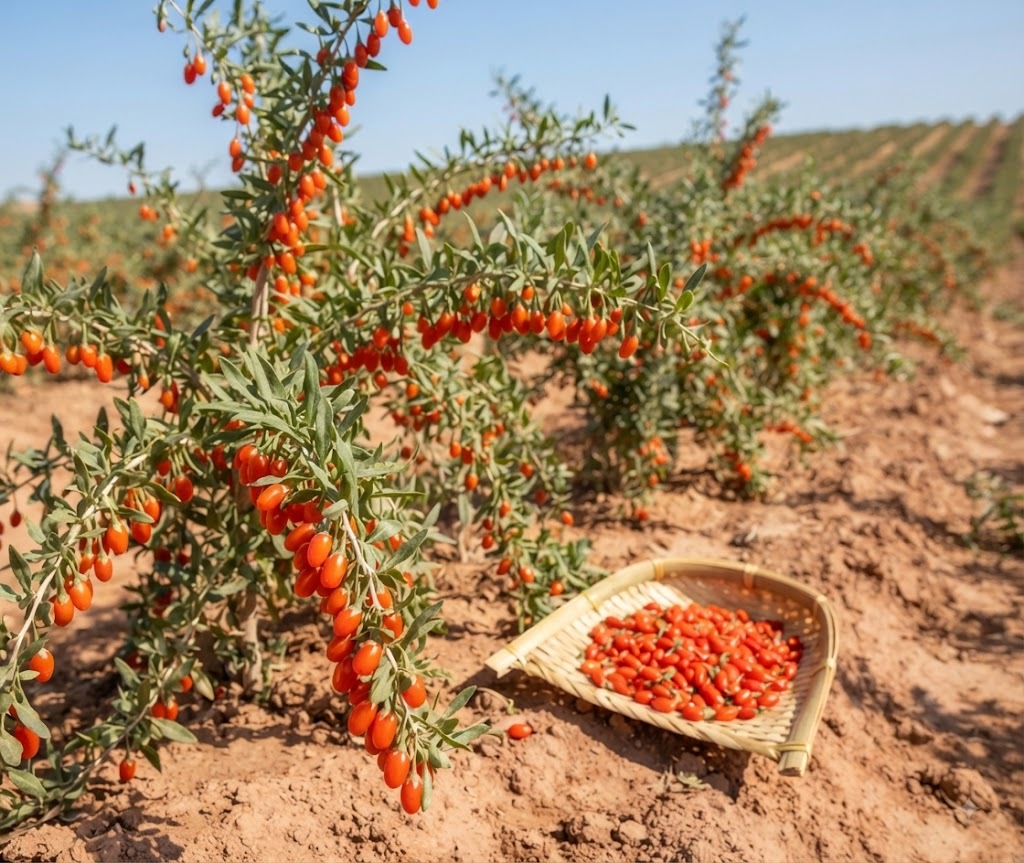
| Key role | It is a representative domestic specialty fruit crop that is converted into fresh fruit, dried fruit, tea, powder, extract, and concentrated food products. |
| Harvesting principle | Record the variety, fruit maturity, harvest date, and purpose (fresh/dry/processing) in the Lot. |
| Product separation | Separate into Fresh Fruit → Dried Fruit → Powder/Tea or Fresh Fruit → Juice/Puree/Extract/Concentrate → Finished Product. |
| Leaf separation | Goji berry leaves are separated from Fruit Products as separate research exists regarding their use as a processing ingredient. ( Nongsaroo ) |
| Domestic main production area | Chungcheongnam-do was introduced as the largest production area, accounting for 72.5% of the national goji berry cultivation area and 81% of the national production volume for 2026, based on the Rural Development Administration's regional news . The data presented Chungnam's cultivation area as 103 ha and its production volume as 382 tons . ( Rural Development Administration ) |
| Variety industry | The Chungnam Goji Berry Research Institute announced in its 2026 official data that it has preserved 150 genetic resources , including the Cheongyang native variety, and developed and distributed a total of 26 new varieties , including 'Hwasu', 'Cheonggam', and 'Cheongsun' . ( Rural Development Administration ) |
| Geographical Indication | Cheongyang Goji berries and Jindo Goji berries have an official history of being managed as registered Geographical Indication specialty products. ( Korea ) |
| Supply and demand risk | The key factors are anthracnose and gall mites, salt accumulation in greenhouse cultivation, harvesting labor, mixing of varieties and species, fresh fruit freshness, drying variations, microorganisms and pesticide residues, and mixing of imported origins and lots. |
| Operating Principles | Connect Species–Cultivar–Farm–Fruit Lot–Fresh/Dried/Processed Lot–Certificate–Buyer RFQ. |
| Final goal | It is the establishment of supply chain intelligence that connects domestic producers, local specialties, processing companies, and buyers, extending to recurring procurement data. |
Basic fields | detail |
| Korean name | Goji berries |
| English name | Goji Berry / Chinese Wolfberry |
| Representative scientific name | Lycium chinense Mill. |
| Major international similar species | Lycium barbarum L. |
| classification | Solanaceae → Lycium → L. chinense |
| Edible parts | Mainly fruit |
| Separate management area | Leaves, root bark, stems, etc. are managed separately from the Fruit Product. |
| Major harvesting stages | Mature fruit suitable for fresh, drying, and processing purposes |
| Basic product form | Fresh Fruit·Dried Fruit·Powder·Tea·Extract·Concentrate |
| Basic processing stage | Harvesting → Sorting → Washing → Drying/Grinding or Juicing/Extraction/Concentration |
| Basic use | Fresh fruit, dried fruit, tea, beverages, powder, food ingredients, local specialties |
| Similarity Principle | L. chinense and L. barbarum are separate plant entities |
Kew manages Lycium chinense and Lycium barbarum as accepted species, respectively. Therefore, the species is not determined solely by the common names goji, goji, and wolfberry. ( Plants of the World Online )
Product Master
Product | Product stage | Key Management Standards |
| Goji Planting Material Lot | breeding materials | Species·Variety·Parent Plant·Lot |
| Goji Cutting Lot | Cutting materials | Mother plant, cutting date, variety |
| Seedling Lot | Seedling cultivation | Variety · Lot · Health |
| Field Goji Lot | production stage | Farm · Variety · Planting Date · Cultivation Method |
| Fresh Goji Fruit | Fresh fruit | Harvest date, variety, color, maturity |
| Fresh Premium Goji | For fresh consumption | Sweetness, size, appearance, and freshness |
| Sorted Goji Fruit | Selected items | Remove immaturity, overripeness, and damage |
| Washed Goji Fruit | Washed items | Washing water, hygiene, refrigeration |
| Dried Goji Berry | dried fruit | Moisture, drying history, color |
| Premium Dried Goji | Grade case and | Size, color, and uniformity |
| Goji Slice | Cut and dried product | Thickness and moisture |
| Goji Fruit Powder | powder | Parent Lot · Particle Size · Microorganisms |
| Goji Tea Raw Material | Dimensional materials | Dry fruit, cutting shape, extraction suitability |
| Goji Juice | Juiced products | Raw Material Lot, pH, Solids |
| Goji Puree | Fruit products | Raw material content and homogeneity |
| Goji Extract | Extracted raw materials | Raw Materials · Solvents · Concentration · Batch |
| Goji Concentrate | Concentrated raw materials | Solids and Concentrated Drainage |
| Goji Leaf | Separate Plant Part | Leaf Harvest Date, Variety, Quality |
| Dried Goji Leaf | Leaf for processing | Dryness, disease, foreign matter |
| Goji Leaf Extract | Leaf extract | Raw Material Lot and Extraction Process |
| Goji Blend Tea | Mixed tea | Goji berry ratio · other ingredients |
| Goji Beverage | finished product | Ingredient Content · Formula |
| Goji Jam/Sauce | processed foods | Fresh fruit, puree, and sugars |
| OEM·PB Goji Product | finished product | Formula · MOQ · Contract |
Classification criteria | Subdivision type | Management principles |
| Plant classification | L. chinense / L. barbarum | Independent Entity by Species |
| varieties | Verified varieties such as Cheonggam, Hwasu, and Cheongsun | Variety verification link |
| Edible parts | Fruit / Leaf | Plant Part Separation |
| Harvest purpose | Fresh / Drying / Processing / Leaf | Set during the production phase |
| Harvesting stage | For ripening and drying of ripe fruit and fresh fruit | Buyer Goal Connection |
| Cultivation method | Open field, rain shelter, facility | Production Entity |
| Distribution methods | Fresh · Dried · Frozen | Product Separation |
| Processing form | Powder·Tea·Juice·Extract·Concentrate | Independent Product |
| local specialties | Cheongyang, Jindo, etc. | Origin Entity |
| Geographical Indication | Check Registration Scope and Product Name | Origin Evidence |
| Final use | Fresh fruit, dried fruit, tea, beverages, food ingredients | Application |
| Transaction type | Source Procurement · Contract Farming · Regular Supply · OEM · PB | RFQ |
Nongsaroo suggests cuttings, layering, division, and seed propagation as methods for propagating goji berries, explaining that cuttings are generally the most widely used. Furthermore, since fruit forms on new branches that grew that year, pruning and training management are key to the production structure. ( Nongsaroo )
step | Essential Dataset | Management purpose |
| Cultivation plan | Species · Varieties · Fresh/Dried/Leaves · Purpose · Area | Production Design |
| Securing mother plants | Breed · Species · Mother Lot | Identity |
| Cuttings and propagation | Cuttings, Mother Plant, Rooting | Seedling production |
| Seedling cultivation | Grave condition/disease | Official quality |
| formula | Date, planting distance, plot | Field Traceability |
| Soil testing | pH·EC·available phosphate·cation | Critical design |
| Growth management | New shoots, branches, and crown | Fruit set basis |
| Pruning and pinching | Timing and Method | Quantity and Harvesting Operations |
| invitation | Landlord/Inducement Type | Workability |
| rising | Temperature, Rainfall, and Humidity | Diseases and yields |
| Watering | Period, Quantity, Water Source | growth |
| dispute | Materials, Ingredients, and Quantity | Production and soil |
| pests | Anthracnose, gall mites, etc. | Quality and Safety |
| flowering | Flowering date and pollination | Fruit set prediction |
| Moisture management | Mixed varieties, bees, etc. | fruition |
| Fruit set | Fruit set and varieties | Harvest Forecast |
| Excessive negligence | Size, Color, Sweetness | Fresh fruit quality |
| Harvest judgment | Color, Maturity, Use | Harvesting at the right time |
| Fresh fruit harvest | Date · Section · Lot | Fresh Product |
| Origin sorting | Immature, damaged, or spoiled | Grade |
| purifying | Water quality and hygiene upon application | Fresh Processing |
| Pre-cooling and refrigeration | For fresh consumption | Shelf-life |
| dry | Temperature, time, and final moisture | Dried Product |
| Jeongseon | taps, foreign matter, defects and | Marketability |
| smash | Particle Size · Batch | Powder |
| Juicing | Yield, pH, and solids | Juice |
| extraction | Raw materials, solvents, and time | Extract |
| concentration | Solids · Batch | Concentrate |
| Leaf harvest | Separate production purpose | Leaf Product |
| Dry leaves | Disease, foreign matter, moisture | Leaf Ingredient |
| Packaging and storage | Temperature, humidity, and packaging | Quality maintenance |
| shipment | Buyer · Quantity · Date | transaction |
Quality items | Fresh Fruit | Dried Fruit | Powder/Tea | Extract/Concentrate | finished product | Public rating |
| Species | essential | succession | succession | succession | tracking | Public/Verified |
| varieties | essential | succession | succession | succession | tracking | Verified |
| mountainous district | essential | essential | succession | succession | mark | Public/Verified |
| Farm | essential | succession | succession | succession | tracking | Verified |
| Lot | essential | essential | essential | essential | essential | Verified/NDA |
| Harvest day | essential | succession | succession | succession | tracking | Verified |
| Maturity | core | Raw material inheritance | succession | succession | tracking | Verified |
| color | core | core | By product | By product | QC | Member |
| weight | essential | Batch | Batch | Batch | By product | NDA |
| size | Fresh Fruit Grade | Dry Grade | — | — | By product | Member |
| Sweetness | Key to fresh fruit | Raw material characteristics | — | By product | By product | Verified |
| appearance | Damage, overripe, spoilage | Color, shrinkage, and uniformity | Raw material inspection | By product | QC | Verified |
| disease | Anthrax, etc. | Raw material inheritance | Raw material inspection | Raw material inheritance | tracking | Verified |
| alien substance | check | core | core | core | core | Verified |
| moisture | Fresh | core | core | By product | By product | Verified |
| microorganism | If necessary | core | core | core | Conformity to standards | Verified/NDA |
| pesticide residues | core | test | Raw material inheritance | test | Conformity to standards | Verified/NDA |
| heavy metals | Risk-based | test | test | test | Conformity to standards | Verified/NDA |
| Drying history | — | essential | succession | succession | tracking | Verified |
| Grinding history | — | — | Powder is essential. | succession | tracking | NDA |
| Juicing history | — | — | — | Juice series | succession | NDA |
| Extraction history | — | — | Tea requires separate extraction conditions. | essential | succession | NDA |
| Concentration history | — | — | — | Concentrate is essential. | succession | NDA |
| packaging | Fresh | essential | essential | essential | essential | Verified |
| save | cold storage | Dry storage | Dry storage | By product | By product | Verified |
| Expiration date | By product | By product | By product | By product | essential | Verified |
| Shipment | essential | essential | essential | essential | essential | Verified |
| Returns | record | record | record | record | record | NDA |
| Claim | record | record | record | record | record | NDA |
| Repurchase | Buyer Connection | Buyer Connection | Buyer Connection | Buyer Connection | Buyer Connection | NDA |
Regarding the new fresh fruit variety 'Cheonggam', a measurement value of 23.4°Brix has been disclosed in the Rural Development Administration's data; however, this is not applied as the grading standard for all goji berries. This value is managed as evidence by linking the variety, test conditions, and measurement time. ( Nongsaroo )
Lot Master Required Field
Lot ID · Item/Product Type · Scientific Name · Variety · Edible Part (Fruit/Leaf) · Harvest Purpose · Cultivation Type · Country/Region/Cultivation Area · Producer · Mother Plant/Cutting Lot · Planting Date · Harvest Date · Maturity · Quality Indicators · Weight/Size/Color/Sugar Content · Specifications/Grade · Anthracnose/Gall Mite/Appearance Check · Pesticide Use History · Pesticide Residue/Microorganism/Heavy Metal Test Reports · Pre-cooling/Drying/Storage History · Raw Material Lot · Grinding/Juicing/Extraction/Concentration History · Packaging Date · Best Before Date · Shipper · Returns/Claims · Repurchase
Customers | Purchase criteria | Cooperation opportunities |
| Goji berry producing farms | Varieties, Seedlings, and Buyers | contract farming |
| Regional agricultural cooperatives and production organizations | Joint Selection · Drying · Origin | Origin RFQ |
| Fresh fruit distributors | Cheonggam, variety, sweetness, size | Fresh Market |
| Drying processing company | Moisture, color, foreign matter, uniformity | Dried Goji |
| car manufacturers | Dry fruit, cutting, and extraction suitability | Tea Ingredient |
| Powder manufacturer | Moisture, microorganisms, particle size | Powder |
| Beverage manufacturer | Juice, Extract, Concentrate | Beverage |
| Korean traditional sweets and traditional foods | Dried fruit, powder, concentrate | Regional Food |
| Jam and sauce manufacturers | Fresh fruit and puree | Processed Food |
| HMR · Meal Kit | Fresh fruit, powder, sauce | Application |
| Confectionery and Bakery | Dried Fruit · Powder | Ingredient |
| Online/Distribution | Dried fruit, tea, powder | Retail |
| Local specialty product companies | Cheongyang·Jindo Origin | Premium Product |
| OEM·PB | Tea·Drink·Powder·Blend | Private Label |
| exporters | Species · Origin · Pesticide Residue | Export RFQ |
| Research Institute | Variety, Disease, Fresh Fruit, Processing | R&D |
Since there is a possibility that domestic L. chinense and imported goji raw materials, particularly L. barbarum varieties, may be mixed in the market, a structure is needed to simultaneously verify Species, Origin, HS, and Product Form in the domestic goji berry supply chain.
step | Key variables | Operational judgment |
| Jongmyo Shrine | Species · Varieties | production base |
| domestic cultivation | Cheongyang · Other regions · Cultivation type | Domestic Supply |
| harvest | Variety · Maturity · Season | Raw Quality |
| Origin sorting | Grade for fresh fruit and drying | Product Split |
| dry | Moisture, color, and yield | Dried Product |
| imported raw materials | Species · Origin · Crop Year | Global Supply |
| Customs clearance | HS · Product Type | Compliance |
| Domestic grinding | Particle size and microorganisms | Powder |
| Extraction and Concentration | Raw Material Lot/Yield | Ingredient |
| local specialties | Origin · Geographical Indication | Premium |
| Domestic distribution | Dried fruits, tea, and beverages | Market |
| export | Pesticide Residues · Quarantine · HS | Global RFQ |
| delivery | Buyer Spec | Contract |
| Repurchase | Quality · Price · Origin | Supplier Score |
Trade Dataset
item | v1.0 processing |
| Fresh Goji Fruit HS | Korea Customs Service to officially verify current HS-K later |
| Dried Goji Berry HS | Verification of detailed classification of dried fruits and other plant products |
| Goji Powder HS | Verification by raw material composition and degree of processing |
| Goji Extract HS | Extract classification must be confirmed separately. |
| Goji Concentrate HS | Verification by composition and food type |
| Korea's import volume | Input after official verification of raw data |
| Korean import value | Input after official verification of raw data |
| Country of origin | Verification of raw data from customs agencies by country |
| Species | Check for L. chinense / L. barbarum on the import documents |
| Customs clearance unit price | Calculated only within the same HS, Product, and Unit |
| FTA | Check origin criteria by country and HS code |
| Quarantine | Fresh fruit, seeds, dried fruit, and processed products are separate. |
| pesticide residues | Separate verification based on domestic and destination country standards |
Products and processes | Key conditions | RFQ conversion |
| Fresh Goji Fruit | Variety, Sweetness, Size, Appearance | Fresh RFQ |
| Sorted Fruit | Maturation, damage, foreign matter | Processing |
| Dried Goji | Moisture, color, and uniformity | Tea/Retail |
| Dried Premium Goji | Size · Color · Origin | Premium Retail |
| Goji Powder | Parent Lot · Particle Size · Microorganisms | Food Ingredient |
| Goji Tea | Raw materials, cutting, extraction | Tea Manufacturer |
| Goji Juice | Fresh fruit · Juice · pH | Beverage |
| Goji Puree | Flesh content and homogeneity | Sauce/Food |
| Goji Extract | Solvent, concentration, and raw material part | Ingredient |
| Goji Concentrate | Solids and Concentrated Drainage | Beverage/OEM |
| Goji Leaf | Variety, Harvest Time, Diseases | Leaf Ingredient |
| Dried Goji Leaf | Drying and uniformity | Tea/Extract |
| Goji Leaf Extract | Raw Material Lot · Heat Extraction | Regional Product |
| Jam·Sauce | Fresh fruit, puree, and sugars | OEM/PB |
| Blend Tea | Ratio of Goji Berry and Other Ingredients | PB |
| Non-commercial products and | Damage/Overripe | Verification of processing conversion status |
| Branches and pruning residues | Cultivation by-products | Compost and Biomass Review |
| extraction residue | Processing by-products | Separate verification of feed and compost utilization |
Nongsaroo specifies a structure in its mass production technology for goji berry leaves that utilizes them as raw materials for regionally specialized processed products by heat-extracting them with water . Therefore, the leaves are not merely a byproduct, but are worth establishing a separate Leaf PRP system for. ( Nongsaroo )
PRP — Product Research Profile
PRP | Key research questions |
| Fresh Goji PRP | Which varieties and harvesting stages are suitable for the fresh fruit market? |
| Dried Goji PRP | How variety and drying conditions affect color, moisture, and marketability |
| Powder PRP | Are the Parent Lot, particle size, microorganisms, species, and origin clear? |
| Tea PRP | Do the raw material parts, such as dried fruits and leaves, and the extraction characteristics meet the Buyer's requirements? |
| Extract PRP | Is the distinction between Fruit and Leaf, solvent, concentration, and yield clear? |
| Regional Origin PRP | Does the use of regional names such as Cheongyang and Jindo connect to actual Origin Evidence? |
| Export PRP | Do the Species, Origin, Pesticide Residues, HS Codes, and Quarantine meet the destination country's requirements? |
first of all | Execution item | Performance indicators |
| 1 | Species·Variety·Origin·Harvest Date·Lot required values | Essential Field Completion Rate |
| 2 | Separate Fresh·Dried·Powder·Leaf·Extract Product | Product identification rate |
| 3 | Soil, Weather, Growth, Flowering, Fruit Set, Harvest Connection | Field–Lot Connection Rate |
| 4 | Datafication of varieties, pollinators, and fertilization | Fruit set analysis rate |
| 5 | Video AI screening for color, size, damage, and anthracnose | Grade Accuracy |
| 6 | Pest and disease AI diagnosis | Early detection rate |
| 7 | Prediction of optimal harvest time for fresh fruit | Harvest Forecast |
| 8 | Production volume forecast | Yield Forecast |
| 9 | Drying yield and final moisture prediction | Drying Yield |
| 10 | Soil EC and Nutrient Runtime Management | Salt Risk Alert |
| 11 | Quality, Pesticide Residue, and COA Connection | Certificate connection rate |
| 12 | Origin · Geographical Indication Verification | Origin Verification |
| 13 | Structure capable of linking Species DNA/analysis data | Identity Verification |
| 14 | Product–Buyer AI Match | RFQ → Sample Conversion Rate |
| 15 | Price, Inventory, and Supply & Demand Forecasts | Forecast error |
| 16 | Buyer Ratings & Repurchase Link | Repeat Order Rate |
Problem group | Problem Definition | Required data |
| L. chinense–L. mixed use of barbarum | Mixed domestic and imported goji species | Scientific Name |
| Mixed varieties | Differences in suitability for fresh, dried, and processing | Cultivar |
| Water management | Differences in fruit setting characteristics by variety | Pollination |
| Severance of Jongmyo history | Mother plant → Cutting → Farm tracking lack | Planting Lot |
| anthrax | Decline in fruit production and marketability | Disease Dataset |
| gall mites | Effects on leaves, growth, and quality | Pest Dataset |
| Salt accumulation in facilities | Soil nutrient excess and growth disorders | Soil EC/Nutrients |
| Weather Risk | Effects on flowering, fruit set, and diseases | Climate |
| Production volume deviation | Contract supply instability | Yield |
| Fresh fruit harvesting labor | Recurring harvest costs | Labor Dataset |
| Freshness | Post-harvest softening and marketability | Cold Chain |
| Drying deviation | Differences in color, moisture, and uniformity | Drying |
| Over-drying/Undrying | Impact on marketability and shelf life | Moisture |
| microorganism | Dried Fruits and Powders Safety | Microbiology |
| pesticide residues | Key to domestic and export transactions | Spray·COA |
| Mixed Origin | Distinction between Cheongyang, Jindo, and imported products | Origin Evidence |
| Misuse of geographical indications | Discrepancy between registered region/product and actual lot | GI Evidence |
| Powder authenticity | Species/Origin cannot be identified by appearance | Parent Lot |
| Leaf–Fruit Mix | Processed ingredient part not indicated | Plant Part |
| Extract source unknown | Fruit/Leaf Parent Lot Disconnection | Genealogy |
| HS classification error | Differences between fresh fruit, dried fruit, powder, and extract | HS Mapping |
| Buyer Spec Discrepancy | Differences in requirements between fresh fruit, tea, dried fruit, and processing companies | RFQ |
| Repurchase not reflected | Quality performance not linked to farm and variety evaluation | Buyer Evaluation |
RFQ Type | Public Registration | Verify/NDA |
| Supply of goji berry seedlings and cuttings | Species · Varieties · Regions | Producer, Quantity, Unit Price |
| Fresh Goji Berry Sales | Variety, Origin, Harvest Season | Farms, Volume, Price |
| Buying fresh fruit | Size · Sweetness · Origin | Target Quantity · Actual Unit Price |
| Sales of dried gooseberry | Variety · Pollination · Origin | Lot · COA · Unit Price |
| Regular supply | Fresh/Dried · Cycle | Monthly volume and price |
| contract farming | Variety · Target Use | Farms, Area, and Purchase Conditions |
| Fresh fruit contract | varieties such as Cheonggam | Sweetness · Grade · Price |
| Drying contract | Variety and Moisture Standards | Dry Yield · Unit Price |
| Leaf processing raw materials | Variety and Harvest Time | Disease, Drying, Unit Price |
| Goji berry powder | Origin · Entry | Parent Lot·COA |
| Tea ingredients | Dried fruit/Leaves · Specifications | Moisture · Price |
| Juice/Puree | Fresh fruit ingredients | Solid content and yield |
| Extract | Fruit/Leaf · Standard Size | Solvent, Concentration, Price |
| Concentrate | Raw Material Parts · Solids | Concentration conditions · MOQ |
| local specialties | Cheongyang·Jindo Origin | GI · Actual Producer |
| Dining Out & School Meals | Fresh fruit, dried fruit, tea | Delivery time · Actual unit price |
| HMR · Confectionery | Powder·Puree·Dried Fruit | Formula |
| OEM·PB | Tea·Drink·Powder·Jam | MOQ · Formula · Contract |
| export | Species · Product · Destination Country | HS · Quarantine · Price |
| Technology demonstration | AI sorting, drying, and fresh fruit | raw data |
| Research cooperation | Variety, Disease, Processing, Soil | IP · Exam materials |
① Need Products & Materials
Companies and institutions seeking necessary products, agricultural products, raw materials, and processed goods register purchasing demands. Registered requests are utilized to review cooperation with potential suppliers and producers based on the RFQ Intelligence Library.
Process:
RFQ Registration → Supplier/Product Review → Collaboration Connection → Future AI Matching
Register
② We are looking for production and manufacturing partners. (Need Suppliers & Manufacturers)
Register a request to find necessary production and supply partners, ranging from farms and producer organizations to processing companies, OEM, ODM, and private label manufacturers.
Process:
RFQ Registration → Review of Production & Manufacturing Capabilities → Collaboration Connection → Future AI Partner Matching
Register
③ We are looking for domestic and international buyers. (Need Buyers)
Farmers, producer organizations, and manufacturing companies are requesting cooperation with new buyers, such as domestic and international distributors, importers, brand companies, and food service and catering businesses.
Process:
RFQ Registration → Product & Supply Capability Review → Market & Buyer Connection → Future AI Buyer Matching
Register
Contact : mail@markethub.org
Version | Main contents | situation |
| v1.0 | Plant Identity · Isolation of L. chinense/L. barbarum · Major Domestic Production Areas · Variety · Fresh/Dried/Powder · Leaf · Extract · RFQ Basic Structure Registration | complete |
| v1.1 | Verification of official raw data for Nationwide KOSIS Production Statistics, Cheongyang/Jindo Regional Statistics, HS, and Import/Export | expected |
| v2.0 | Quality, Processing, Origin, and PRP Segmentation by Fresh Fruit, Dried Fruit, Powder, Tea, Leaf, Extract, and Concentrate | expected |
| v3.0 | Seedlings & Farms – On-site Distribution, Drying, & Processing Companies – Local Specialties, Food, Export Buyer Verified Container Combination | expected |