

Judgment axis | detail |
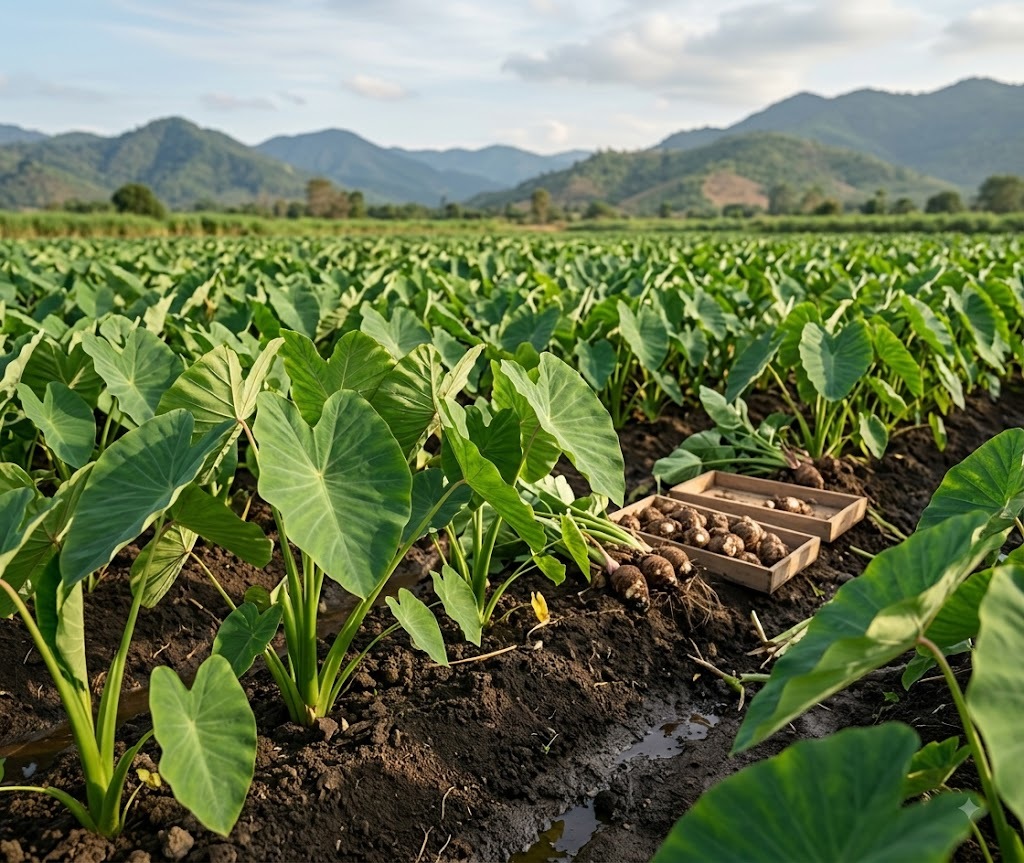
| Item Identity | Taro is a root vegetable and starch crop of the Araceae family, whose rhizomes and bulbs are consumed and processed. |
| Basic registration range | Manages whole taro, baby and adult taro, washed, peeled, and cut taro, frozen taro, taro stems, powder and paste, and HMR ingredients. |
| Core separation | Mother bulbs and offsets, rhizomes and leaf stalks, raw materials, pre-processed products, frozen products, powders, and cooked products are separated into Product and Lot units. |
| Safety Core | It links the irritancy of raw materials, peeling, washing, and heating history, as well as test reports for residual substances, microorganisms, and foreign matter, with cooking suitability for school meals and food service. |
| Purchase criteria | Size, weight, appearance, skin damage, mucilage, spoilage, texture after cooking, freezing stability, test report, and delivery time. |
| Industry Opportunities | These are private brands for holidays, soups, braised dishes, and stews; pre-processed food for school and restaurant meals; frozen HMR; taro stems and local foods; powder and paste-based processed foods; and regional specialties. |
| Operational direction | It connects production site–harvesting–sorting–pretreatment–heating/freezing–quality–RFQ–delivery/repurchase. |
division | Registration details |
| Korean name | taro |
| English name | Taro |
| Representative scientific name | Colocasia esculenta (L.) Schott |
| class | Araceae |
| Edible parts | Corm, cormel, leaf stalk, taro stem |
| Areas/Conditions of Caution | For leaves, leaf stalks, and rhizomes, the edible parts and cooking/processing conditions are verified separately for each product. Irritation management standards for raw and uncooked materials are linked to the food-grade Product and Lot. |
| Harvesting stage | Harvesting after rhizome enlargement and maturation / Separation of mother bulbs and daughter bulbs / Harvesting of taro stems / Pre-processing and receiving for processing stage |
| Product form | Whole taro, baby/large taro, washed products, peeled/cut products, frozen products, taro stems, powder, paste, HMR |
| Processing stage | Harvesting, sorting, washing, peeling, cutting, heating, cooling, freezing, drying, milling, packaging |
| Basic use | Home cooking, dining out, school meals, HMR, stews, soups, braised dishes, steamed dishes, local specialties, frozen pre-processed foods, powder and paste materials |
| Separation target | Potatoes, sweet potatoes, cassava, yams, maranta, and Araceae crops with different edible parts and processing methods |
Representative scientific names are managed based on the plant classification verification system of Kew Plants of the World Online . Local traditional species names, trade names, and variety names are registered in a separate field, separated from the scientific name.
Product Master | Key Management Standards |
| Mogu and Tongtoran | Origin, harvest date, size, weight, appearance, skin damage, spoilage |
| Jagu·Altoran | Specifications, sorting grade, weight per unit, uniformity, peelability, and cookability |
| Washed taro | Raw Material Lot · Washing Conditions · Packaging · Refrigeration Conditions · Release Date |
| Peeled and cut taro | Peeling, cutting specifications, browning, sliminess, quality before and after heating |
| frozen taro | Pretreatment, heating status, rapid freezing, shape after thawing, and texture |
| taro stems | Harvested part · Peeling · Boiling · Drying status · Texture · Packaging |
| Taro powder/paste | Raw Material Lot · Heat Treatment · Moisture · Particle Size · Color · Blending · Microorganisms |
| HMR · Local Foods | Cooking Method · Taro Content · Refrigeration · Freezing Safety · Use-by Date |
Classification criteria | Subdivision type | Management principles |
| plant species | Colocasia esculenta and commercial varieties | Separation from taro and adjacent starch crops based on scientific names |
| Edible parts | Mother bulb · Offspring / Leaf stalk · Taro stem | Tubers and taro stems are managed as separate products. |
| Harvest purpose | Raw ingredients for consumption / For pre-processing and freezing / As a substitute for taro / As a material for processing | Separation of specifications, processing, and transaction conditions by purpose |
| Raw material status | Immediately after harvest / Selected raw material / Washing / Peeling/Cutting / Heating/Freezing | Connecting Raw Material Lot and Process Lot |
| Product form | Whole Taro / Taro Stems / Taro Stems / Frozen / Powder / Paste / HMR | Separation of quality, labeling, and distribution standards by product |
| Final use | Home Meal / School Meals / Dining Out / HMR / PB / Food Ingredients | Separation of Cookability, Standards, Packaging, and MOQ |
| Transaction type | Shipment from production / Bulk for processing / OEM·PB / Buyer RFQ | Unit price, quantity, and contract are processed as Verified/NDA. |
Although taro contains starch like cassava, fresh and pre-processed distribution centered on raw materials, bulbs, and stems, as well as suitability for cooking in stews, soups, and braised dishes, are important. The starch and tapioca-centered product system of cassava is not applied directly to taro.
step | Essential Dataset | Management purpose |
| culture | Variety group · Production area · Cultivation method · Planting date · Production purpose | Verification of raw material identity and procurement purpose |
| harvest | Harvest date, harvest year, mother bulb, daughter bulb distinction, appearance, damage | Raw Material Lot Generation and Sorting |
| Selection | Size, weight, shape, disease, decay, soil, foreign matter | Grade and release judgment by usage |
| Storage and Receiving | Date of arrival, temperature and humidity, storage period, weight loss, spoilage | Determination of storage suitability and processing priority |
| Preprocessing | Cleaning, peeling, cutting, heating, and cooling history | Hygiene, Cookability, and Process Tracking |
| Freezing and processing | Freezing conditions, drying, milling, and paste formation conditions | Product-specific stability and yield management |
| Quality inspection | Appearance, moisture, microorganisms, foreign matter, residue, test report | Delivery, Food Service, and Buyer Submission |
| Packaging and shipping | Packaging Date · Storage Conditions · Use-by Date · Release Lot | Tracking recalls, claims, and repurchases |
Domestic cultivated area, production volume, and shipment volume by region are entered after verifying the base year, unit, and survey scope from the KOSIS National Statistical Portal and related official raw data. In this v1.0, unverified figures are not arbitrarily entered.
Quality items | Whole Taro · Altoran | Pre-processed and frozen products | Taro stems, powder, and paste | Public rating |
| Variety Group · Production Purpose | core | core | importance | Verified |
| Production location, harvest date, arrival date | core | core | importance | Verified |
| Mother bulb, daughter bulb, edible part | core | core | core | Verified |
| Size, weight, appearance, damage, decay | core | importance | importance | Verified/NDA |
| Washing, peeling, cutting, and heating history | corresponding | core | core | NDA |
| Moisture, color, mucilage, texture | importance | core | core | Verified/NDA |
| Residual Substance, Microorganism, and Foreign Matter Test Report | core | core | core | NDA |
| Packaging, storage, and distribution stability | core | core | core | Verified/NDA |
Lot Master Required Field
Lot ID · Item Name · Basis for Scientific Name Verification · Variety Group · Edible Part · Production Purpose · Product Form · Final Use · Origin/Producer · Harvest Date/Year · Mother Bulb/Daughter Bulb Classification · Dimensions/Weight · Appearance/Damage/Spoilage · Storage/Receipt History · Washing/Peeling/Cutting/Heating/Freezing History · Moisture/Color/Texture · Residual Substances/Microorganisms/Foreign Matter Test Report · Packaging Date · Best Before Date · Shipment/Return/Claim
Customers | Purchase criteria | Cooperation opportunities |
| Origin distribution and wholesale | Origin, Harvest Season, Standards, Sorting, Storage Properties | Connecting local specialties and holiday demand |
| School meal and food ingredient distributors | Specifications, Peeling, Cutting, Sanitation, Delivery Time, Test Report | Pre-processed/Frozen Taro RFQ |
| Restaurant specializing in stews and soups | Size, cooking time, texture, and ease of preparation | Commercial Altoran & Pre-processed Products |
| HMR manufacturers | Cutting specifications, shape after heating, refrigeration, and freezing stability | HMR ingredients for soups, stews, and braised dishes |
| Local food manufacturers | Ingredient Origin · Taro Stems · Cooking Method · Labeling | Local brands, private brands, and gift sets |
| food ingredient companies | Moisture, particle size, color, and composition of powders and pastes | Confectionery, porridge, sauces, infant and elderly-friendly materials |
| PB · Online Distribution | Specifications · Small Packaging · Recipe · Quality · Repurchase | Commercialization of Altoran, Frozen, and Taro Stems |
Domestic market size, consumption, and sales volume by channel are not compiled until official statistics or verifiable business data are secured. Initially, a demand map is constructed by accumulating data on shipments from production areas, pre-processing, RFQs, deliveries, and repurchases.
step | Key variables | Operational judgment |
| Production and Procurement | Production area, variety group, mother bulb, daughter bulb, harvest time | Separation for raw materials, pretreatment, and processing purposes |
| Source selection | Specifications, weight, appearance, damage, spoilage | Grade and price negotiation criteria by buyer |
| Storage and Receiving | Date of arrival · Storage temperature and humidity · Weight loss · Spoilage | Determining shipment and processing priorities |
| Preprocessing | Washing, peeling, cutting, and heating history | Verification of suitability for school meals, dining out, and HMR |
| Freezing and processing | Freezing, drying, powder, and paste conditions | Product-specific yield and quality stability management |
| Quality and Safety | Residual substances, microorganisms, foreign matter, test reports | Buyer Submission and Claim Prevention |
| Buyer RFQ | Shape · Specifications · MOQ · Packaging · Delivery Time | Matching suitability other than price |
| Repurchase | Delivery · Cookability · Returns · Claims · Reorders | Producer, Lot, and Processor Evaluation Update |
Import volume, country of origin, and customs clearance unit price are entered after verifying the HS product range, base year, quantity, and value unit from the Korea Customs Service's Import and Export Trade Statistics . Fresh taro, frozen products, prepared foods, and powder are not aggregated as their HS and food requirements may differ.
Products and processes | Key conditions | RFQ conversion |
| Whole Taro · Altoran | Separation, sorting, washing, and packaging of mother bulbs and daughter bulbs | Producer/Wholesale/Retail RFQ |
| Peeled and cut taro | Peeling, cutting specifications, browning, hygiene, storage | School Meals, Dining Out, and HMR RFQ |
| frozen taro | Pretreatment, heating status, rapid freezing, and thawing texture | RFQ for School Meals, Soups, and Convenience Foods |
| taro stems | Harvested part · Peeling · Boiling · Drying · Texture | Local Food & Dining RFQ |
| Taro powder | Heat treatment, drying, particle size, moisture, color, microorganisms | RFQ for Porridge, Confectionery, Sauces, and Food Ingredients |
| Taro paste | Heating, grinding, viscosity, color, and freezing stability | HMR·Dessert·Sauce RFQ |
| Soups, Stews, and Braised Dishes HMR | Taro specifications, shape after heating, and broth stability | OEM·PB·Food Service RFQ |
| Utilization of by-products | Potential for non-food uses of peels and non-edible parts | Separate Entity after verification of laws, safety, and demand sources |
The processing suitability of taro depends on the variety group, harvest and storage conditions, bulb size, pretreatment and heating conditions, and the final cooking method. Specific suitability for school meals or HMR is not confirmed until actual lot-specific test results and reports are verified.
first of all | Execution item | Performance indicators |
| 1 | Origin, Edible Part, Mother Bulb, Offspring, Product Type, Lot ID made mandatory | Required value input rate |
| 2 | Separation of Raw Material, Taro Stems, Pre-processing, Frozen, Powder, and HMR Product Entities | Misclassification reduction rate |
| 3 | Harvest–Storage–Preprocessing–Quality Inspection–Outbound History Connection | Lot tracking rate |
| 4 | Datafication of specifications, cookability, residues, microorganisms, and test reports | Quality document connection rate |
| 5 | Connecting RFQs and repurchases for producers, processors, food service providers, private brands, and buyers | Matching rate · Repurchase rate |
Problem group | Problem Definition | Required data |
| Mother bulbs and daughter bulbs mixed | Taros of different sizes and cooking purposes are distributed as the same product. | Edible parts · Specifications · Uses · Lot |
| Discontinuity of preprocessing history | Washing, peeling, cutting, and heating information is not linked to the delivery lot | Process records, refrigeration, and freezing history |
| Quality degradation during storage | Weight loss, spoilage, and deterioration of appearance are not reflected in the decision to release. | Storage conditions, inspection, disposal, and release data |
| Inconsistency in cooking | The shape and texture requirements for taro used in school meals, soups, and braised dishes differ. | Cooking test, cutting specifications, and texture evaluation |
| Quality variation of taro stems | The harvested part, trimming, boiling, and drying conditions affect marketability. | Part, Process, Moisture, and Texture Data |
| Missing transcript | The report on residual substances, microorganisms, and foreign substances is separated from the delivery documents. | Inspection Report · Shipment Lot |
| Repurchase data disconnection | Returns, cooking complaints, and reorders are not fed back into producer or lot evaluations | Delivery · Claims · Reorders · Evaluation |
RFQ Type | Public Registration | Verify/NDA |
| Procurement of whole and fine taro | Place of production · Specifications · Usage · Packaging · Delivery time | Actual quantity, unit price, producer, shipment date |
| Pre-processed taro for school meals | Peeling, cutting specifications, hygiene, and refrigeration conditions | Test Report · Quantity · Unit Price · Contract |
| frozen taro | Specifications, Pretreatment, Refrigeration Method, Application | Samples, Thawing Tests, Unit Prices, and Reports |
| Procurement of taro stems | Fresh, Boiled, Dried Form, Packaging, Use | Quantity · Moisture · Test Report · Contract |
| Taro powder/paste | Particle Size · Viscosity · Color · Blending Purpose · MOQ | Test Report · Prescription · Unit Price · Contract |
| HMR · Food Service OEM | Target Menu · Specifications · Packaging · Delivery Time | Cost, Sample, Process, Contract |
| Local specialty PB | Country of origin, product type, packaging, sales channel | MOQ · Unit Price · Trademark · Contract |
| Production–Processing–Buyer Cooperation | Required Specifications, Inspection, and Delivery Areas | Producer · Processor · Volume · Contract |
① Need Products & Materials
Companies and institutions seeking necessary products, agricultural products, raw materials, and processed goods register purchasing demands. Registered requests are utilized to review cooperation with potential suppliers and producers based on the RFQ Intelligence Library.
Process:
RFQ Registration → Supplier/Product Review → Collaboration Connection → Future AI Matching
Register
② We are looking for production and manufacturing partners. (Need Suppliers & Manufacturers)
Register a request to find necessary production and supply partners, ranging from farms and producer organizations to processing companies, OEM, ODM, and private label manufacturers.
Process:
RFQ Registration → Review of Production & Manufacturing Capabilities → Collaboration Connection → Future AI Partner Matching
Register
③ We are looking for domestic and international buyers. (Need Buyers)
Farmers, producer organizations, and manufacturing companies are requesting cooperation with new buyers, such as domestic and international distributors, importers, brand companies, and food service and catering businesses.
Process:
RFQ Registration → Product & Supply Capability Review → Market & Buyer Connection → Future AI Buyer Matching
Register
Contact : mail@markethub.org
Version | Main contents | situation |
| v1.0 | Raw Taro, Bulbs, Taro Stems, Pre-processing, Freezing, Processing, RFQ Basic Structure Registration | complete |
| v1.1 | Verification of KOSIS·Korea Customs Service raw data and domestic distribution structure | expected |
| v2.0 | Separation of whole taro, taro stems, frozen, powder, and paste specifications | expected |
| v3.0 | Production–Storage–Preprocessing–Food Service & PB Buyer Verified Container Combination | expected |