

Judgment axis | Key judgment |
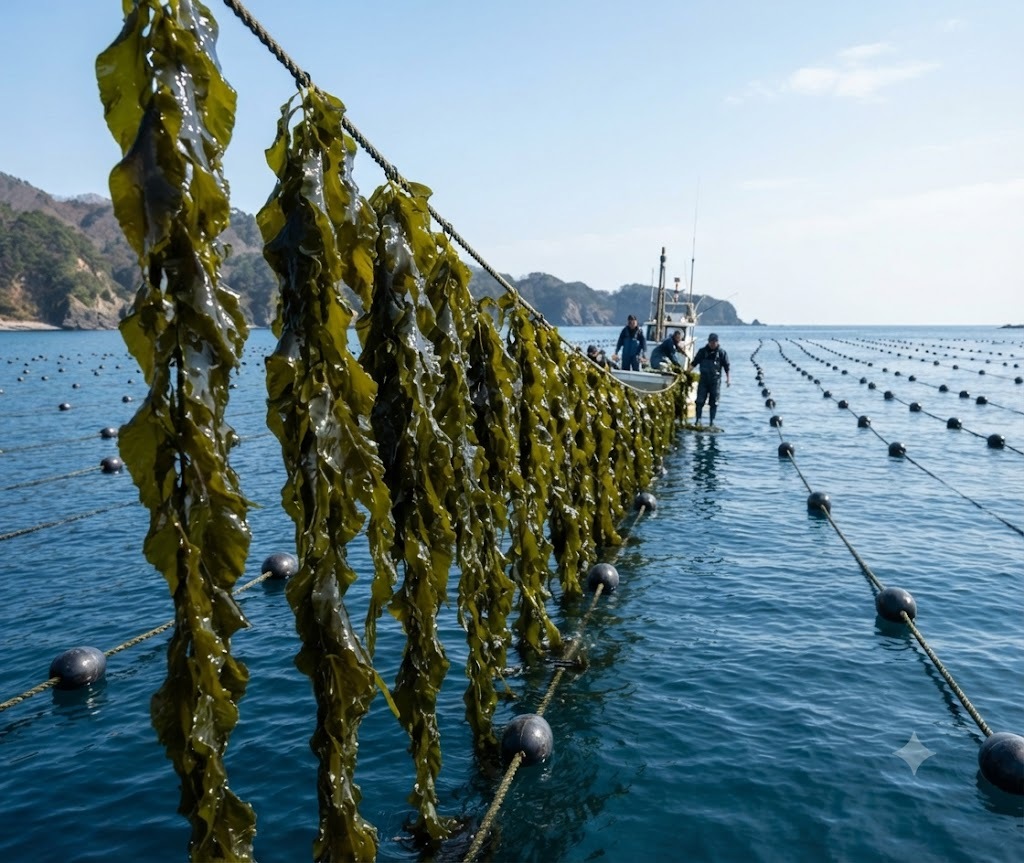
| Item Identity | Miyeok is the brown algae Undaria pinnatifida and is a major aquatic plant farmed in Korea. The same scientific name is used in official data from the National Institute of Fisheries Science. ( National Institute of Fisheries Science ) |
| Key role | It diversifies into numerous industrial products, ranging from edible fresh wakame, boiled and salted wakame, dried wakame, stem wakame, and wakame ear, to raw seaweed for abalone feed. ( National Institute of Fisheries Science ) |
| Harvesting principle | Species, varieties, seed lot, aquaculture farm, seed/rope, temporary transplanting, main cultivation date, water temperature, harvesting date, leaf length, leaf width, weight, part used, and purpose are classified into lots. |
| Product separation | The process involves seed → farmed seaweed → fresh seaweed → boiling → salting → separation of leaves and stems → drying, cutting, and small packaging, and branching out for seaweed ears and abalone feed. |
| Separation of similar items | It is classified as an independent Species/Product from laver and kelp, and maintains a separate Entity principle from domestic wild and native seaweeds such as broad-leaved wakame. The National Institute of Fisheries Science manages wakame and broad-leaved wakame as separate aquatic plant resources. ( National Institute of Fisheries Science ) |
| domestic production | Domestic aquaculture production of wakame seaweed in 2025 is 631,000 tons . This is the official annual production figure announced by the Ministry of Oceans and Fisheries in February 2026. ( Ministry of Finance and Economy ) |
| Comparison with the previous year | The 2024 production of seaweed was 572,000 tons . ( Ministry of Finance and Economy ) |
| Start of form | The National Institute of Fisheries Science suggests a water temperature of 20℃ or lower as the criterion for transplanting wakame seaweed and forecasts the appropriate start time for each region annually. ( National Institute of Fisheries Science ) |
| Early growth risk | High water temperatures during the early stages of aquaculture increase the risk of physiological disorders, such as reduced vitality and shedding of young thalluses, as well as sprout necrosis. ( National Institute of Fisheries Science ) |
| Response to varieties and climate | The National Institute of Fisheries Science has been developing new regionally specialized varieties of seaweed and has also developed Suwon 203, a hybrid resistant to high temperatures. ( National Institute of Fisheries Science ) |
| Seed Innovation | In 2022, the National Institute of Fisheries Science developed and field-tested a technology capable of producing the entire process of wakame seeds on land. ( National Institute of Fisheries Science ) |
| Operating Principles | Connect Variety–Seed–Nursery–Farm Site–Longline/Rope–Harvest–Processing–Buyer RFQ. |
| Final goal | It is to enhance production stability and product-specific recurring procurement capabilities by linking sea area, seeds, water temperature, growth, harvesting, processing, yield, and buyer evaluation. |
According to official statistics from the Ministry of Oceans and Fisheries, domestic aquaculture production of wakame seaweed is projected to reach 631,000 tons in 2025, an increase from 572,000 tons in 2024. However, this figure represents the production volume for marine aquaculture and does not reflect production volumes categorized by edible wakame, abalone feed, or processing type; therefore, it is not arbitrarily divided by product. ( Ministry of Finance and Economy )
Basic fields | detail |
| Korean name | brown seaweed |
| English name | Wakame |
| Representative scientific name | Undaria pinnatifida |
| classification | Brown algae |
| Edible parts | Tilia, stem, sporophyll (seaweed ear) |
| Non-edible · Separate management | Seed cultures, gametophytes, seeds, cultivation ropes, attached organisms, discarded raw materials |
| Major production stages | Securing broodstock and spore leaves → Seed production → Seedling collection → Temporary transplanting → Main cultivation → Growth → Harvesting |
| Major harvesting stages | Leaf length, leaf width, stem thickness, weight, maturity, and optimal timing for use |
| Basic product form | Fresh wakame, water wakame, salted wakame, dried wakame, stem wakame, wakame ear, cut wakame, powder |
| Basic processing stage | Washing → Boiling → Quick Freezing → Salting → Dehydration → Separation of leaves and stems → Washing → Drying, cutting, and packaging |
| Basic use | Soup, side dishes, salad, school meals, dining out, HMR, abalone feed, processed food |
| Similarity Principle | A separate entity from other species such as kelp, broad-leaved kelp, and gompi |
The National Institute of Fisheries Science designates * Undaria pinnatifida * in its official fisheries biological resource database . Furthermore, since the submission of male and female gametophytes, sporophytes, or seed ropes with attached seedlings is required when applying for variety protection of brown algae such as *Undaria* and *Kelp*, the Male/Female Gametophyte–Sporophyte–Seed Rope structure is also used in actual variety and seed management. ( National Institute of Fisheries Science )
Product Master
Product | Product stage | Key Management Standards |
| Wakame Species Master | Biological Entity | Scientific name · Taxonomy |
| Variety/Cultivar | varieties | Variety Name · Breeding Organization · Protection Rights |
| Female Gametophyte | female gametophyte | Strain ID · Culture History |
| Male Gametophyte | male actor | Strain ID · Culture History |
| Sporophyll Parent | Spore leaf raw material | Imitation, Origin, Date of Collection |
| Seed Culture Lot | Seed culture | Variety, cultivation date, vigor |
| Seed Rope | occupation | Seed Lot · Seedling Collection Date · Length |
| Nursery Rope | Gaisik | Sea area, water temperature, start date |
| Grow-out Rope | Main positive | Farm Site · Rope ID |
| Fresh Wakame | Fresh seaweed | Date of collection, thallus, freshness |
| Food-grade Fresh Wakame | Raw materials for processing | Leaf length, stem, foreign matter, processing suitability |
| Abalone Feed Wakame | abalone feed | Production purpose and extraction standards |
| Blanched Wakame | Boiled seaweed | Conditions of self-restraint · Color |
| Salted Wakame | Salted seaweed | Salinity, Moisture, Raw Lot |
| Salted Leaf | Salted leaves | Leaf separation and salinity |
| Salted Stem | Salted stems | Stem thickness and salinity |
| Dried Wakame | dried seaweed | Final moisture, color, and foreign matter |
| Cut Dried Wakame | Cut seaweed | Cutting size and swelling |
| Wakame Stem | Stem seaweed | Thickness, salting, cutting |
| Mekabu/Sporophyll | Seaweed stems | Maturity, viscosity, and foreign matter |
| Wakame Flake | Flake | Size and moisture |
| Wakame Powder | powder | Parent Lot |
| Instant Soup Ingredient | Instant soup ingredients | Cutting, Restoration, Microorganisms |
| HMR Wakame | Pre-processed products | Boiling, cutting, refrigeration |
| OEM·PB Wakame | finished product | Formula · MOQ · Marking |
| Off-grade Wakame | Non-product | Verification of food conversion feasibility |
| Processing Residue | by-product | Safety and Recyclability |
Classification criteria | Subdivision type | Management principles |
| Species | Undaria pinnatifida | Primary Entity |
| varieties | Traditional varieties, new varieties, hybrid varieties | Variety Master |
| Seed form | Gametophyte, sporophyte, spore | Separation of Seed Products |
| production stage | Seed collection, transplanting, and main cultivation | Runtime separation |
| Aquaculture area | City/Province/City/County/Fishing Ground | Farm Site |
| Formation method | Actual methods such as winning streaks | Facility Type |
| Edible parts | Tear, stem, and sea mustache | Product Separation |
| Harvesting purposes | Processed for Edible / Raw / Abalone Feed | Separation of Harvest Plan |
| Original form | Fresh seaweed · Water seaweed | Fresh Product |
| Primary processing | Boiling and salting | Intermediate Product |
| Secondary processing | Drying, cutting, and powdering | Processed Product |
| Final use | Soups, School Meals, Dining Out, HMR, Salads, Feed | Application |
| Transaction type | Contract Forms · Source Procurement · Regular Supply · OEM · PB | RFQ |
step | Essential Dataset | Management purpose |
| Production plan | Species · Sea Area · For Food/Feed · Buyer | Production Design |
| Imitation selection | Variety, Origin, Maturity | Seed Source |
| Securing spore leaves | Date of collection/condition | Seed production |
| Gametophyte culture | Male/Female/Culture ID | Genetic Identity |
| Seed production | Culture Conditions · Lot | Seed Quality |
| Work production | Rope ID · Seed Collection Date | Traceability |
| Gaisik | Sea area, start date, water temperature | Nursery |
| Transplanting growth | Leaf length and adhesion | Survival |
| Main positive | Farm Site · Rope · Job | Grow-out |
| water temperature | Real-time · Daily average | Core Environment |
| salt | Actual measurements | Environmental management |
| Nutrients | Nitrogen, phosphorus, etc. | Growth and quality |
| Current velocity · Waves | marine environment | Attachment and growth |
| ilsa | Light environment | growth |
| Completely melted | Date of occurrence · Degree | Initial Risk |
| Holes, food poisoning, etc. | Abnormal symptoms | Loss Control |
| Attached organisms | Types and degrees | quality |
| Growth survey | Leaf length, leaf width, stem | Harvest Forecast |
| Harvest judgment | Size and maturity by use | Harvesting at the right time |
| Collection | Date, Rope, Weight | Harvest Lot |
| Collection at the production site | Time · Weight | Logistics |
| Selection of fresh seaweed | Color, foreign matter, damage | Fresh QC |
| purifying | Water and time | Food Safety |
| Self-reflection | Time and temperature | Color and texture |
| Rapid freezing | Cooling conditions | Quality fixed |
| Salt | Salt · Period | Intermediate |
| dehydration | moisture removal | process |
| Separation of leaves and stems | Product by part | Yield |
| Separation of sea urchin | sporophylls | Product |
| Rewash | Salt and foreign matter | quality |
| dry | Temperature, time, moisture | Dried Product |
| cutting | standard | HMR |
| smash | Entry to the island | Powder |
| Refrigeration/Freezing | By product | Shelf-life |
| packaging | Weight and material | Distribution |
| shipment | Buyer · Quantity · Date | RFQ |
| Processing by-products | Part/Weight | Resource Use |
The National Institute of Fisheries Science analyzes water temperatures over the past five years, identifies temperatures below 20℃ as the optimal time for transplanting wakame seaweed, and forecasts the best timing for each region. In its 2024 forecast, the institute explained that laver and wakame are cultivated from autumn to the following spring, and that prolonged high temperatures could hinder the growth of young sprouts. ( National Institute of Fisheries Science )
Quality items | Fresh seaweed | Salting and boiling | Dried seaweed · Cut | finished product | Public rating |
| Species | essential | succession | succession | tracking | Public/Verified |
| varieties | essential | succession | succession | tracking | Verified |
| Seed Lot | essential | succession | succession | tracking | Verified/NDA |
| sea area | essential | succession | succession | origin | Public/Verified |
| Farm Site | essential | succession | succession | tracking | Verified/NDA |
| Rope ID | essential | succession | succession | tracking | Verified |
| Gaisikil | essential | succession | succession | tracking | Verified |
| This formation day | essential | succession | succession | tracking | Verified |
| Collection date | essential | succession | succession | tracking | Verified |
| use | edible/feed | edible | edible | By product | Public |
| Area of use | Tear, stem, and sea mustache | separation | separation | By product | Public |
| color | core | Self-simmering color | Dry color | Product color | Verified |
| Leaf length and width | core | Inheritance of raw materials | Raw material characteristics | — | Verified |
| Stem thickness | core | core | By product | By product | Verified |
| weight | core | Process weight | Product weight | Product specifications | Verified |
| alien substance | core | core | core | core | Verified |
| Attached organisms | core | Raw material inspection | — | — | Verified |
| impairment | core | Raw material inspection | By product | QC | Verified |
| salt | — | core | When using salted ingredients | By product | Verified |
| moisture | Fresh | By process | core | core | Verified |
| Resilience | — | — | core | The core of instant products | Verified |
| texture | core | core | After retaking the exam | By product | Verified |
| microorganism | If necessary | core | core | Conformity to standards | Verified/NDA |
| heavy metals | test | test | test | Conformity to standards | Verified/NDA |
| radioactivity | When Policy/Buyer Requires | If necessary | If necessary | destination country's requirements | Verified/NDA |
| Washing water | — | essential | succession | tracking | NDA |
| History of self-reflection | — | essential | succession | tracking | NDA |
| Salting history | — | essential | succession | tracking | NDA |
| Drying history | — | — | essential | tracking | NDA |
| packaging | Mountain area transportation | essential | essential | essential | Verified |
| Expiration date | Fresh standard | By product | By product | By product | Verified |
| Shipment | essential | essential | essential | essential | Verified |
| Returns and Claims | record | record | record | record | NDA |
| Repurchase | Buyer Connection | Buyer Connection | Buyer Connection | Buyer Connection | NDA |
According to data from the National Institute of Fisheries Science, the processing method for wakame involves blanching at a processing plant, flash-freezing with cold seawater, salting, separating the stems and leaves, and then washing, dehydrating, drying, and packaging. Therefore, the Blanching Lot, Salting Lot, Leaf Lot, and Stem Lot are inherited by the Harvest Lot. ( National Institute of Fisheries Science )
Lot Master Required Field
Lot ID · Item/Product Type · Scientific Name · Variety/Cultivar · Male/Female Gametophyte ID · Seed Culture Lot · Seed Rope ID · Seed Producer · Temporary Transplanting Date · Main Cultivation Date · Cultivation Method · Farm Site/Sea Area · Producer/Producer Organization · Water Temperature · Salinity · Nutrients · Sprout Melting · Feeding Damage · Attached Organisms · Harvesting Date/Time · Usage (Edible/Abalone Feed) · Part Used (Thallus/Stem/Sporophyll) · Leaf Length · Leaf Width · Stem Thickness · Raw Material Weight · Color · Tissue · Damage · Foreign Matter · Fresh Lot · Washing · Boiling · Freezing · Salting · Dehydration History · Leaf/Stem/Sporophyll Lot · Drying · Cutting · Grinding History · Moisture · Salinity · Restoration Rate · Microbial · Heavy Metal · Radioactivity Test Report · Packaging Date · Best Before Date · Shipper · Returns · Claims · Repurchase
Customers | Purchase criteria | Cooperation opportunities |
| Seed producers | Breeds, gametophytes, and vigor | Seed RFQ |
| fish farms | Seeds, Optimal Transplanting Time, and High Water Temperature Response | Production |
| Producer organizations | Sea area · Estimated production volume | Joint Supply |
| abalone farm | Weight, Freshness, and Price for Feed | Feed RFQ |
| Fresh seaweed distribution | Color, Freshness, Origin | Fresh Retail |
| Salt processing plant | Tear, Stem, Weight, Yield | Contract Supply |
| dried seaweed companies | Salted ingredients, color, moisture | Drying |
| Stem seaweed company | Stem thickness · Salting | Processing |
| Seaweed ear companies | Sporophyll quality | Specialty |
| school meals | Domestic, Safety, Cutting Standards | Regular RFQ |
| dining out | Fresh, Salted, and Dried | Foodservice |
| HMR | Cutting, Restoration, Microorganisms | Ingredient |
| Instant soup companies | Cut Dried · Restoration | Industrial |
| salad companies | Boiling, salting, and cutting | HMR |
| Large-scale distribution | Origin, Brand, Small Packaging | Retail |
| online | Fresh, Dried | D2C |
| OEM·PB | Salted, dried, and instant soup | Private Label |
| exporters | Product type · National standard | Export |
| Research Institute | Variety, Seed, High Temperature, Disease | R&D |
| AX Company | Water temperature prediction, growth, and harvest prediction | Smart Aquaculture |
step | Key variables | Operational judgment |
| Variety development | Traditional, new varieties, and hybrid varieties | Genetic Supply |
| satellite | Gametophyte · Employment · Vitality | Seed |
| Gaisik | Starting water temperature and sea area | Survival |
| Main positive | Water temperature, ocean conditions, rope | Production |
| growth | Leaf length, leaf width, attachment | Yield |
| Collection | Edible/Feed · Timing | Harvest |
| Collection at the production site | Weight · Time | Logistics |
| Fresh seaweed | Freshness · Origin | Fresh Market |
| Boiling and salting | Processing yield · Salt content | Primary Processing |
| Separation of leaves and stems | Part yield | Product Mix |
| dry | Moisture and color | Secondary Processing |
| HMR | Cutting and restoring properties | Value Add |
| Abalone feed | Fresh seaweed weight and price | Feed Supply |
| export | Form, Origin, Safety | Global RFQ |
| RFQ | Variety, part, shape, specifications | Procurement |
| Repurchase | Quality, Yield, Delivery Time | Supplier Score |
A characteristic of seaweed is that the food industry and the abalone farming feed supply diverge from the same raw material supply chain. Therefore, when analyzing supply volumes, it is essential to distinguish between Food-grade, Abalone Feed, and Processing-grade . ( National Institute of Fisheries Science )
Trade Dataset
item | v1.0 processing |
| Fresh Wakame HS | Future verification of the Korea Customs Service's current HS-K |
| Salted Wakame HS | Verification by salting state |
| Dried Wakame HS | Dry Product Description · Code Verification |
| Prepared Wakame HS | Verification based on preparation, cutting, and mixing status |
| Wakame Powder HS | Verification by degree of processing and composition |
| Customs clearance related to seeds/seeds | Separate verification of regulations for aquatic plant seeds |
| Domestic export volume | Input after official verification of raw data by the Korea Customs Service |
| Domestic export value | Input after official verification of raw data |
| Import volume | Input after official verification of raw data |
| Major exporting countries | Verification of national raw data by HS |
| Major importing countries | Verification of country of origin by HS |
| Customs clearance unit price | Calculated only within the same HS, product type, and unit |
| FTA | Verification by Country, HS, and Criteria of Origin |
| Quarantine and aquatic plant seeds | Verification of regulations by the National Institute of Fisheries Science and quarantine agencies |
| Variety rights | Linking the Aquatic Plant Variety Protection System |
Products and processes | Key conditions | RFQ conversion |
| Fresh Wakame | Origin, Variety, Freshness | Fresh RFQ |
| Abalone Feed Wakame | Weight, Freshness, Price | Aquaculture Feed |
| Blanched Wakame | Conditions of self-restraint · Color | Processor |
| Salted Whole Wakame | salinity and moisture | B2B Ingredient |
| Salted Leaf | Leaf quality and color | HMR |
| Salted Stem | Thickness · Saltiness | Side Dish |
| Wakame Sporophyll | Seaweed stems and sticky | Specialty |
| Dried Whole Wakame | Color and moisture | Retail |
| Cut Dried Wakame | Cutting specifications and resilience | Instant Soup |
| Wakame Flake | Size and moisture | HMR |
| Wakame Powder | Particle size and microorganisms | Food Ingredient |
| Salad Wakame | Self-simmering and cutting | Foodservice |
| Frozen Wakame | Pretreatment and freezing | Industrial |
| Instant Soup Mix | Cut Dried · Formula | OEM |
| Seaweed Mix | Wakame + other seaweeds | HMR/PB |
| Off-grade Wakame | Substandard appearance | Powder and Processing Review |
| Stem Residue | stem part | Separate Product Switching |
| Sporophyll | Seaweed stems | Food Transformation |
| Processing Residue | Processing by-products | Separate verification of food, feed, and biomaterials |
The National Institute of Fisheries Science mentions in official materials the potential for industrial applications of seaweed, such as abalone feed, alginic acid, and fucoidan, in addition to its edible use. However, MarketHub does not use functional, medicinal, or health claims until the relevant food, legal, or clinical evidence is separately verified. ( National Institute of Fisheries Science )
PRP — Product Research Profile
Seaweed PRP operates with the following structure.
Variety → Seed → Nursery → Farm Environment → Growth → Harvest → Part Yield → Blanching/Salting → Drying/Processing → Buyer Application → RFQ Performance
PRP | Key research questions |
| Variety PRP | Do growth, leaf width, stem, and high-temperature characteristics differ by variety? |
| Seed PRP | Is the vitality of actors and workers linked to the survival rate in the field? |
| Land-based Seed PRP | Can terrestrial seed production reduce the risks of typhoons and high water temperatures? |
| Temperature PRP | What is the relationship between water temperature and survival rate during transplanting and main rearing? |
| Farm PRP | What are the effects of water temperature, salinity, flow rate, and nutrients on yield and quality? |
| Physiological Disorder PRP | What is the relationship between bud melting, high water temperature, and algal circulation? |
| Harvest PRP | How do the optimal harvesting stages differ between those for human consumption and those for abalone feed? |
| Part Yield PRP | How do the ratios of thallus, stem, and sea aster differ by variety and harvest date? |
| Salting PRP | What are the effects of boiling and salting conditions on color, texture, and yield? |
| Drying PRP | What are the effects of drying conditions on moisture, color, and resilience? |
| HMR PRP | Do the cut size, recovery time, and texture meet the Buyer's requirements? |
| Export PRP | How do Fresh/Salted/Dried standards differ by country? |
first of all | Execution item | Performance indicators |
| 1 | Make Species·Variety·Seed Lot mandatory | Seed Traceability |
| 2 | Connecting male/female spouse/employee IDs | Genetic Traceability |
| 3 | Farm Site GIS Registration | Site Coverage |
| 4 | Employee/Formation Rope ID Assignment | Rope Traceability |
| 5 | Water temperature IoT and real-time marine data connection | Temperature Coverage |
| 6 | Linking salinity, nutrient, and flow velocity data | Environment Coverage |
| 7 | AI-based time prediction | Nursery Survival |
| 8 | Early warning of high water temperature and sprout wilt | Risk Detection |
| 9 | Image-based leaf length and width measurement | Growth Accuracy |
| 10 | Harvest Timing Prediction | Probability of the right time |
| 11 | Production volume forecast | Harvest Forecast |
| 12 | Automatic volume separation for edible/abalone feed | Usage Allocation |
| 13 | Yield measurement of thallus, stem, and kelp | Part Yield |
| 14 | Automatic recording of boiling and salting processes | Process Compliance |
| 15 | Color and foreign object video AI QC | Grade Accuracy |
| 16 | Automatic moisture control | Moisture Compliance |
| 17 | Product–Buyer AI Match | RFQ → Sample Conversion Rate |
| 18 | Buyer Evaluation → Improvement of Species and Sea Areas | Repeat Order Rate |
Problem group | Problem Definition | Required data |
| Mixed varieties | Unclear production history of traditional, new varieties, and hybrids | Variety |
| Seed viability variation | Difference in survival rates based on work quality | Seed QC |
| High temperature | Delayed transplanting and leaf shedding | Water Temperature |
| Completely melted | Physiological disorders such as high water temperature and water circulation | Environment |
| climate change | Changes in farming start and harvest seasons | Climate |
| Typhoons and rough seas | Losses in employment and aquaculture facilities | Weather |
| Salinity fluctuations | Rainfall and freshwater impact | Salinity |
| Fluctuations in nutrients | Effects on growth, color, and quality | Nutrients |
| Attached organisms | Increase in quality and foreign matter | Fouling |
| Sikhae | False thallus loss | Predation |
| Aging of fishing grounds | Potential decrease in productivity | Farm History |
| Overcrowding | deterioration of air circulation and quality | Farm Density |
| Fluctuation in production volume | Influence of water temperature, ocean conditions, and species | Harvest |
| Mixed volume of food and feed | Distortion in judging market supply volume | Usage |
| Tilia and stem yield variation | Difference in processing profitability | Part Yield |
| Self-study deviation | Color and texture non-uniformity | Blanching |
| Salting deviation | Non-uniformity in salinity and yield | Salting |
| Drying deviation | Differences in moisture, color, and resilience | Drying |
| alien substance | Food Safety and Quality | QC |
| heavy metals | Safety and Export Risk | COA |
| Processing Lot Disconnection | Original sea area history not inherited | Traceability |
| Raw price fluctuations | Impact on production volume and processing demand | Market |
| dependence on the abalone industry | Fluctuations in demand for feed | Feed Demand |
| Export country standard vehicle | Differences in Salting, Drying, and Labeling Standards | Buyer Spec |
| waste aquaculture materials | marine environmental issues | Waste |
| Repurchase not reflected | Buyer evaluations are not fed back to species or fishing grounds | Evaluation |
RFQ Type | Public Registration | Verify/NDA |
| Seaweed varieties | Variety Name · General Characteristics | Training Institutions, Rights, Performance |
| Actor supply | Variety · Form | Culture ID · Quantity |
| Employment supply | Variety · Seedling Collection Date | Seed Lot · Price |
| Fresh seaweed sales | Origin, Use, Harvesting Season | Fish price, actual quantity, unit price |
| Buy fresh seaweed | Tear, stem, weight | Daily and weekly demand |
| abalone feed | Uses/Mountain Areas | Volume/Unit Price |
| For edible processing | Variety · Raw Material Grade | Contract quantity |
| Regular supply | Season/Origin | Weekly/Monthly Volume |
| Contract Form | Variety · Uses | Producer and Price |
| Boiled seaweed | Product form | Process · MOQ |
| Salted seaweed | Salinity/Part | Yield/Unit Price |
| Salted leaves | Grade | Volume and Price |
| Stem seaweed | Thickness · Salting | Specifications/Unit Price |
| Seaweed stems | Maturity and Standards | Volume and Price |
| dried seaweed | Moisture and color | Manufacturer · MOQ |
| Cut seaweed | Cut Size · Resilience | HMR Spec |
| school meals | Domestic and safe | Period/Quantity |
| dining out | Fresh, Salted, and Dried | Demand |
| HMR · Instant Soup | Cut · Restoration | COA·MOQ |
| OEM·PB | Product form | Formula·MOQ |
| export | Fresh/Salted/Dried | National HS Certification |
| High-temperature demonstration | Species/Sea Area | raw data |
| Verification of terrestrial seeds | Seed production | Production costs and vitality |
| Research cooperation | Breeds, diseases, and climate | IP · Exam materials |
① Need Products & Materials
Companies and institutions seeking necessary products, agricultural products, raw materials, and processed goods register purchasing demands. Registered requests are utilized to review cooperation with potential suppliers and producers based on the RFQ Intelligence Library.
Process:
RFQ Registration → Supplier/Product Review → Collaboration Connection → Future AI Matching
Register
② We are looking for production and manufacturing partners. (Need Suppliers & Manufacturers)
Register a request to find necessary production and supply partners, ranging from farms and producer organizations to processing companies, OEM, ODM, and private label manufacturers.
Process:
RFQ Registration → Review of Production & Manufacturing Capabilities → Collaboration Connection → Future AI Partner Matching
Register
③ We are looking for domestic and international buyers. (Need Buyers)
Farmers, producer organizations, and manufacturing companies are requesting cooperation with new buyers, such as domestic and international distributors, importers, brand companies, and food service and catering businesses.
Process:
RFQ Registration → Product & Supply Capability Review → Market & Buyer Connection → Future AI Buyer Matching
Register
Contact : mail@markethub.org
Version | Main contents | situation |
| v1.0 | U. pinnatifida Identity·Variety·Seeds·Transplantation·Main Cultivation·Fresh Undaria pinnatifida·Edible/Abalone Feed·Boiled·Salted·Leaves/Stems/Undaria pinnatifida·Dried·RFQ Basic Structure Registration | complete |
| v1.1 | Verification of official raw data for regional production statistics, varieties, seed companies, aquaculture farms, production by use, HS codes, and import/export | expected |
| v2.0 | Segmentation of Quality, Yield, and PRP by Variety, Seed, Water Temperature, Harvest, Part Yield, Salted/Dried/HMR | expected |
| v3.0 | Breeding & Seed Institutions – Aquaculture Farms & Producer Organizations – Salting & Drying Processing – Abalone Farming – Food Service, Restaurant, HMR, Distribution, Export Buyer Verified Container Combination | expected |