


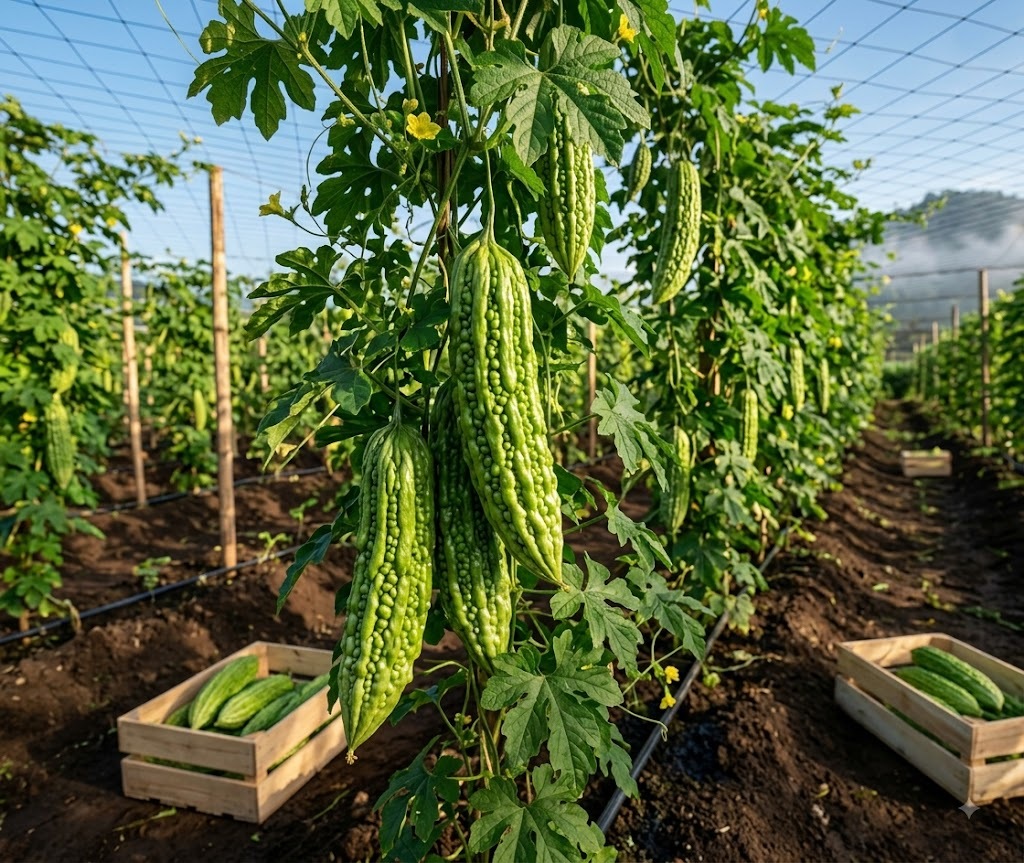
Judgment axis | Key judgment |
| Item Identity | Subtropical fruit and vegetable using the fruit of Momordica charantia of the Cucurbitaceae family |
| Key role | Fresh vegetables · Multicultural dining · Dried goods · Powder · Juice · Processed foods · Research · Functional material ingredients |
| Harvesting principle | Consider not only fruit size but also skin color, yellowing, seed maturity, texture, bitterness, and the buyer's intended use. |
| Product separation | Separate fresh fruit, unripe fruit, cut, dried, powder, frozen, juice, extract raw materials, and individually recognized materials. |
| Separation of similar items | A separate Plant Entity from loofah, cucumber, gourds, etc. Even within the same bitter melon, products are separated by ripeness and processing stage. |
| Domestic statistics | Latest national statistics on nationwide exclusive bitter melon cultivation area and production volume: To be entered after verification of official raw data |
| Korean production base | Cultivation cases involving 195 farms and 45.1 hectares were confirmed in official Jeonnam data from 2016. The mention of a nationwide cultivation area of approximately 100 hectares at the time was based solely on data from 2016. |
| Supply and demand risk | High temperature, weather sensitivity, concentrated shipping period, sharp price drop, pests and diseases, overripening, fresh distribution, quality variation of dried products |
| Operating Principles | Connect Seed–Plant–Flower–Fruit–Harvest Stage–Processing–Buyer RFQ to Lot |
| Final goal | Separating fresh bitter melon from bitter melon for processing, and establishing a contract production and repurchase structure tailored to the actual buyer's specifications for ripeness, size, drying, powder, and extraction. |
Plant Identity
Basic fields | Yeoju registration criteria |
| Korean name | Yeoju |
| English name | Bitter gourd / Bitter melon |
| Representative scientific name | Momordica charantia L. |
| classification | Cucurbitaceae · Momordica |
| Edible parts | Mainly unripe to edible ripe fruit |
| Non-edible · Separate management | Stems, leaves, roots, overripe fruit, fruit peels after harvesting, and items excluded from sorting |
| Major harvesting stages | Green immature fruit / Edible ripe fruit / Yellow overripe fruit / Ripe fruit for seed production |
| Basic product form | Fresh fruit, sorted fruit, cut, freezing, drying, tea raw materials, powder, juice, extract raw materials |
| Basic processing stage | Sorting → Washing → Cutting → Drying · Freezing · Grinding · Juicing · Extraction · Concentration |
| Basic use | Stir-frying, seasoned salads, dining out, multicultural cuisine, dried goods, powders, beverages, food ingredients |
| Similarity Principle | Separation of Plant Entities from Loofah, Cucumber, Gourd, Winter Melon, etc. |
The Agricultural Genetic Resources Center manages variety names, origins, and seed morphologies separately for each bitter melon resource; for example, it registers three Bi cui resources as Momordica charantia breeding varieties. ( Seed Bank )
Product Master
Product ID | Product type | Key Management Standards |
| BIT-P01 | Bitter melon immediately after harvest | Variety · Harvest Date · Ripeness · Color · Lot |
| BIT-P02 | Green, unripe fresh fruit | Skin color, length, thickness, and texture |
| BIT-P03 | Edible ripe fresh fruit | Color, size, bitterness, texture |
| BIT-P04 | Small sorting and | Standards, Color, Uniformity |
| BIT-P05 | Medium to large sorting and | Length, weight, appearance |
| BIT-P06 | Fresh fruit for dining out | Ripening, bitterness, and delivery cycle |
| BIT-P07 | For multicultural ingredients | Variety, Fruit Shape, Harvest Stage |
| BIT-P08 | For school meals | Safety, Size, Delivery Time |
| BIT-P09 | Washed bitter melon | Washing water, product temperature, microorganisms |
| BIT-P10 | Cut Yeoju | Cutting width, seed removal status, and hygiene |
| BIT-P11 | Frozen bitter melon | Blanching status, freezing, and thawing quality |
| BIT-P12 | Dry slices | Cutting thickness, drying temperature, moisture |
| BIT-P13 | Bitter melon tea ingredients | Dryness, color, scent, foreign matter |
| BIT-P14 | bitter melon powder | Particle size, moisture, microorganisms, raw material Lot |
| BIT-P15 | Bitter melon juice ingredients | Variety, Ripeness, Juice Yield, Bitterness |
| BIT-P16 | Bitter melon puree | Color, Viscosity, Heat Treatment |
| BIT-P17 | General extract ingredients | Extraction Part · Solvent · Raw Material Lot |
| BIT-P18 | Unripe fruit extract raw material | Immature stage, drying, standardization |
| BIT-P19 | Individually recognized functional ingredients | Recognition Number, Manufacturer, Standard, Legal Scope |
| BIT-P20 | Yellowing fruit | Separated from fresh edible products |
| BIT-P21 | Fruit for seed production | Variety · Maturity · Seed Lot |
| BIT-P22 | satellite | Variety, Purity, Germination Rate |
| BIT-P23 | by-product | Seeds, peel, stem, and excluded fruits |
| BIT-P24 | PB finished products | Manufacturing Lot · Raw Materials · Labeling · Use-by Date |
Classification criteria | Subdivision type | Management principles |
| Plant classification | Momordica charantia | Separated from Momordica species |
| varieties | Actual varieties and genetic resources | Prohibition of estimating variety based solely on fruit shape and color |
| Negligence | Elongated, short-fruited, etc. | Link to actual breed and Buyer Spec |
| Skin color | Green, pale green, yellow | Separation of accommodation and records |
| Harvesting stage | Immature, ripe, overripe, seed collection | Product Separation |
| Cultivation method | Early and autumn suppression in open fields and facilities | Separation of production periods |
| Distribution methods | Fresh fruit, sliced, frozen, dried | Separate Product ID |
| Processing form | Tea, Powder, Juice, Extract, Concentrate | Create Process Lot |
| Final use | Food ingredients, school meals, HMR, tea, beverages, materials | Buyer RFQ |
| functional ingredients | General food ingredients / Individually recognized functional ingredients | Distinction of legal status |
| Transaction type | In-kind · Regular supply · Contract farming · OEM · PB · Research | Contract |
| origin | Domestic/Imported | Lot separation |
step | Essential Dataset | Management purpose |
| Cultivation plan | Variety · Cultivation Type · Target Product · Buyer | Market-based production |
| satellite | Variety · Seed Lot · Germination | Traceability |
| Seedling cultivation | Sowing date, temperature, seedling age | Tomb quality |
| formula | Date, planting density, facilities | Production schedule |
| survival | Growth and Missing Plants | Initial stability |
| Inducement and Landlord | Method, Height, Work Day | Vine management |
| Topping and stopping | Treatment timing · Number of stems | Fruit setting and labor |
| Growth | Plant height, number of leaves, lateral branches | Production forecast |
| rising | Temperature, Precipitation, Solar Radiation, Wind Speed | High-temperature crop management |
| Facility Environment | Temperature, humidity, and ventilation | Early and inhibited cultivation |
| Watering | Watering amount · Soil moisture | Growth and fruit quality |
| dispute | Type, Quantity, and Time | Quantity and quality |
| flowering | Female flowers, male flowers, blooming date | Fruit set prediction |
| pollination | Natural, Bee, and Artificial Pollination | Fruit set stability |
| Fruit set | Fruit ID · Fruit Set Date | Harvest forecasting |
| pests | Disease symptoms, pests, and control | Production stability |
| virus | Symptoms · Diagnosis · Virus ID | Disease Intelligence |
| Excessive negligence | Length, thickness, color | Harvest Timing |
| Harvest judgment | Skin color, size, texture, and ripeness | Product Classification |
| harvest | Harvest Date · Fruit ID | Harvest Lot |
| Selection | Size, color, scars, and yellowing | Grade |
| purifying | Methods and water quality | hygiene |
| cutting | Standardization and seed removal | Processed raw materials |
| dry | Temperature, time, and final moisture | tea/powder |
| freezing | Pretreatment and freezing methods | Frozen Product |
| smash | Particle size and yield | Powder |
| Juicing | Yield and Filtration | Juice |
| extraction | Part, Solvent, Ratio, Process | Ingredient |
| save | Temperature, humidity, and period | Quality maintenance |
| packaging | Units and packaging materials | circulation |
| shipment | Buyer · Lot · Delivery Date | Delivery |
Quality items | Fresh fruit | Pre-treated products | processed goods | finished product | Public rating |
| Species | essential | succession | succession | tracking | Public |
| varieties | essential | succession | succession | tracking | Public/Verified |
| mountainous district | essential | succession | succession | mark | Public |
| farmhouse | ID | succession | tracking | - | Verified |
| Lot | essential | new | new | Manufacturing Lot | Verified/NDA |
| Sowing and planting dates | record | succession | tracking | - | Verified |
| Fruit setting and harvest dates | core | succession | succession | tracking | Verified |
| Harvesting stage | Immature, ripe, overripe | essential | Raw material specifications | tracking | Verified |
| Skin color | core | Selection | Raw color | By product | Member |
| length | core | core | Cutting material | By product | Member |
| Thickness | record | Selection | Raw material specifications | If necessary | Member |
| weight | record | Packaging specifications | Batch | By product | Verified |
| Protrusions/Surfaces | Variety/Appearance | Selection | - | - | Member |
| Tissue hardness | Accommodation assessment | core | Fabrication aptitude | By product | Verified |
| sulfuration | core | Fresh exclusion criteria | Separate review of extraction, etc. | - | Verified |
| Overripe | core | Product Separation | Review by Use | - | Verified |
| Seed maturity | Determining the level of maturity | Check when cutting | By ingredient | - | Verified |
| acerbity | Variety · Ripening | sensuality | Product specifications | By product | Member/Verified |
| Disease | exception | exception | Review of whether to switch to food | - | Verified |
| Wounds/Compression | test | Selection | Processing Review | - | Verified |
| alien substance | check | purifying | Compliance with standards | Compliance with standards | Verified |
| pesticide residues | test | succession | Compliance with standards | Compliance with standards | Verified/NDA |
| microorganism | When fresh fruit is needed | Cut product core | processed goods | Compliance with standards | Verified/NDA |
| dry moisture | - | - | core | Product Standards | Verified |
| Island | - | - | Powder core | By product | Verified |
| extraction process | - | - | Extract Core | functional ingredients | NDA |
| Indicator components | - | - | By Product | By Accredited Standard | Verified/NDA |
| packaging | Fresh fruit | Preprocessing | processed goods | Final | Member |
| save | essential | essential | By product | By product | Verified |
| Expiration date | The relevant city | cut parts | processed goods | Labeling standards | Member |
| Shipment | record | record | record | record | NDA |
| Returns and Claims | record | record | record | record | NDA |
| Repurchase | Buyer Connection | connection | connection | connection | NDA |
Lot Master Required Field
Lot ID · Item/Product Type · Scientific Name/Variety · Fruit Shape/Skin Color · Cultivation Type · Origin/Cultivation Area · Producer · Facility ID · Seed Lot · Sowing Date · Planting Date · Flowering Date · Fruit Set Date · Harvest Date · Harvest Stage · Fruit Length/Growth/Weight · Tissue Hardness · Yellowing/Overripeness · Seed Maturity · Bitterness Sensory Evaluation · Pest/Disease/Virus Records · Pesticide Use Records · Pesticide Residue/Microbiological Test Report · Sorting/Washing/Storage History · Raw Material Lot · Cutting/Drying/Freezing/Grinding/Juicing/Extraction History · Indicator Component Test · Packaging Date · Best Before Date · Shipper · Returns/Claims · Repurchase
Korean production structure
Nationwide bitter melon cultivation area 2025: To be entered after verification of official raw data
Nationwide bitter melon production volume 2025: To be entered after verification of official raw data
In the current v1.0 version, since nationally approved statistics based on the same criteria could not be verified for the latest nationwide production volume and cultivation area of bitter melon alone, past regional data and current national statistics are not mixed.
The officially confirmed historical regional data is as follows.
base year | Region/Scope | Official figures | Source/Caution |
| 2016 | Jeonnam | 195 farm households | Jeonnam Agricultural Research & Extension Services |
| 2016 | Jeonnam | 45.1ha | Jeonnam Agricultural Research & Extension Services |
| 2016 | Nationwide mention | About 100 hectares | Explanation of the nationwide scale based on data from the Jeonnam Agricultural Research and Extension Services at the time |
These values are used solely as historical evidence to understand the production structure in 2016. ( Rural Development Administration )
Data from the Rural Development Administration in 2018 indicated that the total domestic cultivated area for subtropical crops increased from 99.2 ha in 2012 to 354.2 ha in 2017; however, since this is a statistic for all subtropical crops and not just bitter melon, it is not converted to the bitter melon area. ( Rural Development Administration )
Customers | Purchase criteria | Cooperation opportunities |
| Producer organizations in mountainous regions | Variety, Cultivation Type, Shipping Time, and Marketability Rate | Joint sorting and contract farming |
| Wholesale and specialized vegetable distribution | Fruit shape, color, size, and freshness | Fresh B2B |
| Multicultural food ingredient distribution | Variety, Bitterness, Size, Ripening | Professional Buyer |
| Southeast Asian and Indian dining | Green unripe fruit · Cookable | Regular delivery |
| General dining out | Cutting convenience and bitterness management | Menu development |
| School and public meals | Safety, Cooking Method, Standards | Diversification of food culture |
| HMR · Meal Kit | Cutting, Freezing, and Cooking Aptitude | HMR ingredients |
| Dry tea manufacturing | Dry color, moisture, and raw material purity | Contract processing |
| Powder company | Drying process, particle size, microorganisms | Powder Product |
| Beverage manufacturing | Juicing, Extraction, Bitterness, Blending | Product Development |
| health food companies | Raw Material Specifications · Legal Scope of Use | General food ingredients |
| health functional food company | Individually recognized raw materials and standardization | PRP · Research Cooperation |
| PB·Online | Domestic · Origin · Small Packaging | Brand Product |
| Seed company | Variety, Maturation Period, Disease Resistance | Variety |
| Research Institute | Climate adaptation, cultivation, and functional materials | PRP |
| exporters | Specifications for fresh, dried, and processed products | Country-specific RFQ |
step | Key variables | Operational judgment |
| satellite | Variety, Origin, Germination | production base |
| Korean production | Crop type, shipping period, and estimated volume | Supply Forecast |
| Import procurement | Fresh, dried, and powdered forms | Supply Gap |
| harvest | Degree of ripeness, color, size | Product Classification |
| Origin sorting | Grade · Yellowing · Wound | Buyer Spec |
| refrigerated distribution | Product temperature and delivery time | Fresh quality |
| dry | Slice · Moisture · Color | Year-round supply |
| powder | Particle size, microorganisms, and raw materials | Ingredient |
| extraction | Raw material part, process, indicator component | Material RFQ |
| Distribution and supply | Product Type · Cycle | Buyer SLA |
| RFQ | Spec · Country of Origin · Degree of Processing | Match |
| Repurchase | Quality, bitterness, delivery time, and processability | Repeat trading |
HS·Trade Management
Since bitter melon products are very diverse, a single HS Code is not applied universally.
Product | HS Operating Principles |
| Fresh and refrigerated bitter melon | Check the current HSK fresh vegetable sub-classification formula |
| Frozen bitter melon | Frozen vegetables HS code separate |
| Dry slices | Check dried vegetable classification |
| bitter melon powder | Verification based on processing status and mixing status |
| Juice and concentrate | Beverages and extracts are classified separately. |
| General extract | HS Verification by Manufacturing Process and Use |
| Finished health functional food products | HS codes are separate by product |
| satellite | Check the seeds for sowing three times |
Products and processes | Key conditions | RFQ conversion |
| Fresh fruit | Variety, ripeness, color, size | Fresh RFQ |
| Jeongseon Fresh Fruit | Yellowing, wounds, and fruit-like shapes | Specialized distribution |
| Washing and | Hygiene and temperature | School Meals · HMR |
| Cutting and | Cutting width, seed removal, microorganisms | Meal kit |
| freezing | Blanching, Freezing, and Thawing Quality | HMR |
| Dry slices | Cutting thickness, temperature, moisture | Tea and food |
| Roasted dried raw materials | Process, Color, Scent | tea products |
| powder | Particle size, moisture, microorganisms | food materials |
| juice | Juice yield · bitterness | drinkables |
| Puree | Color, Viscosity, Heat Treatment | Sauces · HMR |
| General extract | Solvent, Yield, Solids | food materials |
| Unripe fruit extract raw material | Harvesting Stage · Drying · Lot | Research and functional materials |
| Individually recognized functional ingredients | Accredited Standards · Manufacturing Process | Health Functional Food |
| Overripe | Yellowing and seed maturation | Seed collection and research |
| satellite | Variety, Germination, Purity | Seed RFQ |
| Seed by-products | Safety and Ingredients | Materials Research |
| peel and stem | Generation Amount · Safety | resource recovery |
| Non-commercial products and | Appearance defects and safety | Drying and extraction review |
| Disease and Decay Division | Food supply chain exclusion | Review of waste and compost |
Separation of Functional and Extracted Products
The Ministry of Food and Drug Safety recognized unripe bitter melon ethanol extract powder as Individually Recognized Functional Ingredient No. 2020-14 , and the official recognition information includes specific functionalities and recommended intake. ( Food Safety Korea )
However, this basis applies only to the following.
Applicable recognized raw material + Applicable manufacturing process + Applicable specifications
It will not be automatically applied next time.
Fresh bitter melon ≠ Dried bitter melon ≠ Bitter melon tea ≠ General bitter melon powder ≠ Optional bitter melon extract ≠ Individually recognized unripe bitter melon ethanol extract powder
Therefore, general food and health functional food ingredients are separated in MarketHub Product Master.
PRP — Product Research Profile
PRP ID | Product Research Profile |
| PRP-BIT-01 | Bitter melon varieties and genetic resources – fruit shape mapping |
| PRP-BIT-02 | Relationship between variety, ripening, and skin color |
| PRP-BIT-03 | Comparison of Open-Field and Greenhouse Productivity |
| PRP-BIT-04 | Comparison of Spring Early–Summer Open Field–Autumn Suppression Cultivation Types |
| PRP-BIT-05 | Weather–Fruit Set–Yield Relationship |
| PRP-BIT-06 | Flowering date – Fruit enlargement – Optimal harvest time |
| PRP-BIT-07 | Harvest Raturity – Bitterness · Texture |
| PRP-BIT-08 | Difference between Green and Yellow Fruit Products |
| PRP-BIT-09 | Fresh Yeoju refrigerated distribution |
| PRP-BIT-10 | Drying Temperature – Color, Moisture, Quality |
| PRP-BIT-11 | Dry Slices – Tea Processing Suitability |
| PRP-BIT-12 | Bitter melon powder particle size, microorganisms, and storage |
| PRP-BIT-13 | Frozen bitter melon culinary aptitude |
| PRP-BIT-14 | Bitterness Adjustment Product |
| PRP-BIT-15 | Extraction process for general food products |
| PRP-BIT-16 | Standardization of unripe fruit extract raw materials |
| PRP-BIT-17 | Individually Recognized Raw Material – General Bitter Melon Separation System |
| PRP-BIT-18 | Domestic vs. Imported Dried/Powder Cost Gap |
| PRP-BIT-19 | Non-commercial goods and processing conversion |
| PRP-BIT-20 | Buyer Spec–Harvest Stage–Processing AI Match |
first of all | Execution item | Performance indicators |
| 1 | Variety, cultivation type, origin, fruit setting date, harvest date, and Lot must be mandatory | Required input rate |
| 2 | Fresh·Dried·Powder·Extract Product Separation | Product identification rate |
| 3 | Connecting weather, facility environment, flowering, fruit setting, and harvest | Runtime connection rate |
| 4 | Datafication of quality, test reports, drying, and extraction history | Traceability rate |
| 5 | Farm – Processor – Distribution – Buyer RFQ Connection | Match rate |
| 6 | Video AI Negligence Detection | Fruit Detection Accuracy |
| 7 | AI Fruit Length and Color Analysis | Measurement error |
| 8 | Prediction of risks for yellowing and overripening | Reduction in overripe rate |
| 9 | Harvest timing prediction | Actual harvest date error |
| 10 | Daily and weekly production forecasts | Production volume forecast error |
| 11 | Diagnosis of pests, viruses, and AI | Early detection rate |
| 12 | Shipment supply forecast | Weekly prediction error |
| 13 | Drying yield prediction | Input–Output Error |
| 14 | Dry product quality prediction | defect rate |
| 15 | Fresh–Dry Arbitrage | Product recovery rate |
| 16 | Cost Comparison of Domestic vs. Imported Products | Buyer Effective Cost |
| 17 | AI Buyer Match | Sample approval rate |
| 18 | Traceability | Finished Product → Fruit Lot Traceability |
| 19 | Repurchase Runtime | Buyer repurchase rate |
Problem group | Problem Definition | Required data |
| Lack of the latest domestic production statistics | Difficulty in verifying the scale of a single item nationwide | National and Regional Statistics |
| Mixed varieties and fruit shapes | Lack of connection between actual variety and trade name | Variety |
| High-temperature crops | Risk of growth and planting during low temperatures | Climate |
| Open-field weather changes | Impact of rainy season, high temperatures, and dryness | Weather |
| Facility production costs | Increase in costs for early and inhibited cultivation | Cost |
| Concentration of production period | Possibility of oversupply in July–August | Harvest Forecast |
| Price plunge | Seasonal production concentration and demand mismatch | Price·Supply |
| Variation in pollination and fruit set | Environmental and pollination effects | Pollination |
| Fruit growth variation | Variety, Fruit Set Location, Weather | Fruit Growth |
| Mixed accommodation | Mixture of green, unripe fruits and yellowed fruits | Harvest Stage |
| Overripe and yellowing | Sharp decline in fresh marketability | Color·Maturity |
| Bitterness variation | Differences in consumer acceptance by variety and ripeness | Sensory |
| pests | Lack of pest control information for new income crops | Disease/Pest |
| virus | Possibility of CMV or other viruses occurring | Virus Test |
| Registered Drugs · PLS | Management of pest control agents for small-area crops | Pesticide |
| Harvest labor | Continuous fruit setting and repeated harvesting | Labor |
| Fresh distribution | Quality degradation · sulfurization | Temperature |
| Variation in dried product | Color, moisture, foreign matter, country of origin | Drying |
| Powder quality variation | Particle size, microorganisms, moisture | Powder Spec |
| General food – Health functional food combination | Legal risks of functional expression | Regulatory |
| Extraction process unclear | Even with the same female lead, the subject matter varies. | Processing |
| Domestic vs. Imported Competition | Cost Gap of Dry and Powdered Raw Materials | Trade·Cost |
| Non-products and utilization | Defective shape and lack of non-standard utilization | Processing |
| Buyer demand dispersion | Fresh, Tea, Powder, Extract Buyers are Different | Buyer |
| Insufficient contract production | Expansion of production without a target product | Contract |
| Repurchase not reflected | Actual consumption and processing evaluations are not fed back into cultivation | Evaluation |
RFQ Type | Public Registration | Verify/NDA |
| Yeoju Local Procurement | Variety, Region, Shipment Date | Farm, Volume, Unit Price |
| Fresh fruit sales | Variety, Fruit Shape, Ripening | Lot · Price · Inventory |
| Buying fresh fruit | Length, color, and harvest stage | Target Price · MOQ |
| Regular supply | Product · Period · Cycle | Weekly volume and price |
| contract farming | Variety, Cultivation Type, Region | Area, Quantity, Price |
| Spring early cultivation | Shipment · Product | Facilities and Estimated Amount |
| Autumn suppressed cultivation | Shipment · Product | Facility and production costs |
| For dining out | Green unripe fruit · Standard | Delivery cycle · Price |
| Multicultural ingredients | Fruit shape, bitterness, and size | actual demand |
| school meals | Safety and Standards | Test Reports and Quantity |
| Cutting · HMR | Cutting type · Ripeness | Expiration date · Microorganisms |
| freezing | Whole/Cut | Processing Yield · MOQ |
| Dry slices | Thickness, moisture, color | Drying yield and price |
| Tea ingredients | Country of origin and drying specifications | Test Report · Lot |
| powder | Particle size and moisture | Microorganisms · MOQ |
| juice | Raw material ripeness and bitterness | Juice extraction test |
| General extract ingredients | Plant parts · Dry condition | Extraction Process and Test Report |
| functional materials | Immature fruit and standardization | Scope of Recognition · NDA |
| OEM·PB | Product concept | Recipe · MOQ · Contract |
| satellite | Variety/Seed Information | Germination · Lot |
| import | Fresh/Dried/Powder | HS · Price · Country of Origin |
| export | Product · Target Country | Quarantine, Price, and Volume |
| Technology demonstration | Crop type · AI harvest · Drying | Dataset |
| Research cooperation | Variety · Disease · Extraction · Functionality | Research data |
| Utilization of by-products | Seeds, pericarp, and standardized non-perforation | Safety and Use |
① Need Products & Materials
Companies and institutions seeking necessary products, agricultural products, raw materials, and processed goods register purchasing demands. Registered requests are utilized to review cooperation with potential suppliers and producers based on the RFQ Intelligence Library.
Process:
RFQ Registration → Supplier/Product Review → Collaboration Connection → Future AI Matching
Register
② We are looking for production and manufacturing partners. (Need Suppliers & Manufacturers)
Register a request to find necessary production and supply partners, ranging from farms and producer organizations to processing companies, OEM, ODM, and private label manufacturers.
Process:
RFQ Registration → Review of Production & Manufacturing Capabilities → Collaboration Connection → Future AI Partner Matching
Register
③ We are looking for domestic and international buyers. (Need Buyers)
Farmers, producer organizations, and manufacturing companies are requesting cooperation with new buyers, such as domestic and international distributors, importers, brand companies, and food service and catering businesses.
Process:
RFQ Registration → Product & Supply Capability Review → Market & Buyer Connection → Future AI Buyer Matching
Register
Contact : mail@markethub.org
Version | Main contents | situation |
| v1.0 | Plant Identity · Domestic Cultivation · Ripening · Fresh · Drying · Powder · Extraction · RFQ Basic Structure Registration | complete |
| v1.1 | Verification of the latest official raw data on production, region, market, HS, and import/export | expected |
| v2.0 | Detailed quality standards by variety, harvest stage, and Fresh, Dried, Powder, and Extract | expected |
| v3.0 | Producer–Drying/Processing–Extraction–Distribution–Buyer Verified Container Combination | expected |