


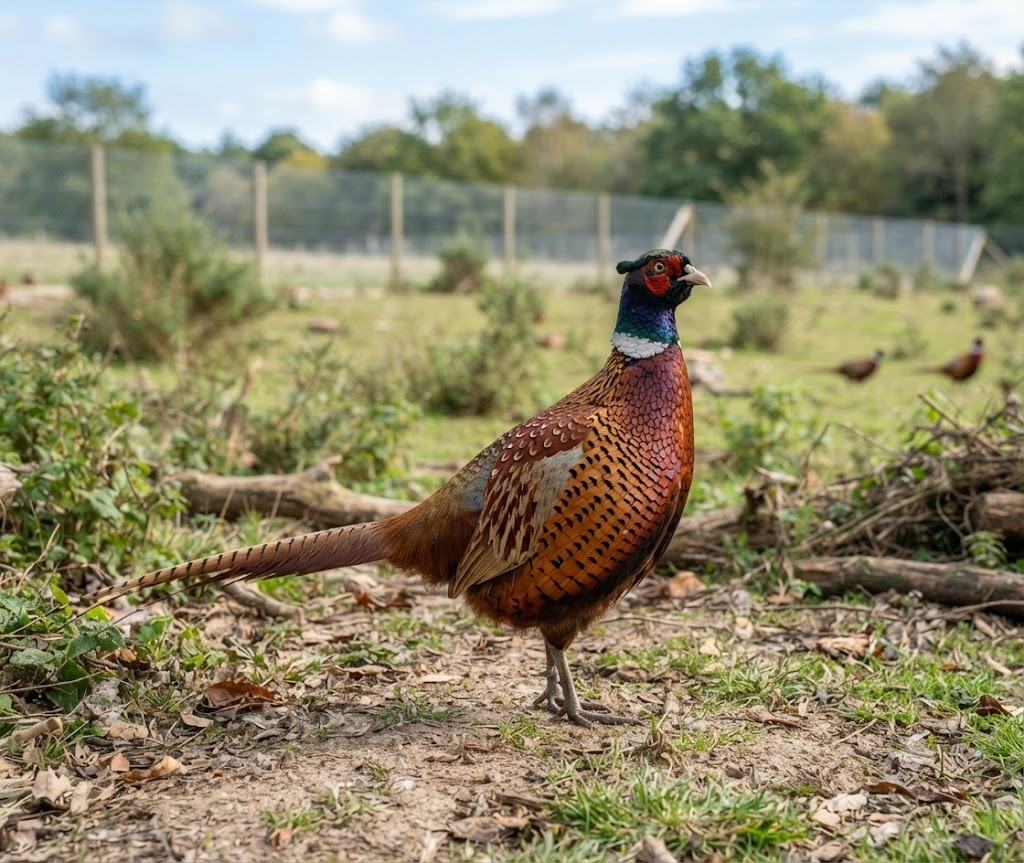
Unlike chickens and ducks, pheasants are not a livestock species intended solely for mass meat production. Distinct markets exist for meat, hatching eggs, hatching, and the production of free-range individuals ; the U.S. USDA also classifies pheasants as a representative commercial game bird and proposes a separate production system that follows the sequence of breeding → hatching eggs → hatching → brooding → field flight pen. ( APHIS )
Therefore, MarketHub does not view pheasant as a simple specialty meat. It is managed by separating the process into breeding stock → hatching eggs → hatching → chicks → rearing → meat or free-range → slaughter/processing or free-range → Buyer , and free-range individuals are subject to different production goals and quality standards than meat pheasants.
Judgment axis | Key points |
| Production type | Meat, hatching eggs, free-range |
| production core | Reproduction, fertilization, hatching, brooding, survival |
| Main Products | Hatching eggs · Young pheasants · Live meat · Pheasant meat |
| Radiation core | Health, Behavior, Flight Ability, Survivability |
| Major risks | Poultry diseases such as AI, early mortality, external contact |
| market | Specialty meat, hatching eggs, free-range |
| AX | Breeding, Hatching, Growth, Mortality Runtime |
| RFQ | Hatching eggs, live animals, meat, and free-range individuals |
| Final goal | Connecting Purpose-Specific Production with Buyer Demand |
Since the pheasant market itself is not large, it is important to first identify who needs pheasants for what purpose rather than producing a large quantity .
In commercial pheasant farming, the production of breeding stock, hatching eggs, and free-range birds is an important area, in addition to meat production. The USDA Game Bird Industry Data also categorizes pheasant production into Breeder, Hatchery, Commercial Production, and Hunting Preserve. ( APHIS )
Therefore, even if they are the same pheasant, hatching eggs, meat individuals, and free-range individuals should not be treated as a single product. The rearing environment, shipping time, buyer, and trading specifications must be managed separately according to the final use.
division | Main purpose | product |
| breeding stock | breeding | fertilized eggs |
| fertilized eggs | hatching | Hatching Egg |
| brooding chicks | growth | Young pheasant |
| meat | Meat | Livestock · Pheasant Meat |
| Radiation | radiation | Release Stock |
| process | food | Carcasses, meat parts, and processed products |
The basic structure is Pheasant → Production Purpose → Production Stage → Product → Buyer .
For pheasants, it is as important to accurately distinguish the production purpose as the breed. While egg laying, fertilization, and hatching performance are important for breeding stock, growth, feed efficiency, and meat quality are more important for meat production, and health status and adaptability to the wild are more important for free-range production.
In particular, if free-range individuals are produced in the same environment as meat animals, they may not meet the intended purpose of use. Therefore, MarketHub manages meat, hatching eggs, and free-range animals as different Production Types from the start.
Production type | Core Management | Final use |
| breeding stock | Reproduction and fertilization | fertilized eggs |
| fertilized eggs | Quality · Hatching | breeding |
| meat | Growth and Feed | Meat |
| Radiation | Health, Behavior, and Adaptation | radiation |
| For processing | Carcass and meat | food |
USDA data describes a production method in which male and female breeding groups are formed in commercial pheasant breeding farms, hatching eggs, raising the young, and then transferring them to outdoor flight pens upon maturity. ( APHIS )
In pheasant production, the stages of breeding, egg laying, hatching, and brooding determine the total production volume. Even if a large number of breeding stock are maintained, if the fertilization or hatching rate is low and early mortality is high, the actual number of individuals available for sale is significantly reduced.
USDA Game Bird data classifies the egg-laying and hatching of breeding pheasants, as well as the process of moving young to an outdoor flight pen after brooding, as separate management stages. This demonstrates that free-range pheasants require rearing goals different from simple weight gain. ( APHIS )
Management area | Things to see at a farm |
| breeding stock | Spawning and fertilization |
| fertilized eggs | Storage/Damage |
| hatching | Hatching rate |
| brooding chicks | Temperature and early mortality |
| feedstuff | Intake amount and cost |
| growth | Weight and uniformity |
| Radiation | Behavior and Outdoor Adaptation |
| meat | Shipping weight and meat quality |
It is realistic for farmers to view the number of finally marketable meat and free-range individuals produced as the core productivity, rather than the number of hatching eggs .
Since pheasants can be raised outdoors or kept in flight pens, particular caution must be exercised regarding the possibility of contact with wild birds. The WOAH proposes preventing contact between farmed birds and wild birds, maintaining hygiene of facilities and equipment, and reporting abnormal mortality early as key biosecurity measures to prevent avian influenza. ( WOAH )
In 2026, WOAH also revised international trade standards and biosecurity standards related to avian influenza. Therefore, even for free-range individuals, it is important for production farms to establish disease, movement, and hygiene management systems equivalent to those for general poultry. ( WOAH )
step | Key Management |
| breeding stock | Health and breeding history |
| fertilized eggs | Production date · Parent group |
| hatching | Hatch Lot |
| brooding chicks | Deaths and Environment |
| Outdoor training | Wild birds and disease control |
| shipment | Population size/purpose |
| Dogye | Meat Lot |
| radiation | Region, Date, Quantity |
The main structure is managed as Breeder Flock → Egg Lot → Hatch Lot → Growing Group → Meat/Release Lot .
The domestic pheasant industry is not a livestock sector with sufficient large-scale official market statistics, unlike chickens or pigs. In fact, the main livestock species aggregates in the Livestock Environment Survey are centered on Hanwoo cattle, beef cattle, dairy cows, pigs, chickens, and ducks, so publicly available statistics on pheasants are relatively limited. ( National Data Institute )
Therefore, rather than arbitrarily estimating the size of the domestic market, actual demand for farm, hatching, meat, and free-range feed must be surveyed individually. In particular, the free-range business is managed separately as it has a buyer structure entirely different from the meat market.
Buyer | Major demand |
| Pheasant farm | Hatching eggs and breeding stock |
| Hatchery | fertilized egg |
| eating house | Pheasant meat |
| food companies | Processed raw materials |
| distribution company | Refrigerated and frozen meat |
| Radiation-related demand sources | Radiation object |
| Research and educational institutions | Livestock · Materials |
| Local governments and agencies | Review by Business Objective |
MarketHub's principle is to find buyers by separating the meat market and the free-range market .
In the international trade of pheasants, hatching eggs, day-old chicks, live animals, and meat are subject to different quarantine regulations. The USDA states that as of 2026, pheasants are classified as Poultry, and that permits, health certificates, inspections, and quarantine measures apply to the import of poultry hatching eggs and poultry under 72 hours of age. ( APHIS )
In particular, countries or regions affected by HPAI may face restrictions on the trade of hatching eggs and live animals. Therefore, the feasibility of trade should not be determined solely based on past import records; instead, the conditions of the counterparty country must be reconfirmed with Korean quarantine authorities at the time of the actual RFQ.
Breeding stock → Hatching eggs → Hatching → Rearing → Broiler/Free-range → Slaughter or Free-range → Buyer
Confirmation area | Main contents |
| fertilized eggs | Correction, Quantity, Quarantine |
| Young pheasant | Age and health |
| Happy Birthday | Usage/Age |
| meat | Refrigeration/Freezing |
| Radiation | Health and Purpose |
| Quarantine | HPAI · Country of Origin |
| trade | HS·Customs |
| Buyer | Specifications, Quantity, Delivery Date |
In international RFQs, Product Form + Origin + Disease Status + Quarantine + Buyer Purpose are checked together.
Meat pheasants do not end as live animals but can be classified into whole meat, cuts, chilled, frozen, and processed products after slaughter. On the other hand, for free-range individuals, health, growth status, and rearing suited to the purpose are more important than meat quality or carcass yield.
Therefore, PRP does not evaluate all pheasants based on a single economic criterion. It is appropriate to evaluate meat products based on production costs and product value per kg, hatching eggs based on hatchability and sales price, and free-range products based on the cost per healthy individual that can be finally supplied.
product | Main uses |
| fertilized eggs | hatching |
| Young pheasant | upbringing |
| Livestock for meat | Meat |
| Pheasant meat | Food Service & Food |
| processed meat | food processing |
| Radiation object | radiation |
Key PRP questions include the hatching rate, whether early mortality can be reduced, whether production costs for meat are competitive, whether the viability and quality of free-range individuals are adequate, and whether actual buyers make repeat purchases .
Pheasant AX can first yield results from connecting data on breeding stock, eggs, hatching, and brooding, rather than from large-scale automation . By recording which breeding group's eggs have a high hatching rate and under which brooding conditions mortality is low, farmers can immediately utilize this information for their next production.
For free-range pheasants, outdoor environmental data becomes important after growth. While video or environmental sensors can be used to monitor density, behavior, mortality, and temperature and humidity, establishing accurate production lot records is the priority.
Apply AX | Expected effects |
| Longitudinal DB | Comparison of breeding performance |
| Egg Lot | Fertilization and Hatching Analysis |
| Hatching Runtime | Improvement in hatching rate |
| environmental sensor | Brooding environment management |
| Historical records | Production cost analysis |
| Video AI | Behavior and density verification |
| Our Runtime | Early detection of problems |
| Buyer Matching | Sales channels by purpose |
The key is data collection → identification of production losses → comparison of causes → subsequent production improvement .
In pheasant farming, the small scale of the industry itself is a significant issue. This is because even if production technology is improved, it does not lead to income for farmers unless there are sufficient buyers for meat, hatching eggs, or free-range pheasants.
In addition, disease management is crucial in free-range production as it may involve increased outdoor rearing and movement. WOAH identifies contact with wild birds and the movement of contaminated vehicles, equipment, and footwear as major risk factors in the spread of HPAI. ( WOAH )
problem | Verification data |
| Decrease in correction rate | Breeding animals · mating |
| Decrease in hatching rate | Hatching eggs and incubators |
| Early mortality | Temperature and feed |
| Growth deviation | Weight and Nutrition |
| AI risks | Wild birds and migration |
| feed costs | Intake amount · Price |
| Meat sales channels | Buyer · Price |
| Radiation demand | Quantity and timing |
| supply instability | Hatching eggs and stocking |
| Lack of market information | Transactions and demand |
The Problem Bank connects on-site problems → production data → cause analysis → improvement → actual sales performance .
It is clearest to classify pheasant RFQs into three categories: hatching eggs and breeding stock RFQs, meat and processing RFQs, and free-range individuals RFQs . Mixing these makes it difficult to accurately compare the buyer's requirements with the producer's supply capacity.
In particular, for RFQs for radiation use, not only the simple number of animals but also the production period, age, health, transportation, and final purpose must be verified. Price, production volume, and contract conditions are verified in detail during the Verified/NDA stage.
RFQ Type | Collaboration Examples |
| breeding stock | for breeding |
| fertilized eggs | For hatching |
| Young pheasant | Standing |
| feedstuff | Brooding and rearing |
| Livestock for meat | Dogye |
| Pheasant meat | Food & Dining |
| process | OEM |
| Radiation | Release Stock |
| Import and export | Hatching eggs, live animals, meat |
| AX Pilot | Hatching and rearing |
In MarketHub, it is appropriate to have the production purpose itself entered as the first field of the RFQ .
Since pheasants are specialty poultry with a limited market size, RFQ (Request First) is particularly important. Rather than producing a large number of individuals first and then looking for sales channels, farmers should identify the demand for meat, hatching eggs, or free-range pheasants before production begins.
MarketHub structures not just a simple request like "I need a pheasant," but also why it is needed, what stage of the product it is, how many there are, and when it is needed .
① Find products/raw materials.
Need Products & Materials
Companies and institutions seeking hatching eggs, young pheasants, live meat, pheasant meat, and processed raw materials register their purchase demands. MarketHub verifies the production purpose, specifications, quantity, region, and delivery date to review farms and companies capable of supplying the products.
RFQ Registration → Review of Use/Supply Conditions → Connecting Producers → AI Matching
Register
② We are looking for production and manufacturing partners.
Need Suppliers & Manufacturers
We seek necessary partners, including breeding farms, hatcheries, broiler farms, slaughterhouses, processing companies, and producers of free-range animals. We evaluate not only production capacity but also capabilities in hatching, rearing, disease control, and continuous supply.
RFQ Registration → Production Capability Review → Partner Connection → AI Partner Matching
Register
③ We are looking for domestic and international buyers.
Need Buyers
Production farms seek new buyers, such as food service, restaurant, and distribution companies, or institutions and businesses that meet their specific needs. Broiler, hatching, and free-range eggs are separated to connect with actual demand.
RFQ Registration → Supply Capability Review → Buyer Connection → AI Buyer Matching
Register
Contact : mail@markethub.org
It is efficient to manage pheasants in Breeder Flock during the breeding stage and in Hatch Lot/Growing Group after hatching. Individuals intended for release must be kept in a separate Release Lot until the final release time to avoid confusion with individuals intended for meat.
By linking the data in this way, it is possible to track which hatching eggs produced by which breeding herd passed through which hatching lot before being supplied for meat or free-range use.
Dataset | Simply put |
| Master | Pheasant · Production Purpose Criteria |
| Entity | Breeding stock · Farm · Buyer |
| Relationship | Hatching eggs, hatching, rearing, and supply |
| Runtime | Hatching · Mortality · Weight · Price |
The representative structure is as follows.
Breeder Flock → Egg Lot → Hatch Lot → Growing Group → Meat Lot / Release Lot → Buyer
If you connect the cost here:
Hatching Egg → Hatching Rate → Survival Rate → Sellable Individuals → Production Cost Per Individual → Selling Price
It can be calculated up to.
Since pheasants are not consistently tracked in detail in major domestic livestock statistics like chickens and ducks, unverified nationwide breeding numbers or market sizes are not arbitrarily recorded. For areas where public statistics are lacking, data is secured from farms, associations, and local governments, and registered after classifying the Evidence Grade. ( National Data Research Institute )
The production system used USDA Game Bird Industry data as the primary benchmark, and the latest WOAH AI standards were applied for disease and quarantine. However, U.S. productivity figures are not applied directly as standard values for Korean farms but are used only as a comparison standard. ( APHIS )
Evidence | source |
| A | Government · WOAH · Official Statistics |
| B | Research institutions and papers |
| C | Association/Verification Industry Data |
| D | Farm and Business Data |
| E | Additional verification needed |
Key factual basis
- The USDA classifies pheasants as commercially produced game birds and addresses the Breeder, Hatchery, and Commercial Production structure separately. ( APHIS )
- Commercial production of pheasants includes breeding management, egg hatching, chick rearing, and outdoor flight pen management. ( APHIS )
- Under the USDA's 2026 poultry import standards, pheasants are also included in the Poultry category. ( APHIS )
- Under WOAH standards, the category of Poultry includes not only the production of meat, eggs, and commercial products, but also domesticated birds raised for the purpose of game restocking. ( WOAH )
- Biosecurity, including preventing contact with wild birds and hygiene of farms, equipment, and vehicles, is important for the prevention of HPAI. ( WOAH )
- In 2026, WOAH revised the standards for international trade and biosecurity related to AI. ( WOAH )
Version History
Version | Main contents | situation |
| v1.0 | First registration of meat, hatching, free-range, and RFQ structures | complete |
| v1.1 | Reinforcement of field data on breeding, pricing, and distribution in Korea | expected |
| v2.0 | Breeder·Egg·Hatch·Release Runtime Connection | expected |
| v3.0 | Production Farms · Food · Radiation Buyer Verified Matching | expected |