

Judgment axis | Key judgment |
| Item Identity | Fruit trees where both fresh and dried fruits form independent markets |
| Key role | Fresh jujubes, dried jujubes, holiday seasonal products, traditional foods, beverages, tea, processed raw materials |
| Harvesting principle | Differentiate harvest times for drying and fresh consumption, and manage harvest purpose as a required Lot value. |
| Product separation | Fresh jujubes, dried jujubes, seedless products, cut products, powder, concentrate, and finished products are managed as separate products. |
| Separation of similar items | Never mix Plant Entity with other crops with similar names, such as date tomatoes. |
| Domestic statistics | National cultivated area and production volume: To be entered after verification of official raw data. |
| Cultivation environment | Nongsaroo identifies regions with an annual average temperature of 8℃ or higher and an average January temperature of -10℃ or higher as suitable cultivation areas. ( Nongsaroo ) |
| Varieties | Nongsaroo introduces varieties such as Mudeung Jujube, Geumseong Jujube, and Wolchul Jujube, presenting the differences in fruit weight, sugar content, and fruiting characteristics by variety. ( Nongsaroo ) |
| Supply and demand risk | Weather during flowering period, poor fruit set, fruit cracking, rainfall during harvest, dry quality, concentrated demand during holidays |
| Market role | The Ministry of Agriculture, Food and Rural Affairs included jujubes among the top 10 seasonal products for the 2026 Lunar New Year and managed them as targets for expanded supply of forest products. ( Ministry of Agriculture, Food and Rural Affairs ) |
| Operating Principles | Variety–Origin–Harvest Purpose–Fresh/Dried–Lot–Product–Buyer RFQ Connection |
| Final goal | Connecting production, fresh fruit, drying, processing, peak season demand, and buyer repurchase into a single runtime. |
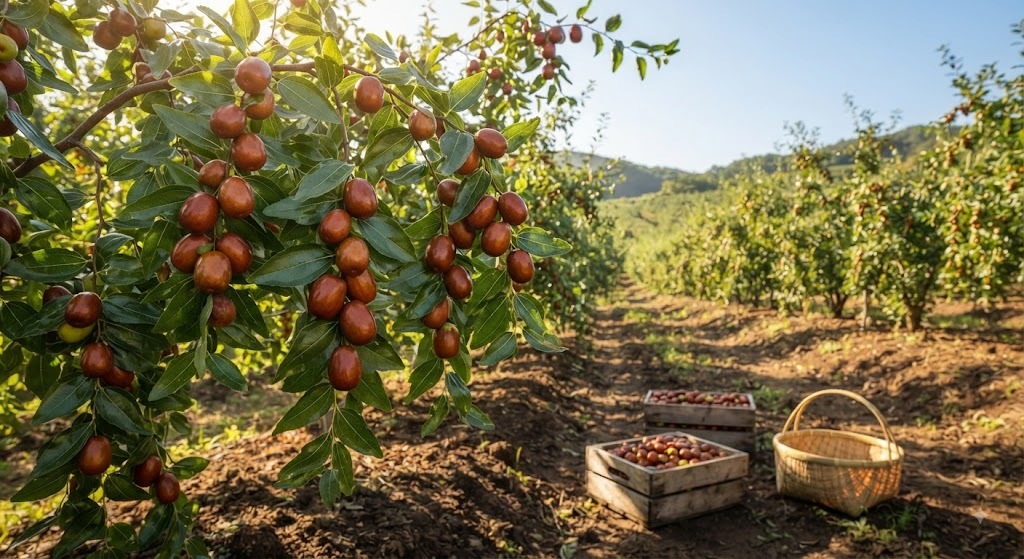
According to data from the Rural Development Administration, jujubes should be harvested in October after they are fully ripe; specifically, those intended for fresh consumption should be harvested about 10 days later than those intended for drying. Therefore, the harvest purpose and the harvest date must be recorded together. ( Nongsaroo )
Basic fields | detail |
| Korean name | jujube |
| English name | Jujube |
| Representative scientific name | Input later after verification of official plant classification raw data |
| classification | Jujube tree fruit |
| Edible parts | The flesh of mature fruit |
| Non-edible · Separate management | kernel, seed, branch, leaf, etc. |
| Major harvesting stages | Immature fruit → Ripe fruit for drying → Fully ripe fruit for fresh consumption → Dried fruit |
| Basic product form | Fresh jujubes, selected fresh fruit, dried jujubes, seedless products, cut products, powder, concentrated raw materials |
| Basic processing stage | Sorting, drying, refrigeration, seed removal, cutting, grinding, extraction, concentration |
| Basic use | Raw food, dried fruit, tea, beverages, traditional foods, processed food, PB |
| Similarity Principle | Similar products with simple product names, such as date-shaped tomatoes, are handled separately by Plant Entity. |
Nongsaroo presents varieties such as Mudeung Jujube, Geumseong Jujube, and Wolchul Jujube, describing Mudeung Jujube as having a sugar content of 9–11g and 31–32°Bx with fruit ripening in early October, and Geumseong Jujube as having a sugar content of approximately 7g and 29°Bx. These values are standard reference values from the corresponding Nongsaroo variety introduction data, while the actual RFQ specifications apply measured values by farm, year, and lot. ( Nongsaroo )
Product Master
Product ID | Actual product form | Key Management Standards |
| JUJUBE-P01 | Raw materials from the source | Variety · Origin · Farm · Harvest Date |
| JUJUBE-P02 | Selected fresh dates | Size, weight, color, cracking, and hardness |
| JUJUBE-P03 | Premium fresh jujubes | Large size, uniformity, appearance, small packaging |
| JUJUBE-P04 | Raw materials for drying | Harvest maturity, damage, and drying suitability |
| JUJUBE-P05 | Dried jujubes | Drying conditions, moisture, appearance, packaging |
| JUJUBE-P06 | Seedless dried jujubes | Raw Material Lot · Seed Removal Rate · Damage Rate |
| JUJUBE-P07 | Cut jujube | Cutting thickness, moisture, foreign matter |
| JUJUBE-P08 | Jujube powder | Grind size, moisture, microorganisms |
| JUJUBE-P09 | Jujube extract and concentrate raw materials | Raw Material Lot, Extraction, and Concentration Specifications |
| JUJUBE-P10 | Jujube tea and beverage ingredients | Buyer specifications regarding solid content, composition, etc. |
| JUJUBE-P11 | Traditional food and HMR ingredients | Product Specifications · Delivery Time |
| JUJUBE-P12 | PB · Finished Products | Ingredient Traceability, Labeling, and Use-by Date |
Classification criteria | Subdivision type | Management principles |
| Plant classification | Jujube tree | Plant Master |
| varieties | Confirmed varieties such as Boeun, Mudeung, Geumseong, and Wolchul | Variety Entity |
| Harvesting stage | Unripe/For drying, moderately ripe/For fresh, fully ripe | Harvest Purpose Connection |
| Cultivation method | Open field/other verified cultivation types | Actual farm price |
| Distribution methods | Fresh fruit, dried fruit, small packaging, bulk | Product Separation |
| Processing form | Drying, seed removal, cutting, grinding, extraction, concentration | Processing ID |
| Final use | Raw food, ancestral rites, gifts, tea, beverages, traditional foods, food processing | Separation by Buyer |
| Demand period | Normal times, Chuseok, Seollal, etc. | Seasonal Demand |
| Transaction type | In-kind · Contract farming · Regular supply · Private brand · Processed procurement | Contract NDA |
Nongsaroo identifies regions with an annual average temperature of 8°C or higher and an average January temperature of -10°C or higher as suitable for cultivating jujube trees, explaining that the central and southern regions are appropriate. It states that flowering occurs between mid-June and July, and notes that flowering times vary by variety. ( Nongsaroo )
step | Essential Dataset | Management purpose |
| Cultivation plan | Variety · Area · Target for Fresh/Drying | Production plan |
| Seedlings and propagation | Variety/Seedling Source | Variety Management |
| formula | Official Date/Packaging ID | Production history |
| germination | Germination date and temperature | Growth prediction |
| flowering | Flowering date, variety, sunlight, weather | Fruit prediction |
| Pollination and fruit set | Pollinators, firefighting insects, fruit set | Fruit stability |
| Growth management | New shoots, fruit set, and fruit enlargement | Production volume forecast |
| rising | Temperature, rainfall, sunshine, drought | Quality Risk |
| Watering | Watering amount and timing | Heat and management |
| dispute | Input amount and timing | Production history |
| pests | Occurrence and Control | Quality and Safety |
| Harvest judgment | For ripeness, coloring, and fresh/dried purposes | Harvesting at the right time |
| harvest | Harvest day, work shift, weight | Raw Lot |
| Selection | Size, color, heat, and damage | Fresh Fruit/Processed Branch |
| Pre-cooling | Applicability for fresh fruit | Leading management |
| cold storage | Fresh fruit storage conditions | Shipment control |
| dry | Method, temperature, time, moisture | Dried Lot |
| Seed removal | Pretreatment and Yield | semi-processed |
| cutting | Thickness and damage rate | B2B raw materials |
| smash | Particle size and moisture | Powder Product |
| Extraction and Concentration | Raw Material Lot · Process | Beverage and tea ingredients |
| packaging | Specifications by fresh/dried fruit | circulation |
| shipment | Buyer · Lot · Delivery Date | Delivery |
Quality items | Fresh fruit | Dried jujubes | processed goods | finished product | Public rating |
| mountainous district | essential | succession | succession | tracking | Public |
| Cultivation method | essential | succession | succession | tracking | Member |
| varieties | essential | essential | Raw material standards | tracking | Public/Verified |
| farmhouse | ID | succession | tracking | tracking | Verified |
| Lot | essential | new | new | new | Verified/NDA |
| Harvest day | essential | succession | succession | tracking | Verified |
| Harvest purpose | Fresh/Dried | dry | process | tracking | Verified |
| appearance | core | core | Raw material verification | Product Standards | Member |
| weight | Individuals/Packaging | packaging | Input and Output | Display amount | Member |
| size | core | rating | Raw material specifications | Product specifications | Member |
| coloring | core | Color after drying | Raw Material Evaluation | Product Standards | Member |
| Heat and | core | Raw material selection | eliminate | tracking | Verified |
| Longitude and maturity | Fresh fruit core | Before drying | Raw material standards | tracking | Verified |
| moisture | Fresh fruit reference | core | core | Product Standards | Verified |
| nucleus/seed | interior | Essential check | Separation when removing seeds | tracking | Verified |
| Damage/Deterioration | test | test | Non-conformity exclusion | Product Management | Verified |
| alien substance | check | essential | essential | essential | Verified |
| pesticide residues | Compliant with standards | Raw material inheritance | check | Legal standards | Verified/NDA |
| microorganism | If necessary | importance | importance | Product Standards | Verified/NDA |
| Drying history | - | essential | succession | tracking | Verified/NDA |
| Seed removal history | - | The relevant city | essential | tracking | NDA |
| Processing history | - | - | essential | essential | NDA |
| packaging | For fresh consumption | moisture-proof packaging | By product | Labeling packaging | Member |
| save | cold storage | Dry storage | By product | By product | Verified |
| Expiration date | By condition | By product | setting | mark | Verified |
| Shipment | record | record | record | record | Verified |
| Returns | record | record | record | record | NDA |
| Claim | record | record | record | record | NDA |
| Repurchase | Buyer Connection | Buyer Connection | Buyer Connection | Buyer Connection | NDA |
Lot Master Required Field
Lot ID · Item/Product Type · Scientific Name or Variety · Cultivation Type · Origin/Cultivation Area · Producer · Cultivation Method · Planting Date · Flowering Date · Purpose of Harvest · Harvest Date · Quality Indicators · Weight/Specifications/Grade · Coloration/Ripeness/Cracking/Pests/Diseases/Appearance Check · Pesticide Use Records · Pesticide Residue/Microbiological Test Report · Pre-cooling/Refrigeration History · Raw Material Lot · Drying History · Seed Removal/Cutting/Grinding/Extraction/Concentration History · Packaging Date · Use-by Date · Shipper · Returns/Claims · Repurchase
Customers | Purchase criteria | Cooperation opportunities |
| Producer organizations in mountainous regions | Variety, Harvest Purpose, Specifications | Joint screening |
| Forestry cooperatives and distribution organizations | Fresh fruit, dried fruit, quality, quantity | Collection at the production site |
| wholesale market | Size, Color, Origin, Marketability | Fresh jujubes and dried jujubes |
| Large-scale distribution | Large size, uniformity, small packaging | For holidays and gifts |
| online | Fresh fruit freshness, packaging, and delivery | Direct from the farm |
| traditional market | Dried Jujubes · Specifications for Ritual Offerings | Peak season sales |
| Food manufacturer | Moisture, seed removal, and cutting specifications | B2B processed raw materials |
| Tea and beverage companies | Powder, Extraction, and Concentration Standards | Raw material contract |
| traditional food companies | Dried jujubes · Cut jujubes | Yakshik, Hangwa, Tea |
| food service companies | Dried jujubes · Cut products | Regular delivery |
| School and public meals | Safety and ease of processing | Dried and processed raw materials |
| HMR · Meal Kit | Cutting, Powdering, Extraction | Product development |
| PB business operator | Regionality and processing standards | Jujube tea, snacks, and beverages |
| exporters | Product form, quarantine, and packaging | Trade RFQ |
| Research and technology institutions | Variety · Fruit cracking · Drying · Processing | Joint demonstration |
step | Key variables | Operational judgment |
| Production in the producing area | Variety, Crop Condition, Fruit Set | Supply forecast |
| Contract farming and procurement | Fresh/For drying · Standard | Production plan |
| harvest | Accommodation, Purpose, and Timing | Product Branch |
| Fresh fruit sorting | Size, coloration, cracking | Fresh RFQ |
| dry | Method, moisture, and loss rate | Dried RFQ |
| save | Fresh fruit refrigeration, dried fruit moisture protection | Inventory Management |
| Seed removal | Yield and damage rate | semi-processed |
| cutting | Thickness and uniformity | B2B raw materials |
| Powder/Extraction | Yield and specifications | Manufacturing raw materials |
| Distribution and supply | Season · Peak Season · Delivery Time | Buyer Response |
| RFQ · Repurchase | Valuation, Claims, Inventory | Repeat trading |
Import and export management
item | Management principles |
| HS Code | Verification of the accurate HS codes for fresh, dried, and processed dates by product type based on the Korea Customs Service standards |
| Import volume | Input after verification of raw data from the Korea Customs Service's import and export trade statistics. |
| Revenue | Input after official verification of raw data |
| Export volume | Input after official verification of raw data |
| export value | Input after official verification of raw data |
| major countries | Enter quantity and amount after verifying raw data by country |
| Quarantine | Check quarantine requirements by fresh/dried state |
| FTA | Review of Agreement Tariff Rates by Country of Origin and HS Code |
| certification | Management by Buyer Requirements |
| Customs clearance | Separation of fresh fruit, dried fruit, powder, and concentrate |
| distribution | Separation of moisture-proof conditions for fresh, refrigerated, and dried products |
Products and processes | Key conditions | RFQ conversion |
| Raw materials from the source | Variety and Harvest Purpose | Raw RFQ |
| Fresh jujubes | Large fruit, discoloration, cracking | Fresh RFQ |
| Raw materials for drying | Ripening, Damage, Moisture | Drying RFQ |
| Dried jujubes | Dryness, color, and size | Dried Fruit RFQ |
| Seedless jujubes | Removal rate · Damage | Food manufacturing |
| Cut jujubes | Cutting thickness and uniformity | Tea, Korean Confectionery, HMR |
| Jujube chips | Drying, cutting, moisture | Snack RFQ |
| Jujube powder | Particle size, moisture, microorganisms | food ingredients |
| extract | Extraction yield and specifications | Beverages and Tea |
| concentrate | Buyer specifications such as solid content | OEM/PB |
| Non-market fresh jujubes | Heat, appearance defects, and safety | Processing suitability evaluation |
| nucleus/seed | Separation by-products | Separate usability verification |
| Selected items | Causes of decay and damage | Processing/Disposal Classification |
The Rural Development Administration introduces examples of the mechanization of jujube seed removal and flesh cutting, demonstrating that jujubes cut to a consistent thickness can be distributed as a semi-processed product. ( Nongsaroo )
Product Research Profile (PRP)
PRP area | Key question |
| varieties | How does suitability differ between fresh and dried use? |
| Harvest season | What is the difference between the optimal harvest time for fresh fruit and for drying? |
| Heat and | What is the relationship between rainfall, irrigation, varieties, and heat? |
| drying yield | What is the yield of dried dates compared to the raw material? |
| Seed ratio | What is the edible part yield by variety and size? |
| Seed removal | What are the yield and damage rates when mechanized? |
| cutting | How do product uses and quality differ by thickness? |
| Powder/Extraction | What are the processing yield and buyer specifications? |
| save | What are the optimal storage conditions for fresh and dried jujubes? |
| demand | How does demand during peak seasons such as Lunar New Year and Chuseok connect to production planning? |
| Buyer | What are the effects of variety, size, moisture, and processing type on repurchase? |
first of all | Execution item | Performance indicators |
| 1 | Make Variety, Origin, Harvest Purpose, Harvest Date, and Lot mandatory values | Required value completion rate |
| 2 | Fresh Jujube, Dried Jujube, Sliced, Powdered, Extracted Product Separation | Product identification rate |
| 3 | Linking weather, flowering, fruit set, fruit cracking, and harvest data | Growth history connection rate |
| 4 | Datafication of quality, certificates, drying, and processing history | Lot tracking rate |
| 5 | Farm – On-site Distribution – Processing Company – Buyer RFQ Connection | RFQ Match Rate |
| 6 | Video AI Size, Coloring, Heat, and Sorting | Automatic sorting accuracy |
| 7 | Flowering and fruiting prediction | Error compared to actual fruit set |
| 8 | Heat and risk prediction | Reduction in heat and damage rates |
| 9 | Production volume and harvest time forecast | Prediction error |
| 10 | Drying completion · Moisture prediction | Drying failure rate |
| 11 | Automated seed removal and cutting | Throughput and damage rate |
| 12 | Holiday demand forecast | Excess/Shortage Inventory Rate |
| 13 | Price and Inventory Analysis | Peak season supply accuracy |
| 14 | AI Buyer Match | Sample→Contract Conversion Rate |
| 15 | Traceability | Raw material to finished product traceability |
Problem group | Problem Definition | Required data |
| Mixed varieties | Differences in size, sugar content, and fruit setting characteristics by variety | Breed Dataset |
| Mixed for fresh and drying purposes | The optimal time varies depending on the purpose of harvesting. | Harvest Purpose |
| Weather during the Enlightenment period | Reduced fruit yield due to high temperatures, rainfall, and insufficient sunlight | Weather and blooming |
| Water and fertilization instability | Flowering conditions and pollinator influence | Moisture and fruit set |
| Fruiting variation | Changes in quantity by year | Fruit set and yield |
| Heat and | Fruit cracking after rainfall during ripening | Rainfall, Irrigation, and Heat |
| pests | Decline in marketability and production volume | Occurrence and Control |
| Harvest season concentration | Supply concentration during specific periods | Harvest and shipment |
| Fresh fruit quality variation | Differences in size, color, and hardness | Lot quality |
| Drying deviation | Differences in drying time, moisture, and color | Drying Log |
| Seed removal yield | Nuclear ratio and mechanical damage | Input and Output |
| Processing yield | Differences in cutting, powdering, and extraction yields | Processing Yield |
| Discontinuation of test reports | Separation of safety information and Lot | Inspection · Lot |
| Peak season inventory imbalance | Concentrated demand during Seollal and Chuseok | Demand and Inventory |
| Discrepancy in contract farming | Difference between Buyer specifications and production results | Contract production |
| Price fluctuations | Price changes due to holidays and shipping seasons | Price and shipment |
| Lack of by-product utilization | Lack of a system for utilizing core and non-selected items | Busan volume |
| Repurchase not reflected | Delivery results are not connected to the next production plan | Reviews · Repurchase |
RFQ Type | Public Registration | Verify/NDA |
| Fresh jujube procurement from the source | Region, Variety, Period | Farm, Volume, Unit Price |
| Raw materials for drying | Variety · Ripening | Volume and Price |
| Dried jujube sales | Specifications/Product Type | Lot · Unit Price |
| purchase | Required specifications and uses | MOQ · Price |
| Regular supply | Product · Delivery Cycle | Physical quantity/contract |
| contract farming | Variety · Fresh/Dried Purpose | Farms, Area, Unit Price |
| Seed removal product | Product specifications | Yield and processing costs |
| Cut jujube | Thickness and product shape | MOQ · Unit Price |
| Jujube powder | Particle size and moisture | Test Report · Price |
| Extracts and concentrates | Specifications and Uses | Process · MOQ |
| Dining Out & School Meals | Dried jujubes · Cut products | Delivery time and price |
| traditional food | Dried jujube, sliced, powder | Supply cycle |
| HMR·PB | Tea, Beverages, and Snacks | Manufacturing conditions |
| Holiday seasonal products | Fresh fruit, dried fruit, and gift sets | Actual quantity and price |
| export | Fresh, dried, and processed products | Quarantine and contract |
| local specialties | Local jujubes and processed products | Producer/Manufacturer |
| Technology demonstration | Heat drying, AI sorting, and seed removal | Facilities and test conditions |
| Research cooperation | Variety, Fruiting, Processing | Dataset·IP |
① Need Products & Materials
Companies and institutions seeking necessary products, agricultural products, raw materials, and processed goods register purchasing demands. Registered requests are utilized to review cooperation with potential suppliers and producers based on the RFQ Intelligence Library.
Process:
RFQ Registration → Supplier/Product Review → Collaboration Connection → Future AI Matching
Register
② We are looking for production and manufacturing partners. (Need Suppliers & Manufacturers)
Register a request to find necessary production and supply partners, ranging from farms and producer organizations to processing companies, OEM, ODM, and private label manufacturers.
Process:
RFQ Registration → Review of Production & Manufacturing Capabilities → Collaboration Connection → Future AI Partner Matching
Register
③ We are looking for domestic and international buyers. (Need Buyers)
Farmers, producer organizations, and manufacturing companies are requesting cooperation with new buyers, such as domestic and international distributors, importers, brand companies, and food service and catering businesses.
Process:
RFQ Registration → Product & Supply Capability Review → Market & Buyer Connection → Future AI Buyer Matching
Register
Contact : mail@markethub.org
Version | Main contents | situation |
| v1.0 | Plant Identity · Fresh Jujube · Dried Jujube · Processing · RFQ Basic Structure Registration | complete |
| v1.1 | Verification of representative scientific names, official production statistics, market, and trade raw data | expected |
| v2.0 | Subdivision of quality standards for variety, harvest purpose, fresh fruit, drying, seed removal, cutting, powder, and extraction | expected |
| v3.0 | Producer–Drying/Processor–Distributor–Buyer Verified Container combination | expected |