

Judgment axis | Key judgment |
| Item Identity | The representative species is Agaricus bisporus (JE Lange) Imbach, identified as MycoBank No. 292246. ( MycoBank ) |
| Key role | It is a representative edible mushroom supplied as a raw material for fresh mushrooms, slices, pre-processed products, canned goods, frozen products, powder, and sauces, based on domestic facility cultivation. |
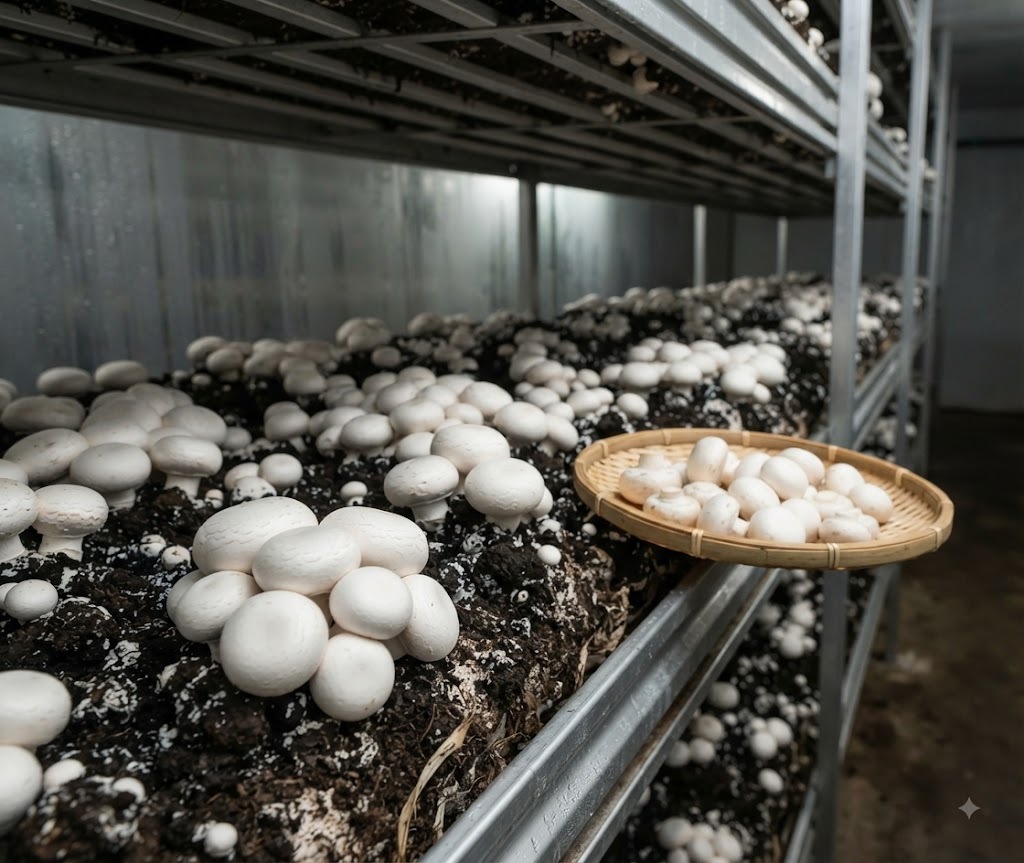
| production core | Unlike other major mushrooms, fermented compost substrate, post-fermentation, and casing are the key processes that determine productivity and quality. ( Nongsaroo ) |
| Harvesting principle | Record Strain, Spawn, Compost Batch, Casing Batch, Flush, Harvest Date, Cap Size, Degree of Splitting, Color, and Buyer Spec in the Lot. |
| Product separation | Separate into White/Brown → Closed Cap/Open Cap → Fresh Whole/Sliced → Canned/Frozen/Dried/Powder. |
| Separation of similar items | It is separated from other species such as oyster mushrooms and shiitake mushrooms, and even within the same A. bisporus, white and brown varieties and maturity stages are classified into Product units. |
| domestic production | The Agri-Food Information Portal identifies Chungcheongnam-do as a major production area and introduces it as a year-round production item. Specific, up-to-date nationwide production volume and area will be entered later after verification of official raw data. ( Food Nuri ) |
| Domestic varieties | The Rural Development Administration developed domestic varieties such as Saea, Saejeong, Saeyeon, Saedo, and Saehan, and also developed the subsequent variety 'Idam' through field trials. ( Rural Development Administration ) |
| Harvest cycle | The Nongsaroo work schedule suggests managing 4 to 5 harvests for spring and autumn cultivation, while recent data on the 'Idam' variety describes a production structure generally involving about 3 harvests. Since there are differences depending on the variety, substrate, and cultivation system, management should be performed on a per-flush basis. ( Nongsaroo ) |
| Post-harvest management | In 2025, the Chungnam Agricultural Research and Extension Services officially announced that pre-cooling immediately after harvest is important for suppressing candied splitting and extending shelf life. ( Nongsaroo ) |
| Supply and demand risk | The key factors are uneven compost fermentation, failure of post-fermentation, spawn contamination, quality and pH of the topsoil, pests and diseases, environmental variations, harvesting labor, cracking, browning, cold chain distribution, and price fluctuations. |
| Operating Principles | Strain–Spawn–Compost–Pasteurization/Conditioning–Casing–Flush–Fruit Body Lot–Processing–Buyer Connect the RFQ. |
| Final goal | It accumulates production processes, quality, processing, Buyer Spec, and repurchase into a single Runtime. |
Basic fields | detail |
| Korean name | button mushrooms |
| English name | Button Mushroom / White Mushroom / Cultivated Mushroom |
| Representative scientific name | Agaricus bisporus (JE Lange) Imbach |
| Biological classification | Fungi → Basidiomycota → Agaricomycetes → Agaricales → Agaricaceae → Agaricus |
| Fungal Name DB | MycoBank No.292246 ( MycoBank ) |
| Edible parts | fruiting body |
| Non-edible · Separate management | Mycelium, compost medium, casing material, spent medium, contaminated medium |
| Major production stages | Compost preparation → Fermentation → Post-fermentation → Inoculation → Mycelial culture → Covering → Fruiting → Fruiting body growth → Harvesting |
| Major harvesting stages | Cap size, degree of cleavage, color, stem length, and Buyer stages by use |
| Basic product form | Fresh Whole·Brown/White·Sliced·Canned·Frozen·Dried·Powder |
| Basic processing stage | Sorting → Pre-cooling → Washing/Cutting → Blanching → Canning/Freezing or Drying/Grinding |
| Basic use | Fresh food retail, dining out, pizza, soup, sauce, HMR, canned goods, food manufacturing |
| Similarity Principle | Other Agaricus spp. are classified as Species, and color, maturity, and product form within the same species are classified as Products |
MycoBank manages historical names, such as Psalliota hortensis, by linking them to the current Agaricus bisporus. Even when scientific names from historical literature are discovered, it does not immediately create a separate Species but first verifies the current taxonomy. ( MycoBank )
Product Master
Product | Product stage | Key Management Standards |
| Agaricus Strain | strain | Species · Strain ID · Breeding Institute |
| Spawn Lot | spawn | Date of manufacture · Vitality · Purity · Contamination |
| Compost Raw Material Lot | Compost raw materials | Raw materials such as rice straw and chicken manure · Origin |
| Phase I Compost | 1st fermentation | Moisture, temperature, turning over, additives |
| Phase II Compost | Post-fermentation medium | Processes such as temperature, time, and ammonia |
| Spawned Compost | Inoculation medium | Spawn Lot · Inoculation Date |
| Colonized Compost | Mycelial culture | Mycelial colonization and culture medium temperature |
| Casing Material Lot | Backfill material | Materials, particle size, pH, moisture |
| Cased Bed Lot | Backfill completed | Covering amount, thickness, and mycelial state |
| White Button Mushroom | White type | Cultivar · Color · Cap Size |
| Brown Button Mushroom | brown type | Cultivar · Color · Scent · Cap Size |
| Closed-cap Mushroom | Unopened type | Opening and opening of the lid |
| Open-cap Mature Mushroom | Mature type | Opening · Cap diameter · Uses |
| Premium Fresh Whole | Fresh, premium | Size, shape, surface, and hardness |
| Foodservice Bulk | For dining out | Specifications, Weight, Delivery Time |
| Fresh Sliced Mushroom | sliced | Thickness, browning, microorganisms |
| Blanched Mushroom | Blanching | Temperature, Time, Yield |
| Canned Whole Mushroom | canned goods | Raw material specifications, filling solution, heat treatment |
| Canned Sliced Mushroom | Sliced canned goods | Thickness, Weight, Heat Treatment |
| Frozen Mushroom | freezing | Pretreatment and Freezing Temperature |
| Dried Mushroom | dry | Moisture, color, scent |
| Mushroom Powder | powder | Parent Lot · Particle Size · Microorganisms |
| Mushroom Puree | Puree | Solid content and homogeneity |
| Mushroom Soup Base | food ingredients | Mushroom Content · Formula |
| OEM·PB Product | finished product | Formula · MOQ · Contract |
| Spent Mushroom Compost | Waste culture medium | Raw materials, contamination, and recyclability |
Classification criteria | Subdivision type | Management principles |
| Species | Agaricus bisporus | Primary Entity |
| strains and varieties | verified varieties such as Saea, Saejeong, Idam, and Dahyang | Strain Master |
| color | White / Brown | Product Segment |
| Maturity stage | Closed / Partially Open / Open | Separation of Harvest Products |
| Cultivation type | Bed systems, multi-tiered facilities, etc. | Facility Entity |
| badge | Phase I / Phase II Compost | Batch separation |
| Backfill | Soil-based/Peat-based etc. | Casing Entity |
| Harvest cycle | 1st, 2nd, 3rd or higher | Productivity by Flush |
| Distribution methods | Fresh·Chilled·Frozen·Canned | Product Separation |
| Preprocessing | Whole / Trimmed / Sliced | Product separation |
| Processing form | Blanched, Puree, Dried, Powder | Processing Entity |
| Final use | Retail·Foodservice·Pizza·Soup·HMR·Canning | Application |
| Transaction type | Regular supply · Contract farming · Processed raw materials · OEM · PB | RFQ |
step | Essential Dataset | Management purpose |
| Production plan | Species · Strain · Target Grade · Buyer | Production Design |
| Securing compost raw materials | Raw Material Type · Origin · Lot | Traceability |
| Retirement | Moisture, period, sediment size | Initial absorption |
| Main sedimentation | Ingredients · Additives · Turning · Temperature | Phase I |
| Compost fermentation | Temperature, Period, Ammonia | Badge quality |
| standing statue | Area, thickness, and input amount | Production volume management |
| passion | Temperature and time | Pest and disease control |
| Post-fermentation | Temperature, Time, and Ammonia Removal | Phase II |
| cooling | Vaccination appropriateness | Spawn Safety |
| spawn inoculation | Strain · Spawn Lot · Vaccination Date | Identity |
| Mycelial culture | Medium temperature, room temperature, humidity | Colonization |
| Confirmation of mycelial attachment | Growth rate and pollution | QC |
| Preparation of backfill material | Materials, particle size, pH, moisture | Casing Quality |
| Backfill | Backfill work, thickness, and uniformity | Fruiting |
| Mycelial growth in the casing layer | Temperature, Humidity, and CO₂ | Preparation for occurrence |
| Induction of occurrence | Temperature reduction and ventilation | Pinning |
| feet | Original number · Date | Yield Forecast |
| Fruiting body growth | Temperature, humidity, CO₂, ventilation, and irrigation | Quality |
| Harvest judgment | Cap size, degree of separation, color | Buyer Grade |
| harvest | Date · Flush · Weight | Harvest Lot |
| Trimming the base | Remove Casing Residue | Fresh QC |
| Selection | Size, color, shape, damage | Grade |
| Pre-cooling | Lowering of product temperature | Shelf-life |
| cold storage | Temperature and period | Fresh Quality |
| purifying | When needed for processing | Processing |
| sliced | Thickness and uniformity | HMR/Canning |
| Blanching | Temperature and time | Process stabilization |
| canned goods | Filling, Sealing, Heat Treatment | Shelf-stable Product |
| freezing | Pretreatment and freezing | Frozen |
| dry | Temperature, time, and final moisture | Dried |
| smash | Particle size and metal detection | Powder |
| packaging | Weight, Material, Gas Environment | Delivery |
| Closure | Removal of substrate and topsoil | Hygiene and circulation |
| Cleaning and disinfection | Cultivation room/tools | Next Cycle |
Quality items | Fresh button mushrooms | Slicing and Pre-processing | Canned goods and frozen goods | Dry/Powder | Public rating |
| Species | essential | succession | succession | succession | Public/Verified |
| Strain/Cultivar | essential | succession | succession | succession | Verified |
| Color type | White/Brown | succession | succession | succession | Public/Verified |
| Compost Batch | essential | succession | succession | succession | Verified/NDA |
| Backfill Batch | essential | succession | succession | succession | Verified/NDA |
| production facilities | essential | succession | succession | succession | Verified |
| Flush | essential | succession | succession | succession | Verified |
| Harvest day | essential | succession | succession | succession | Verified |
| Cap diameter | core | Before amputation | Raw material specifications | Raw material characteristics | Verified |
| Sequence | core | Raw material inheritance | Raw material inheritance | Raw material inheritance | Verified |
| God color | core | Browning management | Processed color | Dry color | Verified |
| Great length | Grade | Trim | By product | Raw material characteristics | Member |
| form | Original/Deformed | Before amputation | Whole/Slice | — | Verified |
| hardness | core | Raw material quality | By product | — | Verified |
| impairment | core | core | Raw material inspection | Raw material inspection | Verified |
| Backfill residue | core | eliminate | Raw material inspection | Raw material inspection | Verified |
| alien substance | check | core | core | core | Verified |
| moisture | Fresh | By product | By product | core | Verified |
| browning | core | Very important | By process | By product | Verified |
| microorganism | If necessary | core | Conformity to standards | core | Verified/NDA |
| pesticide residues | Conformity to standards | succession | test | test | Verified/NDA |
| heavy metals | Risk-based | test | test | test | Verified/NDA |
| Pre-cooling | Fresh Core | succession | — | — | Verified/NDA |
| Refrigeration history | core | core | Before preprocessing | — | NDA |
| sliced | — | Thickness and time | succession | — | NDA |
| Blanching | — | The relevant city | essential | — | NDA |
| heat treatment | — | — | Canned food key | — | NDA |
| freezing | — | — | Frozen food key | — | NDA |
| dry | — | — | — | essential | NDA |
| smash | — | — | — | Powder is essential. | NDA |
| packaging | essential | essential | essential | essential | Verified |
| Expiration date | By product | By product | By product | By product | Verified |
| Shipment | essential | essential | essential | essential | Verified |
| Returns and Claims | record | record | record | record | NDA |
| Repurchase | Buyer Connection | Buyer Connection | Buyer Connection | Buyer Connection | NDA |
Since button mushrooms can continue to open and discolor even after harvest, Cap Opening and Browning are used as independent indicators in Fresh Quality. In 2025, the Chungnam Agricultural Research and Extension Services announced that pre-cooling helps suppress cap splitting and improve marketability by lowering the product temperature. ( Nongsaroo )
Lot Master Required Field
Lot ID · Item · Product Type · Scientific Name · Strain/Cultivar · Color Type (White/Brown) · Spawn Lot · Compost Material Lot · Phase I Compost Batch · Phase II Compost Batch · Alignment/Post-fermentation History · Substrate Moisture/Temperature · Inoculation Date · Mycelial Culture Date · Casing Material Lot · Covering Date/Covering Thickness · pH · Moisture · Date of Occurrence · Flush · Harvest Date · Cap Diameter · Degree of Opening · Color · Hardness · Stem Length · Shape · Weight · Dimensions · Grade · Deformity · Browning · Damage · Covering Residue · Foreign Matter Check · Pesticide Usage Records · Pesticide Residue · Microorganism · Heavy Metal Test Report · Pre-cooling/Refrigeration History · Raw Material Lot · Washing · Slicing · Blanching · Canning · Freezing · Drying · Grinding History · Packaging Date · Best Before Date · Supplier · Returns/Claims · Repurchase
Customers | Purchase criteria | Cooperation opportunities |
| spawn companies | Species·Cultivar·Vitality | Spawn RFQ |
| Composting medium company | Fermentation level, moisture, hygiene | Compost Supply |
| Backfill material companies | Particle size, pH, moisture | Casing Supply |
| production farms | Variety · Substrate · Buyer | Contract Production |
| Producer organizations | Scheduled Production · Joint Sorting | Local distribution |
| wholesale market | Size, color, cracks, and freshness | Fresh |
| Large-scale distribution | Small packaging, specifications, and safety | Retail |
| Online distribution | Pre-cooling, Packaging, Freshness | Fresh Delivery |
| food service companies | Whole/Slice · Size | Foodservice |
| Pizza and pasta franchise | Slices, Standards, Regular Supply | Contract |
| Steak · Hotel | Large, shape, color | Premium |
| School and public meals | Domestic, Safety, Delivery Time | Regular RFQ |
| HMR · Meal Kit | Fresh Slice · Trimmed | Pre-processing |
| Soup and sauce companies | Puree·Powder | Ingredient |
| Canning company | Whole/Slice · Processing Suitability | Canning |
| frozen food companies | Blanched/Frozen | Frozen |
| Seasoning companies | Powder | Seasoning |
| OEM·PB | Soup·Sauce·Canned | Private Label |
| exporters | Fresh/Canned · HS · Standard | Export |
| Research Institute | Varieties, compost, topsoil, diseases, smart cultivation | R&D |
step | Key variables | Operational judgment |
| Varieties and strains | Domestic/Imported · IP | Genetic Supply |
| spawn | Vitality·Purity·Lot | Spawn |
| Compost raw materials | Rice straw, chicken manure, additives | Raw Material |
| Compost production | Phase I·II | Core Input |
| Backfill material | Soil, peat, lime, etc. | Fruiting Input |
| culture | Environment · Flush | Fresh Supply |
| Pre-cooling and sorting | Cracking · Browning · Grade | Fresh Market |
| Preprocessing | Trim/Slice | Foodservice |
| canned goods | Whole/Slice | Shelf-stable |
| freezing | Blanched/Frozen | Industrial |
| Powder/Puree | Processing yield | Ingredient |
| Domestic distribution | Wholesale, Distribution, Food Service, and Catering | Demand |
| import | By Product (Fresh/Canned, etc.) | Global Supply |
| export | Fresh/Canned/Processed | Global RFQ |
| RFQ | Specifications, Quantity, Delivery Time | Procurement |
| Repurchase | Quality, Price, Delivery Time | Supplier Score |
Trade Dataset
item | v1.0 processing |
| Fresh/Chilled Agaricus HS | Future verification of the Korea Customs Service's current HS-K |
| Frozen Mushroom HS | Verification by actual item description |
| Dried Mushroom HS | Species subclassification verification |
| Canned/Prepared Mushroom HS | Verification by preparation and storage method |
| Mushroom Powder HS | Verification by degree of processing and composition |
| Spawn HS | Verification of spawn customs classification |
| Korea's Fresh Import Volume | Input after official verification of raw data |
| Canned food import volume | Input after official verification of raw data |
| Korea's export volume | Input after official verification of raw data |
| Major countries of origin and exporting countries | Verification of raw data by the Korea Customs Service |
| Customs clearance unit price | Calculation only within the same HS, Product, and Unit |
| FTA | Verification by HS, Rule of Origin, and Agreement |
| Quarantine | Check by Product, such as spawn and fresh mushrooms |
| Food safety | MFDS standard connection |
Products and processes | Key conditions | RFQ conversion |
| Fresh White Button | Size, Separation, Color | Retail RFQ |
| Fresh Brown Mushroom | Variety, Color, Scent | Premium RFQ |
| Premium Closed Cap | Separation diagram · morphology | Hotel/Retail |
| Bulk Foodservice | Size, Price, Delivery Time | Foodservice |
| Trimmed Mushroom | Removal of base and backfill residue | HMR |
| Fresh Slice | Thickness, browning, microorganisms | Pizza/HMR |
| Blanched Slice | Process and yield | Frozen/Canning |
| Whole Canned | Raw Material Specifications · Heat Treatment | Canning RFQ |
| Sliced Canned | Thickness · Net Weight | Industrial |
| Frozen Mushroom | Blanching and freezing | HMR/Food |
| Dried Mushroom | Moisture, color, scent | Ingredient |
| Mushroom Powder | Particle size and microorganisms | Soup/Seasoning |
| Puree | Solid content and homogeneity | Sauce/Soup |
| Extract | Raw material and extraction conditions | Flavor Ingredient |
| Soup Base | Mushroom Content | OEM/PB |
| Off-grade Fruit Body | Substandard appearance | Processing conversion |
| Trim Waste | stems, bases, etc. | Processing review after safety verification |
| Spent Compost | Compost and backfill mixed by-product | Separate verification of compost, soil improvement, etc. |
| Contaminated Compost | Diseases and pollution | Food supply chain exclusion |
PRP — Product Research Profile
Mushroom PRP operates with the following structure.
Species/Strain → Spawn → Compost Formula → Phase I Fermentation → Phase II Conditioning → Incubation → Casing → Pinning → Flush → Harvest Quality → Pre-cooling → Processing → Buyer Application → RFQ Performance
PRP | Key research questions |
| Strain PRP | Which variety is suitable for the target color, size, yield, and growth temperature? |
| Compost PRP | How do raw materials, moisture, and fermentation conditions affect mycelial growth and yield? |
| Phase II PRP | Were post-fermentation and alignment performed in a manner suitable for contamination and productivity? |
| Casing PRP | Are the particle size, pH, moisture, and thickness of the backfill material suitable for occurrence and quality? |
| Flush PRP | How do primary, secondary, and tertiary production volumes and product rates change? |
| Fresh PRP | Do the cap size, cracking, color, hardness, and browning match the Buyer Grade? |
| Pre-cooling PRP | How does the pre-cooling method affect breakage, loss, and shelf life? |
| Slice PRP | Do browning, microorganisms, and shelf life after cutting meet HMR conditions? |
| Canning PRP | Are the variety, size, blanching, and heat treatment suitable for the finished product yield? |
| Powder PRP | Are the off-grade/fresh/dried ingredients, particle size, and microorganisms clearly identified? |
| Disease PRP | What is the relationship between compost, topsoil, irrigation, flies, mites, and disease occurrence? |
| Export PRP | Do Product, HS, Shelf-life, and Quarantine meet the destination country's requirements? |
first of all | Execution item | Performance indicators |
| 1 | Species·Strain·Spawn·Compost·Casing·Lot required values | Essential Field Completion Rate |
| 2 | White/Brown·Fresh/Processing Product Separation | Product identification rate |
| 3 | Compost Raw Materials · Mixing · Moisture · Fermentation Runtime | Compost Traceability |
| 4 | Phase I Fermentation Temperature Sensing | Fermentation Uniformity |
| 5 | Post-fermentation temperature and ammonia management | Phase II Compliance |
| 6 | Badge internal temperature IoT | Overheating Detection |
| 7 | AI video of mycelial attachment | Colonization Score |
| 8 | Backfill material pH and moisture sensing | Casing Consistency |
| 9 | Automatic control of temperature, RH, CO₂, and ventilation | Environment Stability |
| 10 | The foot predicts | Pinning Forecast |
| 11 | Production volume forecast by Flush | Yield Forecast |
| 12 | Video AI selection of god size, color, and series | Grade Accuracy |
| 13 | Automatic harvest timing determination | Harvest Accuracy |
| 14 | Browning AI Measurement | Quality Loss Detection |
| 15 | Pre-cooling and refrigeration temperature log connection | Cold-chain Coverage |
| 16 | Fresh→Canning/Processing Yield Prediction | Processing Yield |
| 17 | Early detection of pests and diseases | Disease Detection |
| 18 | Product–Buyer AI Match | RFQ → Sample Conversion Rate |
| 19 | Buyer Ratings & Repurchase Link | Repeat Order Rate |
Problem group | Problem Definition | Required data |
| Mixed Species · Variety Mix | Unmanaged color, yield, and temperature characteristics by variety | Strain |
| dependence on imported varieties | Variety Costs · Spawn Supply Risk | Variety/IP |
| Variation in spawn vitality | Difference in mycelial culture and yield | Spawn QC |
| Variation in compost raw materials | Differences in raw material moisture, ingredients, and origin | Compost Material |
| Uneven fermentation | Variation in culture medium quality and productivity | Phase I Log |
| Post-fermentation failure | Harmful gas, pollution, water reduction | Phase II |
| Overheating of the medium | Inhibition of mycelial growth | Internal Temperature |
| Variation in backfill material | Non-uniform fruiting body development | Casing |
| Poor pH of backfill soil | Mycelial and disease problems | pH |
| Variation in backfill moisture | Differences in growth and quality | Moisture |
| Ventilation and CO₂ deviation | Differences in fruiting body morphology and occurrence | CO₂/Airflow |
| Decline in productivity during harvest cycle | Cost increase per Flush | Yield by Flush |
| God | Fresh Grade degradation | Cap Opening |
| browning | Deterioration of appearance and shelf life | Color |
| Harvest labor | Repetitive harvesting and sorting costs | Labor |
| Delayed pre-cooling | Separation/Quality Deterioration | Harvest-to-Cooling |
| Bacterial and fungal diseases | Loss of production volume and marketability | Disease |
| Fungus gnats and mites | Pathogen spread and quality degradation | Pest |
| microorganism | Fresh Slice/HMR Safety | Microbiology |
| Sliced browning | HMR · Foodservice Product Quality | Processing |
| Canned food yield | Influence of raw material size and variety | Canning Yield |
| Waste culture medium disposal | Processing costs and environmental burden | Spent Compost |
| Overproduction and price fluctuations | Simultaneous production and shipment | Supply/Price |
| Buyer Spec Discrepancy | Difference in demand for retail, pizza, and canned goods | RFQ |
| Repurchase not reflected | Delivery results unlinked to variety and compost improvement | Buyer Evaluation |
RFQ Type | Public Registration | Verify/NDA |
| Mushroom strain | Species·Cultivar·Color | Breeding organs and performance |
| Supply of spawn | Cultivar · shape | Manufacturer · Lot · Quantity · Unit Price |
| Compost raw materials | Type of Ingredient · Origin | Quantity, Ingredients, Price |
| Mushroom compost substrate | Phase II status | Formula · Moisture · Price |
| Backfill material | Materials · General pH | Mixing · Lot · Unit Price |
| White button mushrooms for sale | Cultivar Grade | Farms, Volume, Price |
| Brown button mushrooms for sale | Cultivar · Color · Grade | Volume and Price |
| Fresh Whole Purchase | Size, Separation, Color | Quantity Demanded · Actual Unit Price |
| Regular supply | Grade · Period | Weekly/Monthly Volume/Price |
| contract production | Variety/Target Product | Facilities, Production Capacity, Unit Price |
| School meal delivery | Domestic/Standard | Delivery cycle and volume |
| Foodservice supply | Whole/Size | Weekly Demand and Unit Price |
| Pizza franchise | Slice Size | Specifications and demand |
| HMR · Meal Kit | Trimmed/Sliced | Microorganisms and expiration dates |
| Canned food ingredients | Size and machinability | Yield/Unit Price |
| frozen ingredients | Preprocessing and Quality | Yield · MOQ |
| dried product | Moisture and color | Lot · Price |
| powder | Particle size and microorganisms | Parent Lot·COA |
| Puree/Soup Base | General specifications | Formula·MOQ |
| OEM·PB | Soup·Sauce·Canned | Formula · Contract |
| export | Fresh/Processed | HS · Quarantine · COA |
| Smart farm demonstration | Compost, backfill, and environmental sensors | raw data |
| Demonstration of disease management | Disease·Pest·Environment | Empirical data |
| Waste badge cooperation | Raw materials/contamination status | Quantity and processing conditions |
| Research cooperation | Variety, compost, backfill, processing | IP · Exam materials |
① Need Products & Materials
Companies and institutions seeking necessary products, agricultural products, raw materials, and processed goods register purchasing demands. Registered requests are utilized to review cooperation with potential suppliers and producers based on the RFQ Intelligence Library.
Process:
RFQ Registration → Supplier/Product Review → Collaboration Connection → Future AI Matching
Register
② We are looking for production and manufacturing partners. (Need Suppliers & Manufacturers)
Register a request to find necessary production and supply partners, ranging from farms and producer organizations to processing companies, OEM, ODM, and Private Label manufacturers.
Process:
RFQ Registration → Review of Production & Manufacturing Capabilities → Collaboration Connection → Future AI Partner Matching
Register
③ We are looking for domestic and international buyers. (Need Buyers)
Farmers, producer organizations, and manufacturing companies are requesting cooperation with new buyers, such as domestic and international distributors, importers, brand companies, and food service and catering businesses.
Process:
RFQ Registration → Product & Supply Capability Review → Market & Buyer Connection → Future AI Buyer Matching
Register
Contact : mail@markethub.org
Version | Main contents | situation |
| v1.0 | Fungal Identity · Species–Cultivar–Spawn · Compost Phase I/II · Covering · White/Brown · Fresh · Slice · Canned · Frozen · Powder · RFQ Basic Structure Registration | complete |
| v1.1 | National and Regional Production Statistics · Cultivar Status · HS · Fresh/Canned Import/Export · Price Formula Raw Data Verification | expected |
| v2.0 | Compost · Casing · Flush · Fresh Grade · Pre-cooling · Slice · Canning · Frozen · Quality by Powder · Yield · PRP Segmentation | expected |
| v3.0 | Breeding & Spawn Companies – Compost & Covering Soil Supplier – Production Farms – Pre-processing, Canning, & HMR Manufacturers – Food Service, Restaurant, Distribution, Export Buyer Verified Container Combination | expected |