


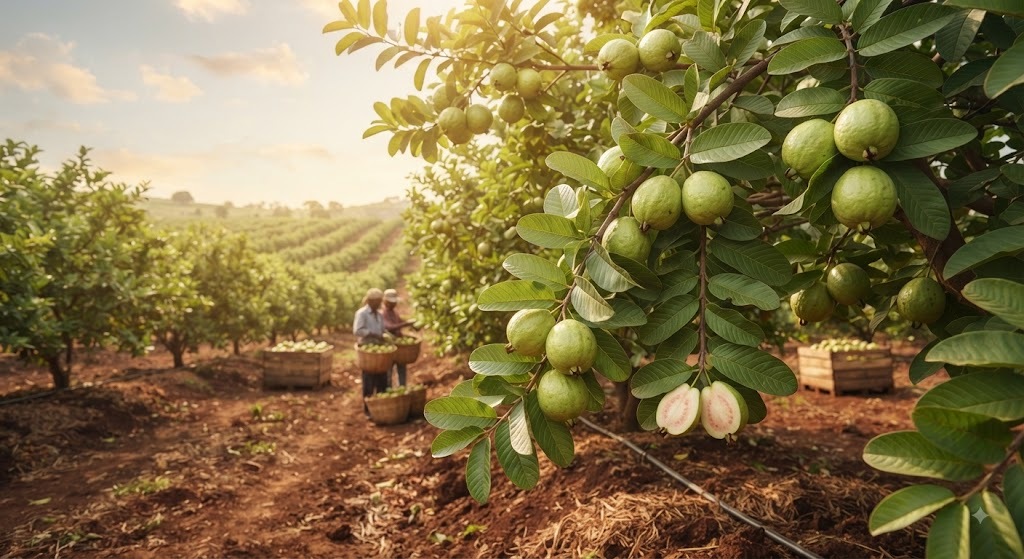
Judgment axis | Key judgment |
| Item Identity | According to the Rural Development Administration's Nongsaroo standards, English name is Guava, scientific name is Psidium guajava L., a tropical and subtropical fruit tree of the Myrtaceae family ( Nongsaroo ) |
| Key role | Domestic subtropical specialty fresh fruits and processed raw materials for purees, juices, jams, beverages, and desserts |
| Harvesting principle | Separate variety, flesh color, ripeness, and fresh/processing use, and manage harvest date and ripeness as Lot core values. |
| Product separation | Manage fresh fruit, ripened fruit, sliced fruit, frozen fruit pulp, puree, juice, concentrate, and jam as individual products. |
| Separation of similar items | Do not integrate with other Psidium species or similar tropical fruits. |
| Domestic statistics | Nationwide Guava Cultivation Area and Production Volume: To be entered after verification of official raw data |
| Domestic adaptability | The Rural Development Administration included guava among the eight subtropical fruit species deemed superior following domestic adaptability trials in 2019. ( Rural Development Administration ) |
| Varieties | Data from the Rural Development Administration explains that improved varieties differ in fruit size, aroma, stone cells, disease resistance, yield, etc. ( Nongsaroo ) |
| Safety Management | Guava is a tropical fruit subject to the Positive List System (PLS), and both domestic and imported varieties are subject to pesticide residue management ( Ministry of Agriculture, Food and Rural Affairs ). |
| Quarantine risk | According to Nongsaroo quarantine information, guava has been identified as a host plant for certain fruit flies; therefore, it is necessary to check quarantine requirements by country and pest when importing fresh fruit. ( Nongsaroo ) |
| Supply and demand risk | Facility overwintering, varieties, ripeness, fruit flies, import logistics, storage loss, processing yield, and limitations on domestic production scale |
| Operating Principles | Species–Cultivar–Facility/Origin–Harvest Stage–Product–Lot–Buyer RFQ Connection |
| Final goal | Simultaneously managing domestic subtropical production and import/processing procurement, while feeding delivery performance back into production/processing plans |
Basic fields | detail |
| Korean name | Guava |
| English name | Guava |
| Representative scientific name | Psidium guajava L. ( Nongsaroo ) |
| classification | Myrtaceae, Psidium genus ( Nongsaroo ) |
| Edible parts | The edible part of a mature fruit |
| Non-edible · Separate management | Leaves, stems, roots, and pruning by-products are separated from general fruit products. |
| Major harvesting stages | Immature fruit → Mature fruit for distribution → Fruit ripe for raw consumption → Fully ripe fruit for processing → Overripe fruit |
| Basic product form | Fresh fruit, selected fruit, sliced fruit, frozen fruit pulp, puree, juice, concentrate, jam |
| Basic processing stage | Sorting, ripening, washing, cutting, freezing, crushing, pureeing, juicing, concentrating, heating |
| Basic use | Raw Food · Beverages · Cafe · Dessert · Bakery · Jams · Sauces · HMR · PB |
| Principle of similar items | Psidium species other than P. guajava are managed as separate entities. |
The Rural Development Administration explains that guava is an evergreen shrub capable of growing to a height of approximately 3 to 6 meters , and introduces that varieties have been improved and are cultivated in various tropical and subtropical regions around the world. These figures are stored as general plant characteristic values in Nongsaroo, while actual greenhouse tree shape and height are managed as farm-specific datasets. ( Nongsaroo )
Product Master
Product ID | Actual product form | Key Management Standards |
| GUAVA-P01 | Raw materials from domestic sources | Variety · Facility/Cultivation Area · Harvest Date · Ripening |
| GUAVA-P02 | Selected fresh fruit | Size, weight, color, appearance, and hardness |
| GUAVA-P03 | Fresh fruit ripened after harvest | Ripening level, ripening period, aroma, release date |
| GUAVA-P04 | Premium small packaging | Uniformity, Appearance, Country of Origin, Packaging |
| GUAVA-P05 | Fully ripened fruit for processing | Ripening, Safety, and Flesh Yield |
| GUAVA-P06 | Cut guava | Cutting specifications, hygiene, browning, and expiration date |
| GUAVA-P07 | Frozen guava flesh | Freezing conditions, storage, and thawing quality |
| GUAVA-P08 | Guava Puree | Pulp, seed treatment, particle size, color, aroma |
| GUAVA-P09 | Guava juice ingredients | Juice Yield · Filtration · Buyer Standards |
| GUAVA-P10 | Guava concentrate | Concentration, color, aroma, acidity |
| GUAVA-P11 | Guava Jam & Filling | pulp, viscosity, blending, heating |
| GUAVA-P12 | Dry/Powder Product | Dryness, moisture, particle size, packaging |
| GUAVA-P13 | PB · Finished Products | Raw material traceability, manufacturing, labeling, and expiration date |
Classification criteria | Subdivision type | Management principles |
| Plant classification | Psidium guajava L. | Species Master |
| Species | Other Psidium spp. | Separate Entity after scientific name verification |
| varieties | Confirmed varieties such as Safeda and Ruby | Cultivar ID |
| flesh color | Actual variety values such as white, pink, and red | Buyer Quality Field |
| Harvesting stage | Immature · Mature · Raw ripe · Processing ripe · Overripe | Harvest Stage |
| Cultivation method | Actual cultivation forms such as greenhouses and open fields | Production ID |
| origin | Domestic/Imported | Origin Entity |
| Distribution methods | Fresh fruit, small packaging, cut, frozen | SKU separation |
| Processing form | Puree, Juice, Concentrate, Jam, Dried, Powder | Product ID |
| Final use | Raw Food · Cafe · Beverages · Confectionery · HMR · PB | Buyer Specification |
| Transaction type | In-kind · Contract farming · Regular supply · Import · OEM/PB | Contract NDA |
step | Essential Dataset | Management purpose |
| Cultivation plan | Species · Varieties · Area · Uses | Production plan |
| Seedlings and propagation | Variety, Seedling Source, Grafting Information | Variety Tracking |
| formula | Official Date · Facility/Packaging ID | Production history |
| New shoots and tree shape | New shoots, pruning, tree height | Fruit setting and work management |
| flowering | Flowering date and amount | Production forecast |
| Fruit set | Fruit set and fallen fruit | Yield prediction |
| Facility Environment | Temperature, humidity, sunlight | Domestic adaptation management |
| rising | Outside temperature, low temperature, rainfall | Risk Management |
| Watering | Water quantity, water quality, and timing | Growth and fruit quality |
| dispute | Materials, Quantity, and Timing | Production history |
| pests | Occurrence, Control, and Pesticides | Safety and quantity |
| Fruit fly management | Occurrence, Trap, Control | Quarantine and quality risks |
| Harvest judgment | Color, scent, hardness, and uses | Fresh/Processed Branch |
| harvest | Date, Time, Weight | Raw Lot |
| Selection | Size, color, damage, decay | Product Separation |
| ripening | Start Date · Period · Accommodation | Fresh Product |
| Pre-cooling/Refrigeration | Time and temperature | Quality maintenance |
| purifying | Washing process and hygiene | Preprocessing |
| cutting | Standards and seed treatment | Fresh-cut |
| freezing | Freezing and storage | Year-round processing |
| Crushing and Puree | Input, Output, Seed Processing | Processing Yield |
| Juicing | Input Amount · Stock Solution Amount | Juice Product |
| concentration | Concentration Process · Product Specifications | Ingredient |
| Jam · Heating | Mixing, heating, and filling | finished product |
| Dry/Powder | Dryness, moisture, particle size | Ingredient |
| packaging | Packaging by product type | circulation |
| shipment | Buyer · Lot · Delivery Date | Delivery |
Quality items | Fresh fruit | Pre-processed and frozen products | processed goods | finished product | Public rating |
| Species | essential | succession | succession | tracking | Public/Verified |
| varieties | essential | succession | Raw material standards | tracking | Verified |
| flesh color | essential | succession | Raw material specifications | Product Standards | Member |
| Place of origin | essential | succession | succession | tracking | Public |
| Farmers · Suppliers | ID | succession | tracking | tracking | Verified |
| Facilities and types of cultivation | essential | succession | tracking | - | Verified |
| Lot | essential | new | new | new | Verified/NDA |
| Harvest day | essential | succession | succession | tracking | Verified |
| appearance | core | Raw material selection | The relevant city | Product Standards | Member |
| Weight/Size | Buyer specifications | input | Output | Display amount | Member |
| Skin color | Accommodation index | Raw material standards | Color Management | tracking | Member |
| flesh color | Variety Indicators | essential | core | Product specifications | Verified |
| Longitude and maturity | core | Fabrication aptitude | Raw material standards | tracking | Verified |
| incense | Variety and ripeness evaluation | Raw Material Evaluation | Product specifications | Product Standards | Member |
| Stone cells and texture | By variety | Raw material suitability | Puree and Juice Aptitude | tracking | Verified |
| Damage/Deterioration | test | eliminate | Non-conformity exclusion | management | Verified |
| pests | test | Raw material traceability | tracking | - | Verified |
| alien substance | check | essential | essential | essential | Verified |
| pesticide residues | Legal standards | succession | check | Legal standards | Verified/NDA |
| microorganism | If necessary | importance | importance | Product Standards | Verified/NDA |
| purifying | The relevant city | essential | record | tracking | Verified |
| Freezing history | - | Frozen food is essential | succession | tracking | NDA |
| pulp yield | specimen | core | Cost linkage | tracking | NDA |
| Puree/Juice Yield | - | input | core | Cost linkage | NDA |
| Processing history | - | corresponding | essential | essential | NDA |
| packaging | Fresh fruit | Hygiene/Freezing | By product | Labeling packaging | Member |
| save | cold storage | freezing | By product | By product | Verified |
| Expiration date | Test-based | Test-based | setting | mark | Verified |
| Shipment | record | record | record | record | Verified |
| Returns and Claims | record | record | record | record | NDA |
| Repurchase | connection | connection | connection | connection | NDA |
Lot Master Required Field
Lot ID · Item/Product Type · Species/Scientific Name/Variety · Flesh Color · Cultivation Type · Origin/Cultivation Area/Place of Origin · Producer/Supplier · Seedling Source · Planting Date · Flowering/Fruit Set Information · Harvest Date/Harvest Time · Harvest Purpose · Skin Color/Flesh Color/Ripeness/Hardness · Quality Indicators · Weight/Specifications/Grade · Texture/Aroma · Pests/Diseases/Fruit Flies/Appearance Check · Pesticide Usage Records · Pesticide Residue/Microbiological Test Report · Ripening/Pre-cooling/Refrigeration/Freezing History · Raw Material Lot · Processing History (Washing/Cutting/Puree/Juicing/Concentration/Jam/Drying) · Packaging Date · Best Before Date · Shipper · Returns/Claims · Repurchase
Customers | Purchase criteria | Cooperation opportunities |
| Domestic subtropical fruit farms | Variety, Facility, Harvest Period | contract farming |
| Producer organizations in mountainous regions | Variety, Ripeness, Specifications, Quantity | Joint screening |
| Fresh produce and specialized distribution | Appearance, aroma, ripeness, flesh color | Premium Fresh Fruit |
| Online/Direct Transaction | Domestic · Ripeness · Delivery Durability | Direct from the farm |
| Large-scale distribution | Standards, Country of Origin, Safety | Small packaging · Private label |
| importer | Origin, Variety, Quarantine | Import RFQ |
| Cafes · Drinks | Fruit pulp, puree, juice, flavor | Regular raw material supply |
| Hotels and Restaurants | Fresh fruit, sliced fruit, puree | Premium Menu |
| Bakery · Dessert | Puree, filling, and flesh color | Product development |
| Juice manufacturer | Juice yield, aroma, color | B2B raw materials |
| Puree manufacturer | Flesh yield, particle size, and seeds | Processing contract |
| Jam manufacturer | Ripness, flesh, aroma | Processing RFQ |
| HMR · Meal Kit | Sauces, Purees, and Cuts | Product Development |
| PB·OEM | Beverages, Jams, Desserts | Manufacturing cooperation |
| Research and technology institutions | Variety, Facility Adaptation, Processing | Joint demonstration |
step | Key variables | Operational judgment |
| domestic production | Variety, Facility, Fruit Set, Harvest | Local Supply |
| Overseas production | Country, Variety, Crop Conditions | Import Supply |
| Contract farming and procurement | Fresh fruit/processing purpose | Product Planning |
| harvest | Saturation, Color, Scent | Fresh/Processing Branch |
| Selection and ripening | Appearance, ripeness, and hardness | Fresh fruit sales |
| Refrigeration/Freezing | Temperature and stock | Supply control |
| Import and Quarantine | Origin·Pest·HS | Import Lot |
| Fruit pulp/puree | Yield, Seed, Color | B2B raw materials |
| Juicing and Concentration | Yield and specifications | Beverage ingredients |
| Jams · Processed Foods | Ripeness, Aroma, Viscosity | PB/OEM |
| Distribution and supply | Delivery time, packaging, temperature | Buyer Quality |
| RFQ · Repurchase | Claims, Evaluation, Yield | Repeat trading |
Import and export management
item | Management principles |
| HS Code | Check Korea Customs Service HS codes by product type, such as fresh guava, frozen fruit, puree, juice, and jam. |
| Import volume | Input after verification of raw data from the Korea Customs Service's import and export trade statistics. |
| Revenue | Input after official verification of raw data |
| Export volume and value | Input after official verification of raw data |
| Major suppliers | Enter raw HS quantity and value data by country |
| Quarantine | Confirmation of quarantine pests, such as fruit flies, by origin |
| FTA | Agreement Tariff Rates by Country, HS, and Product Type |
| PLS | Pesticide residue management for both domestically produced and imported guavas |
| Food safety | Standards by processing type, such as frozen, puree, and juice |
| cold chain | Classification of Fresh and Frozen Products |
| Processing Logistics | Application of product-specific conditions for purees, concentrates, and jams |
Products and processes | Key conditions | RFQ conversion |
| Raw materials from the source | Species · Varieties · Harvest Date | Raw RFQ |
| Freshly Selected | Appearance, aroma, ripeness, flesh color | Fresh RFQ |
| Fresh fruit ripened after harvest | Sukdo, Gyeongdo, Hyang | Retail/Foodservice |
| Fully ripened fruit for processing | Safety and flesh yield | Processor RFQ |
| Cutting and | Tissue, Seed, Browning, Hygiene | Dining Out · HMR |
| frozen fruit flesh | Freeze-thaw quality | Year-round B2B |
| Puree | Seed treatment, particle size, color, and scent | Beverage/Bakery |
| Juice extract | Juice extraction yield and filtration | Beverage RFQ |
| concentrate | Concentration, scent, color | Ingredient RFQ |
| jam | pulp, viscosity, aroma | OEM/PB |
| Fillings and sauces | Viscosity and thermal stability | Bakery |
| Drying | Dryness, moisture, and tissue | Snack |
| powder | Particle size and moisture | food ingredients |
| Non-commercial products and | Appearance defects, overripe, safety | Processing conversion |
| Pericarp and seeds | Separation from the product | Materialization is after research and legal verification. |
| Leaf and pruning byproducts | Separation from edible fruit supply chains | Prohibition of automatic registration using food and tea |
Although the Rural Development Administration's introductory materials on guava mention uses for the leaves, this is not the same as general fresh Food Plant Products. Therefore, leaves are not automatically included in the guava fruit RFQ; instead, they are managed as a separate raw material entity after verifying their suitability for food ingredients, compliance with relevant laws, and safety . ( Nongsaroo )
Product Research Profile (PRP)
PRP area | Key question |
| Species | Did you confirm whether it is P. guajava or another Psidium species? |
| varieties | How do fruit size, aroma, flesh color, and texture differ? |
| flesh color | Do fresh, puree, and beverage products match buyer preferences? |
| Sukdo | What are the optimal harvest and ripening stages for fresh fruit and processing? |
| texture | How do stone cell levels affect the quality of raw food and purees? |
| pulp yield | What is the ratio of the actual edible portion to the original material? |
| satellite | What are the seed removal methods and yields in purees and juices? |
| freezing | Are the aroma, color, and texture maintained after thawing? |
| Puree | Do the particle size, color, and scent meet manufacturing standards? |
| Juicing | What are the extraction yield and filtration characteristics? |
| concentration | Do the scent and color meet the Buyer's specifications after processing? |
| Buyer | What are the repurchase performance results by variety, ripeness, and product type? |
first of all | Execution item | Performance indicators |
| 1 | Species·Cultivar·Flesh Color·Origin·Harvest Date·Lot made mandatory | Required value completion rate |
| 2 | Separation of Fresh Fruit, Ripening, Cutting, Freezing, Puree, Juice, and Concentrate Products | Product identification rate |
| 3 | Facility environment, flowering, fruit setting, growth, and harvesting are linked. | Production history connection rate |
| 4 | Datafication of quality, certificates, ripening, freezing, and processing history | Traceability rate |
| 5 | Farm – Processor – Distribution – Buyer RFQ Connection | RFQ Match Rate |
| 6 | Video AI screening for peel color, size, and damage | Automatic judgment accuracy |
| 7 | AI identification aid for variety and flesh color | Variety identification rate |
| 8 | Pest and disease AI diagnostic assistance | Early detection rate |
| 9 | Yield and harvest time prediction | Prediction error |
| 10 | Prediction of ripeness and post-ripening | ripe release rate |
| 11 | Prediction of fresh fruit storage loss | Disposal and Claim Rates |
| 12 | Puree and Juice Yield Prediction | Error compared to actual |
| 13 | Domestic Production–Import Supply and Demand Analysis | Supply shortage prediction rate |
| 14 | AI Supplier/Buyer Match | Sample→Contract Conversion Rate |
| 15 | Traceability | Seedling/Importer → Finished Product Traceability |
Problem group | Problem Definition | Required data |
| Mixed Species | Other Psidium species may be mixed in under the guava product name. | Species · Scientific name |
| Lack of variety information | Differences in flesh color, aroma, and texture by variety are not reflected | Cultivar |
| Lack of domestic production statistics | Independent verification of the latest nationwide production scale is necessary. | Area and production volume |
| Wintering costs for facilities | Domestic overwintering and heating cost burden for subtropical crops | Facilities, Temperature, Fuel |
| Seedling reliability | Possibility of discrepancy between variety and seedling source | Seedlings and varieties |
| Fruit set deviation | Production fluctuations due to facility environment and flowering conditions | Flowering and fruit setting |
| pests | Deterioration of production and quality | Occurrence and Control |
| Fruit fly quarantine | Quarantine risks when procuring fresh fruit from overseas | Origin·Pest |
| Difference in maturity | Difference in optimal ripeness stages between fresh and processed fruit | Harvest Stage |
| Mixed flesh colors | Buyer requirements and product mismatch | Flesh Color |
| Texture variation | Texture variation due to differences in stone cells and ripeness | Variety · Texture |
| Storage loss | Possibility of softening, damage, or decay | Storage Log |
| Cut product quality | Browning, Microorganisms, and Tissue Changes | Fresh-cut Dataset |
| Seed treatment | Seed separation process required from juice and puree | Process Yield |
| Puree yield | Yield differences by variety and ripeness | Input and Output |
| Competition from imported products | Price and supply difference between domestic and imported raw materials | Origin·Price |
| PLS · Test Report | Need to link registered pesticides, residue standards, and lots | Pesticide · Certificate |
| Repurchase not reflected | Buyer evaluation not linked to selection of next variety/farm | Evaluation·Reorder |
RFQ Type | Public Registration | Verify/NDA |
| Domestic Guava Procurement | Variety, flesh color, region, harvest period | Farm, Volume, Unit Price |
| Fresh fruit sales | Degree of ripeness, size, and product type | Lot · Price |
| Buying fresh fruit | Variety, flesh color, and specifications | MOQ · Unit Price |
| Regular supply | Product · Delivery Cycle | Physical quantity/contract |
| contract farming | Variety, Use, Facilities | Farms, Area, Price |
| Facility cultivation cooperation | Facility Type · Target Production | Production Costs, Heating, and Facility Information |
| imported fresh fruit | Origin·Species·Variety | Quarantine · Importer · Unit Price |
| Fully ripened fruit for processing | Variety · Ripening | Flesh yield and price |
| Cutting and | Size, flesh color, and hygiene | Expiration date/Unit price |
| frozen fruit flesh | Freezing · Product Specifications | Test Reports · MOQ |
| Puree | Color, scent, particle size, seeds | Yield · MOQ |
| Juice ingredients | Juicing and Filtration Standards | Unit price · process |
| concentrate | Concentration Standards · Origin | MOQ · Price |
| Jams and fillings | Product form | Mixing/Contract |
| Dining Out & Cafe | Fresh fruit, puree, juice | Delivery time and price |
| Bakery | Puree, filling, cutting and | Supply cycle |
| HMR·PB | Jams, drinks, sauces | Expiration date/contract |
| local specialties | Domestic Guava Processed Products | Producer/Processor |
| export | Fresh and processed products | Quarantine and contract |
| Technology demonstration | Facility, Storage, AI Sorting, Processing | Test conditions |
| Research cooperation | Variety, Adaptability, Processing | Dataset·IP |
① Need Products & Materials
Companies and institutions seeking necessary products, agricultural products, raw materials, and processed goods register purchasing demands. Registered requests are utilized to review cooperation with potential suppliers and producers based on the RFQ Intelligence Library.
Process:
RFQ Registration → Supplier/Product Review → Collaboration Connection → Future AI Matching
Register
② We are looking for production and manufacturing partners. (Need Suppliers & Manufacturers)
Register a request to find necessary production and supply partners, ranging from farms and producer organizations to processing companies, OEM, ODM, and private label manufacturers.
Process:
RFQ Registration → Review of Production & Manufacturing Capabilities → Collaboration Connection → Future AI Partner Matching
Register
③ We are looking for domestic and international buyers. (Need Buyers)
Farmers, producer organizations, and manufacturing companies are requesting cooperation with new buyers, such as domestic and international distributors, importers, brand companies, and food service and catering businesses.
Process:
RFQ Registration → Product & Supply Capability Review → Market & Buyer Connection → Future AI Buyer Matching
Register
Contact : mail@markethub.org
Version | Main contents | situation |
| v1.0 | Plant Identity · Domestic Adaptation Cultivation · Fresh Fruit · Ripening · Freezing · Puree · Juice · RFQ Basic Structure Registration | complete |
| v1.1 | Verification of the latest official raw data on domestic production statistics, varieties, markets, HS codes, and import/export | expected |
| v2.0 | Subdivision of quality standards for Cultivar, flesh color, ripeness, post-ripening, cutting, freezing, puree, juicing, and concentrate | expected |
| v3.0 | Combine Producer/Importer–Cold-chain–Processor–Distributor–Buyer Verified Container | expected |