


Analysis Region: Gyeonggi-do and 31 cities and counties
Core Agricultural Zones: Major agricultural areas in Gyeonggi, including Yeoncheon, Paju, Pocheon, Yangpyeong, Yeoju, Icheon, Anseong, Pyeongtaek, and Hwaseong, as well as the Seoul Metropolitan Area's urban and suburban agricultural zones
Agenda: How to transform Gyeonggi agriculture through data, AI, robotics, and distribution innovation amidst population aging, climate crisis, farmland reduction, and labor shortages
Golden Time Type: Opportunity + Structural Risk
Reference Date: August 28, 2026
Version: Regional AX Golden Time Intelligence v3.1
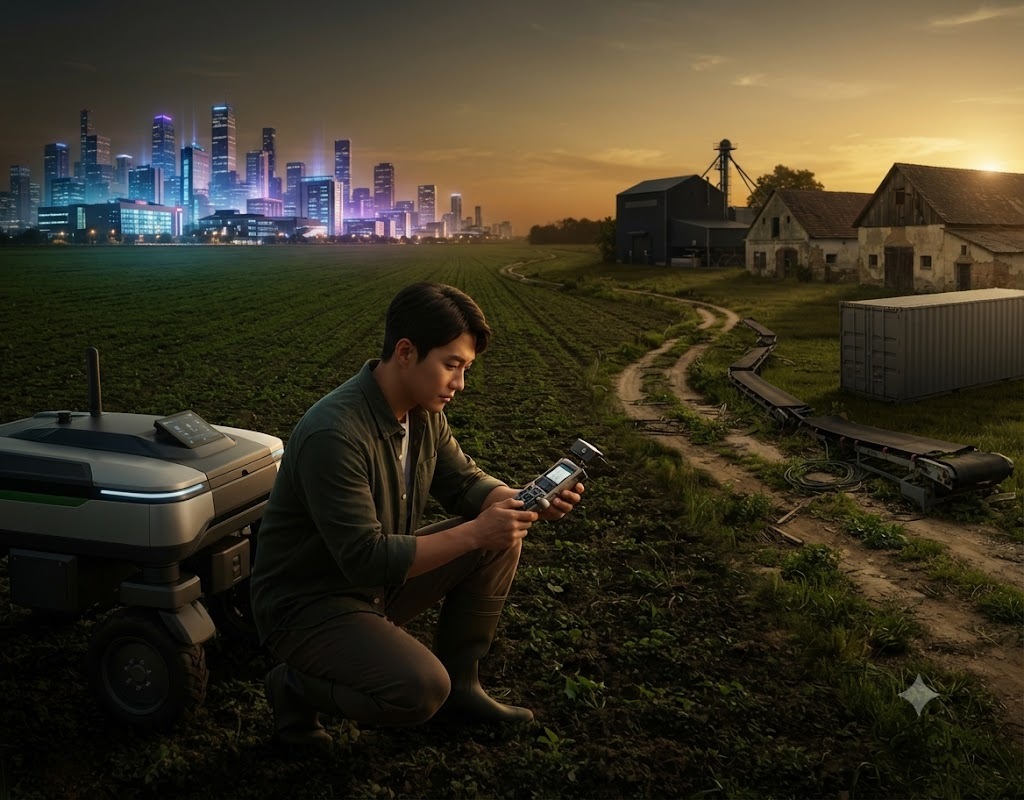
The most significant characteristic of Gyeonggi-do agriculture is the simultaneous existence of substantial agricultural regions within South Korea's largest metropolitan area. While Gyeonggi-do serves as a hub for semiconductors, AI, biotechnology, and metropolitan service industries, areas such as Yeoncheon, Paju, Pocheon, Yangpyeong, Yeoju, Icheon, Anseong, Pyeongtaek, and Hwaseong produce rice, vegetables, fruit, flowers, livestock, and specialized crops. Consequently, Gyeonggi agriculture differs from typical rural agriculture. Although farmland and rural communities are declining and the population is aging, a massive consumer market of 14 million people and a world-class ecosystem for AI and high-tech industries exist right next door.
The first structural risk identified is the agricultural population. According to the 2024 Agriculture, Forestry, and Fisheries Survey, there were 106,373 farm households and a farming population of 255,127 in Gyeonggi Province. Compared to the national figures of 973,707 farm households and approximately 2,004,000 farming households, Gyeonggi agriculture still maintains a significant absolute scale. However, the national farming population decreased by 4.1% and the number of farm households by 2.5% compared to 2023, while the proportion of the farming population aged 65 or older rose to **55.8%**. Although the detailed age structure of Gyeonggi Province cannot be viewed as identical to the national figures, Gyeonggi agriculture is also not exempt from the national structural changes of workforce reduction and aging. ( Statistics Korea )
The second change is climate. In the heavy snowfall damage at the end of 2024, 1,761 hectares of agricultural and fisheries facilities in Gyeonggi Province were damaged, including 649 hectares of vinyl greenhouses, 373 hectares of orchards, and 726 hectares of ginseng. The province injected an additional 17.1 billion won for demolition costs, on top of existing emergency recovery funds and disaster relief funds. This is evidence that the climate crisis is not a future risk to agriculture, but is already becoming a current cost that shakes the profitability of agricultural management and the payback period of facility investments . ( Gyeonggi Provincial Government )
The third change is technology. The AI analysis technology for agricultural and forestry satellite imagery , demonstrated by the Gyeonggi Agricultural Research and Extension Services and Yeoncheon County, utilized data from 168 rice farms and 52 soybean farms in Yeoncheon to support the prediction of growth status, abnormal signs, farming history, and yields; the related system received a CES 2026 Innovation Award. Based on this, Gyeonggi Province is pursuing a plan to establish a smart farming management platform for Gyeonggi rice by 2028. ( Gyeonggi News Portal )
By June 2026, operations began on a service that uses AI to analyze crop biological data and genetic changes before disease symptoms become visible, providing advance warnings of risks associated with pests, high temperatures, and drought. In other words, the smartification of Gyeonggi agriculture has begun to shift from the level of sensors and automated irrigation to Predictive Agriculture . ( Gyeonggi News Portal )
However, technological development does not mean the AX transition of the entire Gyeonggi agriculture.
- Smart farm installation ≠ increase in farm income
- AI Prediction ≠ Actual Farm Utilization
- Data Collection ≠ Data-Driven Management
- Support for young farmers ≠ Youth settlement
- Technology development ≠ agricultural structural innovation.
Gyeonggi Province's Golden Time does not lie in installing expensive smart farms for every farm. The key is to expand ' Lightweight Agriculture AX' within the next two to three years, which connects climate, soil, growth, price, and distribution data tailored to Gyeonggi's diverse agriculture—including open fields, greenhouses, fruit trees, and livestock—and enables even small farms to manage production, pests, shipment, and price decisions with just a smartphone .
It is not accurate to view Gyeonggi agriculture as a single industry.
Yeoncheon, Paju, and Pocheon in northern Gyeonggi Province are characterized by strong border region traits and are associated with rice, soybeans, livestock, and open-field farming. Yangpyeong, Yeoju, and Icheon in the east are linked to eco-friendly agriculture, rice, field crops, and regionally specialized crops. In southern regions such as Anseong, Pyeongtaek, and Hwaseong, agricultural land and urban functions compete as agriculture, large-scale industry, and urban development proceed simultaneously.
In addition, it is close to the metropolitan consumer market , making it advantageous for creating suburban farming businesses such as greenhouse vegetables, flowers, local food, experience, healing agriculture, and urban agriculture .
According to 2024 national statistics, there are over 106,000 farm households in Gyeonggi Province, with a farming population of approximately 255,000. Gyeonggi Province accounts for about 10.9% of the total number of farm households and about 12.7% of the farming population nationwide. This means that despite being an industrialized and urbanized region, Gyeonggi Province still represents a scale that cannot be ignored within the national agricultural sector. ( Statistics Korea )
However, agriculture in Gyeonggi Province faces stronger land pressure than in other agricultural regions. As industrial complexes, new towns, roads, railways, logistics facilities, and housing developments continue, farmland becomes both a productive asset and a target for development.
Therefore, Gyeonggi Province's agricultural policy faces the question of how to utilize the remaining farmland with high productivity and added value, going beyond simple production increase .
In this respect, AX is not a selective technical support but is linked to the structural productivity issues of Gyeonggi-do agriculture.
The most important thing to avoid in smart agriculture policy is viewing facilities and equipment as performance indicators.
Installing large-scale greenhouses and sensors, along with introducing automated equipment, may appear to be smart farming. However, when considering initial investment costs, electricity bills, maintenance expenses, equipment breakdowns, and the ability to utilize data, the same approach is not suitable for all farms and crops.
The Gyeonggi Agricultural Research and Extension Services also addressed smart agriculture by 2026, identifying the high initial investment and operating cost burden of existing smart farms as issues, and analyzed that generative AI and robotic technology are creating the possibility for lightweight smart agriculture that does not rely on excessive facility investment . ( Gyeonggi Agricultural Research and Extension Services )
Furthermore, research on smart farm databases by the Gyeonggi Agricultural Research and Extension Services diagnoses that even though environmental, growth, and control data are accumulated in existing smart farms, their actual utilization is insufficient due to decentralized management, a lack of data standards, and limited accessibility . ( Gyeonggi Agricultural Research and Extension Services )
In other words, even in smart agriculture, if it ends with sensor installation and data generation, it is not AX.
The process must be connected from data collection → standardization → analysis → prediction → farmer's judgment → work changes → to changes in cost, quantity, and quality.
The next challenge for Gyeonggi agriculture is not to increase the number of smart farm facilities, but to increase the rate at which data changes actual farm decision-making .
The first structural change is the shift from empirical agriculture to predictive agriculture .
Agriculture has long been operated based on farmers' experience and local knowledge. While experience remains important, increasing variability in climate patterns makes it difficult to determine planting, pest control, and harvesting times solely based on past experience.
The AI early prediction service for crop bio-information, which Gyeonggi Province began operating in 2026, demonstrates this change. Rather than responding after disease symptoms become visible, the AI detects abnormal signals within the crops in advance to predict risks of pests, diseases, high temperatures, and drought. ( Gyeonggi News Portal )
The second is the shift from individual farm management to regional-level management .
By utilizing satellites and AI, vast rice and soybean cultivation complexes can be analyzed simultaneously without visiting individual farms. In the Yeoncheon demonstration, satellite data was used to analyze growth conditions, and abnormal situations were communicated to farmers via KakaoTalk. (Gyeonggi Agricultural Research and Extension Services )
The third is the shift from a production-centered approach to production + distribution + price data management .
No matter how much farmers increase productivity, their income will not improve if they misjudge the timing of shipment and prices. Therefore, future smart agriculture must be connected not only to growth data but also to wholesale market prices, online sales, and consumer demand.
The fourth is a shift from technology centered on full-time farmers to AI services that small-scale farmers can also utilize .
If satellite, weather, public data, and smartphone-based services can be utilized without facility investments of tens of millions of won, the entry cost for smart agriculture itself is lowered.
This change is particularly important in Gyeonggi Province because farms of various sizes and suburban agriculture coexist, rather than large-scale corporate farms.
Gyeonggi Province is simultaneously pursuing technology, education, income, and youth policies in relation to the 2026 Agriculture AX.
In terms of technology, the most important thing is the Gyeonggi rice smart farming management platform . The Gyeonggi Agricultural Research and Extension Services is pursuing the development of a platform that integrates satellite information, soil, and weather data to analyze growth conditions and production yields for each plot over a three-year period starting in 2026.
It will be applied to 'Yeonjin' in Yeoncheon and 'Suchanmi' in Anseong, with plans to establish separate web platforms for extension agencies and mobile platforms for farmers. The system is designed to allow farmers to check growth conditions, weather conditions, pest and disease risks, and harvest time predictions via mobile devices. ( Gyeonggi Agricultural Research and Extension Services )
Research on establishing a data platform is currently underway in greenhouse horticulture. The structure integrates, stores, and analyzes environmental, growth, and facility control data produced in smart farms, connecting them to future growth prediction and automatic control. ( Gyeonggi Agricultural Research and Extension Services )
There are also changes in education. In 2026, the Gyeonggi Agricultural Research and Extension Services (Gyeonggi Agricultural Research and Extension Services) operated separate Smart Agriculture, Smart Agriculture Follow-up, and AI Agriculture Application classes. In particular, the AI Agriculture Application class was designed to utilize AI in agricultural marketing and management. ( Gyeonggi Agricultural Research and Extension Services )
Competitiveness enhancement programs are being operated for young farmers to support production and processing facilities, idea commercialization, and organization. In 2025, 344 individuals were selected as recipients of the farming settlement support for young farmers, and young successor farmers were provided with settlement grants of 900,000 to 1.1 million won per month for up to three years. ( Gyeonggi Provincial Government )
Policy is already in motion at multiple levels.
The question is whether these are connected to a single agricultural AX path .
The biggest structural risk to South Korea's entire agricultural sector is aging.
In 2024, out of a nationwide farming population of 2,004,000, approximately 1,118,000 were aged 65 or older, accounting for **55.8%**. Those aged 70 or older alone numbered 785,000, representing 39.2% of the farming population. Compared to the 19.2% proportion of the general population aged 65 or older, the level of aging in agriculture is very high. ( Statistics Korea )
Gyeonggi Province has relatively better technical conditions to respond to this structure compared to other agricultural regions.
This is because AI, robotics, satellite, and ICT companies, as well as universities and research institutions, are located within the region, and large-scale consumer markets and logistics networks are also nearby.
In other words, Gyeonggi Province's competitiveness does not lie in the area of farmland.
Technology proximity + Market proximity is a strength.
For this reason , it is more realistic for Gyeonggi Province's agriculture to become a testbed for high-productivity, high-value-added agriculture located close to cities, rather than aiming to be the nation's largest agricultural production region .
Yeoncheon's satellite AI agriculture receiving a CES 2026 Innovation Award is a symbolic example of this potential. ( Gyeonggi-do News Portal )
However, if technology development is not disseminated to farms, Gyeonggi Province's AI industry and agriculture will remain separate industries despite being in the same region.
Gyeonggi Province has approximately 106,000 farm households and a farming population of 255,000 . ( Statistics Korea )
In contrast, Gyeonggi Province's representative satellite AI demonstration for smart agriculture was based on actual data from a total of 220 farms in Yeoncheon, including 168 rice farms and 52 soybean farms. ( Gyeonggi News Portal )
This does not mean that the demonstration at 220 farms is small. Rather, it is important because the technology was put into operation in an actual production complex.
However, when compared to the total scale of Gyeonggi Province, which has over 100,000 farm households, it becomes clear that the current key task is scale-up rather than research and development.
If we connect this with the 344 new recipients of the 2025 Young Farmer Settlement Program, another problem emerges. Even if young farmers continue to be introduced, separate verification is required to determine whether this can replace the aging and exodus of existing farmers. ( Gyeonggi Provincial Government )
Furthermore, considering the fact that 1,761 hectares of agricultural and fisheries facilities were damaged by heavy snowfall in 2024, climate resilience as well as productivity must be the core objectives of AX. ( Gyeonggi Provincial Government )
Therefore, the AX of Gyeonggi agriculture must go so far as to compensate for labor reduction with technology, predict climate risks, lower production costs, and increase income by linking it to market prices .
The first is the gap between technology development and adoption by farms . Gyeonggi Province is developing significantly advanced technologies, such as satellite AI, bio-information AI, and smart farm data platforms, but there is a lack of integrated statistics showing the actual utilization rate by farms.
The second is the gap between facility-based smart farms and open-field agriculture . While smart agriculture has long developed around facility horticulture, Gyeonggi agriculture includes many open-field and large-scale production complexes for rice, soybeans, fruit trees, field crops, and livestock.
The third is the gap between data generation and data standardization . Research by the Gyeonggi Agricultural Research and Extension Services also points out that the decentralized management of smart farm data and the lack of standards pose problems for field application. ( Gyeonggi Agricultural Research and Extension Services )
The fourth is the gap between smart agriculture and farm income . Even if labor hours are reduced through automation, business performance may not improve if investment and maintenance costs increase further.
The fifth is the gap between young farmers entering the field and long-term settlement . We must track whether young people who started farming with subsidies remain in agriculture after 5 or 10 years.
The sixth point is the gap between the urban consumer market and the rural production area . Even though a consumer market of 14 million is nearby, the advantages may not be fully converted into farm income due to the wholesale, distribution, and pricing structures.
The first foundation of Gyeonggi Agriculture AX is the connection of agricultural data .
The data currently needed is not a simple farm household register.
Plot → Soil → Weather → Variety → Sowing → Growth → Pesticides/Fertilizers → Pests and Diseases → Yield → Shipment → Price → Income
This needs to be connected.
Satellite AI has begun connecting plots and crop growth, and smart farm data platforms aim to connect facility environments with growth information. The next step is to connect distribution and pricing as well.
The second is talent.
While attracting new young farmers is important, an AX that existing elderly farmers can use is even more important. A structure that allows receiving alerts and work recommendations via KakaoTalk and smartphones may be more suitable for the reality of Gyeonggi-do than a system that requires learning a complex dashboard.
In this regard, the transmission of abnormal situations via KakaoTalk during the Yeoncheon satellite AI demonstration is significant. It is a method that enables technology to keep pace with the digital proficiency of farmers. ( Gyeonggi-do News Portal )
The third is agricultural machinery and robots.
In a situation where labor shortages are intensifying, agricultural labor issues cannot be solved by data alone unless the mechanization and automation rates of tillage, sowing, pest control, and harvesting are increased.
For example, a study on Icheon garlic analyzed the self-seeding rate to be 84.7%, the planting mechanization rate to be 5.7%, and the harvesting mechanization rate to be 37.1%. Although this is an example of a specific crop, it serves as evidence that the mechanization of labor-intensive processes in regional agriculture may still remain low . ( Gyeonggi Agricultural Research and Extension Services )
Therefore, Agriculture AX must be designed not only with AI but also with AI + Data + Robot + Machinery + Market .
For smart agriculture to succeed, the research results of the Agricultural Research and Extension Services must change the daily work of actual farms.
In the Yeoncheon case, satellite AI analysis results were provided via KakaoTalk, and automated farming log and work history management functions were also applied. Farmers can check for crop abnormalities and work timing without the need for separate, complex programs. ( Gyeonggi Agricultural Research and Extension Services )
The AI-based early prediction service for unfavorable environments in 2026 will also provide alerts via web platforms and KakaoTalk. This increases the likelihood of responding before danger strikes, compared to the current method of controlling pests after they occur. ( Gyeonggi-do News Portal )
To assess whether these services have actually reached farmers, one must measure the reduction in pesticide use, the reduction in pest damage, the reduction in working hours, the stability of yields, and changes in income, rather than just the number of subscribers.
In addition, Gyeonggi Province is operating policies to stabilize the income of farmers. The 2025 Opportunity Income for Farmers and Fishermen was implemented in 24 cities and counties, and is designed to allow youth, environmentally conscious, and returning farmers and fishermen to receive 150,000 won per month, up to a maximum of 1.8 million won per year. ( Gyeonggi Provincial Government )
While such income support can enhance agricultural sustainability, from an AX perspective, support policies must be linked with productivity innovation.
The ultimate goal should be to transition from agriculture that relies on subsidies to sustainable agriculture through technology .
In Gyeonggi Province, conditions in agriculture also vary significantly among the 31 cities and counties.
Yeoncheon, Paju, and Pocheon in northern Gyeonggi Province are characterized by extensive open fields, rice paddies, soybean farms, livestock farming, and border regions. Technologies that observe large areas at low cost, such as satellite AI, are highly valuable.
For Yeoju and Icheon, AX, which connects production, branding, and distribution centered on rice and locally specialized crops, is important.
In Anseong, Pyeongtaek, and Hwaseong, technology to increase the productivity of remaining farmland is important because high-tech industries, urban development, and agriculture compete for the same space.
In areas such as Yangpyeong and Gapyeong, there is relatively great potential for service-type agriculture that connects eco-friendly, experiential, tourism, and healing agriculture with the local population.
Therefore, it is not efficient for Gyeonggi Province to distribute the same smart farm model to all cities and counties.
What is needed is the Gyeonggi Agricultural AX Map .
Zones must be classified into open-field, facility, livestock, suburban, and eco-friendly/tourism types, and technology, data, and distribution policies must be designed differently for each.
This is what distinguishes Gyeonggi-do, where cities and rural areas coexist, from other agricultural provinces in the country.
The first reason is that the decline in the agricultural population may occur faster than the adoption of technology.
The nationwide farming population decreased by 85,000 in one year, falling from approximately 2,089,000 in 2023 to approximately 2,004,000 in 2024. The proportion of elderly farmers continues to rise. ( National Data Agency )
If automation and mechanization begin after the number of farmers has drastically decreased, the production base may already be weakened.
The second reason is that climate change is rapidly turning into an production risk. Just like the damage caused by heavy snowfall in 2024, a single extreme weather event can simultaneously destroy hundreds to thousands of hectares of facilities and crops. ( Gyeonggi Provincial Government )
The third reason is that agricultural AI technology has moved beyond the laboratory and started operating in the actual field.
Satellite AI, early prediction of crop biological information, and smart farm big data platforms are being developed and demonstrated simultaneously.
The fourth point is that agricultural data standards and platform structures have not yet been fully established. If data standards, farmer rights, APIs, and service structures are properly designed now, various agricultural AIs can be connected within a single ecosystem in the future.
Therefore, the period from 2026 to 2028 is a golden time for Gyeonggi agriculture to transition from facility-centered smart farms to a data and AI-based agricultural operating model .
12-1. Golden Time Application Case in Basic Local Governments ① — Yeoncheon-gun
Yeoncheon is one of the most important demonstration areas for Gyeonggi Agriculture AX.
The agricultural satellite AI analysis technology, jointly developed by the Gyeonggi Agricultural Research and Extension Services, Yeoncheon County, and private companies, utilized actual data from 168 rice farms and 52 soybean farms in Yeoncheon . It integrated growth change analysis, identification of anomalies, automated farming logs, work history management, and yield forecasting into a single service. ( Gyeonggi News Portal )
The core of this system is not the smart farm greenhouse.
The advantage is that instead of installing separate sensors in every rice paddy, farmland is observed from satellites and analyzed using AI .
This is a crucial approach in regions where farm households are widely dispersed and the farming population is aging. Based on this achievement, Gyeonggi Province plans to establish a smart farming management platform for Gyeonggi rice by 2028. ( Gyeonggi Agricultural Research and Extension Services )
Yeoncheon has also been included as a pilot area for the 2026 Rural Basic Income. At the same time, the Northern Gyeonggi Agricultural R&D Center and the Green Bio Special Zone are being pursued as regional development projects. ( Gyeonggi Agricultural Research and Extension Services )
Yeoncheon's Golden Time lies in the fact that these policies are not operated separately.
- Basic income → Agricultural sustainability
- R&D → Production Technology
- AI Satellite → Production Forecast
- There is a need to integrate green biotechnology with high added value into a single regional agriculture model.
If that happens, Yeoncheon can become an open-field farming AX testbed rather than a region with a declining agricultural population.
12-2. Golden Time Application Cases in Basic Local Governments ② — Icheon City
Icheon shows a different type of Golden Time than Yeoncheon.
Icheon possesses a strong regional brand centered on rice, while simultaneously being a region that requires improvements to the production structure of locally grown crops such as garlic.
A 2025 study conducted by the Gyeonggi Agricultural Research and Extension Services confirmed a high self-seeding rate of 84.7% , a low planting mechanization rate of 5.7% , and a harvesting mechanization rate of 37.1% in Icheon garlic . The study analyzed the need to improve the production system in response to climate change, an aging population, and labor shortages. ( Gyeonggi Agricultural Research and Extension Services )
This case provides an important lesson for smart agriculture.
The bottlenecks that need to be resolved before AI models could be seeds, mechanization, and work methods .
Therefore, the Lee Cheon-hyung AX should not be a method of installing AI sensors in every farm, but rather a method that connects bulb quality → sowing mechanization → growth data → pest and disease prediction → harvest mechanization → GAP and quality → distribution.
In particular, in cases where there is a local brand already known to consumers, such as Icheon, connecting production volume with quality standardization and sales price data can make the economic effects of AX more direct.
If Yeoncheon is a demonstration site for satellite-based open-field Scale Management, Icheon can be a demonstration site for regionally specialized crop Value Chain AX .
The first loss is the disruption of agricultural technology .
If elderly farmers fail to digitize their cultivation experience and regional crop data before retirement, decades of accumulated field knowledge could be lost along with it.
The second is the production base of farmland.
If agricultural income remains low in Gyeonggi Province, where urban development pressure is high, the economic incentive to maintain farmland for agricultural use may also weaken.
The third is young farmers.
Even if young people enter agriculture, it is difficult to expect sustainable settlement if they inherit a structure that is labor-intensive and subject to high income volatility.
The fourth is the time for responding to the climate crisis.
It is too late to establish predictive agriculture after climate change has intensified. We must accumulate data now to secure sufficient training data a few years from now.
The fifth is the opportunity in the metropolitan consumer market.
Even though Gyeonggi Province is the closest production area to 14 million consumers, if this advantage is not converted into data-based contract farming, direct sales, and local brands, agricultural products will remain within the existing wholesale distribution structure.
The sixth point is the separation of the AI industry and agriculture.
Even though world-class AI and semiconductor companies exist in Gyeonggi-do, if they cannot be utilized in the agricultural sector, the ripple effect of the region's advanced industries will be limited.
The greatest opportunity for Gyeonggi-do agriculture is that the physical distance between agriculture and technology, and between agriculture and the market, is all close .
AI, robot, satellite, and sensor companies are located within Gyeonggi-do.
At the same time, there are 14 million consumers.
By utilizing this structure, Gyeonggi Province can create an agricultural model that is strong in Precision + Freshness + Local Market + High Value rather than competition in large-scale production volume.
For example, if AI predicts next week's production volume, it can provide advance supply plans to distributors, school cafeterias, restaurants, and corporate catering.
By analyzing weather and growth conditions to provide advance warnings of pest and disease risks, pesticide usage and damage can be reduced.
By analyzing consumption data, the varieties and cultivation area for the next crop season can also be adjusted.
With this, Agriculture AX goes beyond farm automation to production forecasting → demand forecasting → contracting → production → shipping.
It expands to.
This model can be particularly effective in regions like Gyeonggi-do where production and consumption sites are close.
Gyeonggi Agriculture's AX needs to shift from facility support to the direction of creating Regional Agricultural Intelligence .
Changes to observe | Things to do with AX | Policy decision | Verification indicators |
| Decrease in the number of farmers | Labor demand forecast by region and crop | Priority support for mechanization and robots | Working hours and manpower shortage |
| Aging | Usability-centric AI service | Mobile and voice services | Utilization rate of elderly farmers |
| climate change | Weather and Growth AI Prediction | Sowing and pest control adjustment | Damage reduction rate |
| pests | Biometric and satellite data detection | preemptive control | Warning precedence period |
| open-field crops | Satellite-based wide-area observation | Intensive management of vulnerable parcels | Observed area and quantity |
| Facility farming | Data Standardization and Analysis | Environmental automatic control | Productivity and Energy |
| Farm work | Analysis of Automatable Processes | Machinery and Robot Investment | Mechanization rate |
| agricultural product prices | Market and shipment data forecasting | Adjustment of shipment timing | Farm revenue |
| consumer demand | B2B and consumer data analysis | contract farming | Contract ratio |
| young farmers | Integrated support for management, technology, and sales channels | Intensive support for growing farms | 5-year settlement rate |
The most necessary thing is the Gyeonggi Agricultural Digital Twin .
It does not mean visualizing farmland in 3D, but rather crop + soil + weather + growth + work + yield + price for each plot
This is a structure that is connected and can reproduce changes in real-world agriculture using data.
AX should not be a system that farms on behalf of farmers, but rather an Intelligence Layer that reduces the uncertainty that farmers had to make decisions based solely on experience .
Opportunity + Structural Risk
The readiness of Gyeonggi-do agriculture is not as low as expected.
In Yeoncheon, satellite AI-based open-field farming was demonstrated using actual farm data and even received a CES 2026 Innovation Award. By 2026, an AI-based early prediction service for risks related to pests, high temperatures, and drought was launched, and a smart farm big data platform and AI agricultural education programs are also being operated. ( Gyeonggi-do News Portal )
Therefore, the technical opportunity is great.
However, structural risk is also evident.
The agricultural population is declining and aging, the climate crisis is increasing production risks, and smart agriculture data remains fragmented. Above all, there is a lack of publicly available outcome data to verify the speed at which demonstration technologies are spreading to approximately 100,000 farms in Gyeonggi Province.
Therefore, the current stage is determined as Opportunity + Structural Risk .
Gyeonggi Province's competitiveness lies not in securing more farmland, but in creating agriculture that produces more accurately and stably with shrinking farmland and manpower, and directly connects to a consumer market of 14 million .
In future runtime analysis, it is necessary to continuously track at least the following evidence.
- Number of farm households in Gyeonggi-do
- Farm population in Gyeonggi-do
- Proportion of the farming population aged 65 and over
- Number of young farmers
- Number of newly selected young farmers
- 3- and 5-year settlement rates of young farmers
- Changes in cultivated land area in Gyeonggi-do
- Area of fallow land and farmland conversion
- Cultivation area of major crops by city/county
- Agricultural income by city and county
- Number of farms adopting smart farms
- Smart farming actual active user farms
- AI satellite observation area
- AI production output prediction accuracy
- Accuracy of pest and disease AI alerts
- Damage reduction rate after alert
- Changes in pesticide and fertilizer usage
- Working hours before and after smart farming
- Mechanization rate by crop
- Farms actually using agricultural robots
- Area and amount of damage caused by climate disasters
- agricultural product contract farming ratio
- Changes in farm gate prices and distribution margins
- Proportion of online and direct sales of agricultural products by region
- Gyeonggi Agriculture Data Standards and API Linkage Rate
The most significant data gap currently is that while it is possible to verify what smart farming technologies Gyeonggi Province has developed, there is a lack of public data to continuously compare, at the provincial level, how labor hours, production volume, costs, and income have changed after actual farm households have used them .
Runtime Chain
Farmland/Farm Households → Climate, Soil, and Growth Data → AI Prediction → Agricultural Decision Making → Automation/Mechanization → Production/Quality → Distribution/Price → Farm Income → Youth Settlement → Rural Sustainability
The first key evidence of this analysis is the fact that agriculture in Gyeonggi Province maintains a significant scale despite urbanization. According to the 2024 Agriculture, Forestry, and Fisheries Survey, Gyeonggi Province recorded 106,373 farm households and a farm population of 255,127. Nationwide, both farm households and the farm population are decreasing, and the proportion of the farm population aged 65 or older has reached 55.8%. ( Statistics Korea )
National Data Center 2024 Agriculture, Forestry, and Fisheries Survey Results
The second piece of evidence is climate risk. In 2024, heavy snowfall damaged 1,761 hectares of agricultural and fisheries facilities in the province, and Gyeonggi Province invested significant funds for restoration and removal. This demonstrates that the climate crisis is a current cost of agricultural management. ( Gyeonggi Provincial Government )
The third point is the technical potential of Gyeonggi Agriculture AX. The satellite AI system developed by the Gyeonggi Agricultural Research and Extension Services and Yeoncheon County was demonstrated in actual production complexes based on rice and soybean data from 220 farms, and its functions have been expanded to include farm management, growth analysis, and yield prediction. ( Gyeonggi News Portal )
The fourth point is the shift toward predictive agriculture. Starting in June 2026, a service began operation in which AI detects abnormal signs in crops early and provides warnings of risks related to pests, diseases, high temperatures, and drought. ( Gyeonggi-do News Portal )
Gyeonggi Province AI Crop Risk Early Prediction Service
The fifth piece of evidence is the Readiness GAP of the data itself. Research on smart farm data by the Gyeonggi Agricultural Research and Extension Services analyzed that even when environmental, growth, and control data are accumulated, their field utilization is insufficient due to decentralized management, a lack of standards, and accessibility issues. ( Gyeonggi Agricultural Research and Extension Services )
Gyeonggi Agricultural Research & Extension Services Smart Farm Database Research
Structural insights remaining from this analysis
If the phrase "AXing Gyeonggi agriculture" is used to mean "building more smart farms," the greatest potential of Gyeonggi agriculture will be missed.
Agriculture in Gyeonggi-do has different starting conditions compared to other agricultural regions.
Farmland is competing with urban development.
The agricultural population is aging rapidly.
Climate change is intensifying.
However, right next to it are 14 million consumers, and there are also AI, semiconductor, robot, and software companies.
In other words, Gyeonggi Province is the region with the closest technology and market, even though agricultural resources are decreasing .
Therefore, the strategy for Gyeonggi-do agriculture should focus on increasing productivity and added value per unit of farmland and per unit of labor, rather than expanding agricultural area.
The role of AI here is not to replace farmers.
It is to reduce the numerous uncertainties that farmers have to decide on every day.
- When will the rain come?
- Will pests and diseases come?
- Should pest control be carried out now?
- When should the harvest take place?
- How much will the production volume be this time?
- Where and for what price will it be sold?
Farmers have long judged these questions based on experience.
Going forward, decisions must be made based on a combination of farmers' experience, satellite imagery, weather, soil, growth, and market data .
What is particularly important is the 'lightness' of the technology.
Not all 100,000 or so farm households can build large-scale smart farms. However, they can use smartphones.
That is why a structure like the Yeoncheon case, where satellites observe farmland, AI analyzes it, and KakaoTalk informs farmers, is important.
It is not about installing expensive AI on farms, but about having AI observe the entire region and deliver necessary information to farmers .
This model could be much more realistic for Gyeonggi agriculture, which is aging rapidly.
Also, Gyeonggi Province Agriculture AX must not end with production.
Being close to a consumer market of 14 million is a competitive advantage that other agricultural regions cannot easily possess.
If production volume can be predicted, pre-contracts can be made with school meal providers, hospitals, hotels, restaurants, corporate catering services, and distributors. If prices and consumer demand are also predicted, it is possible to change what and how much to produce.
At that moment, Agriculture AX is not a smart farm, but Smart Production → Smart Distribution → Smart Market
It expands to.
This is also connected to the youth employment analyzed in No. 006. In future agriculture, not only traditional farmers are needed, but new AgriTech roles involving agricultural data analysis, robots, drones, satellites, biotechnology, and distribution AI may emerge.
Therefore, Gyeonggi agriculture's AX is not merely a defensive policy to protect rural areas.
This could become a growth policy that creates new future industries by expanding Gyeonggi Province's existing AI and high-tech industries into agriculture .
Golden Time Thesis — The golden time for Gyeonggi agriculture is not the time to install more smart farm facilities, but the time to transition from "agriculture based on experience" to "agriculture based on prediction, contracting, and production" by connecting the shrinking number of farmers and farmland within the next two to three years using satellite, AI, robot, climate, and market data. If we fail to connect agriculture with a consumer market of 14 million people and South Korea's largest AI and high-tech industry ecosystem right next door, we will miss the most unique AX opportunity that Gyeonggi Province possesses.
Version | Reference Date/Revision Date | Major changes |
| v1.0 | 2026.08.28 | The first analysis of the potential for the AX transition in Gyeonggi agriculture, where urban and rural areas coexist. Verifying the scale of Gyeonggi farm households and the farm population in 2024, nationwide agricultural aging, climate disasters, smart farm data standardization issues, satellite AI agriculture, bio-information AI risk prediction, and youth farmer policies; and determining the Golden Time as Opportunity + Structural Risk based on the necessity of establishing open-field and region-specialized Agricultural AX and Regional Agricultural Intelligence through the cases of Yeoncheon and Icheon. |
