

Judgment axis | Key judgment |
| Item Identity | The USDA APHIS and USDA Plant Reference System classify Bertholletia excelsa as a woody plant that produces Brazil nuts, an edible nut. ( ACIR ) |
| Key role | Amazon Natural Forest Non-Wood Products · In-shell Nut · Shelled Kernel · Premium Nut · Confectionery · Minced Nut · Oil Ingredients |
| Production principles | Prioritize tracking Forest Area, Collector, Collection Date, Fallen Pod, Drying, and Processor over general orchard production |
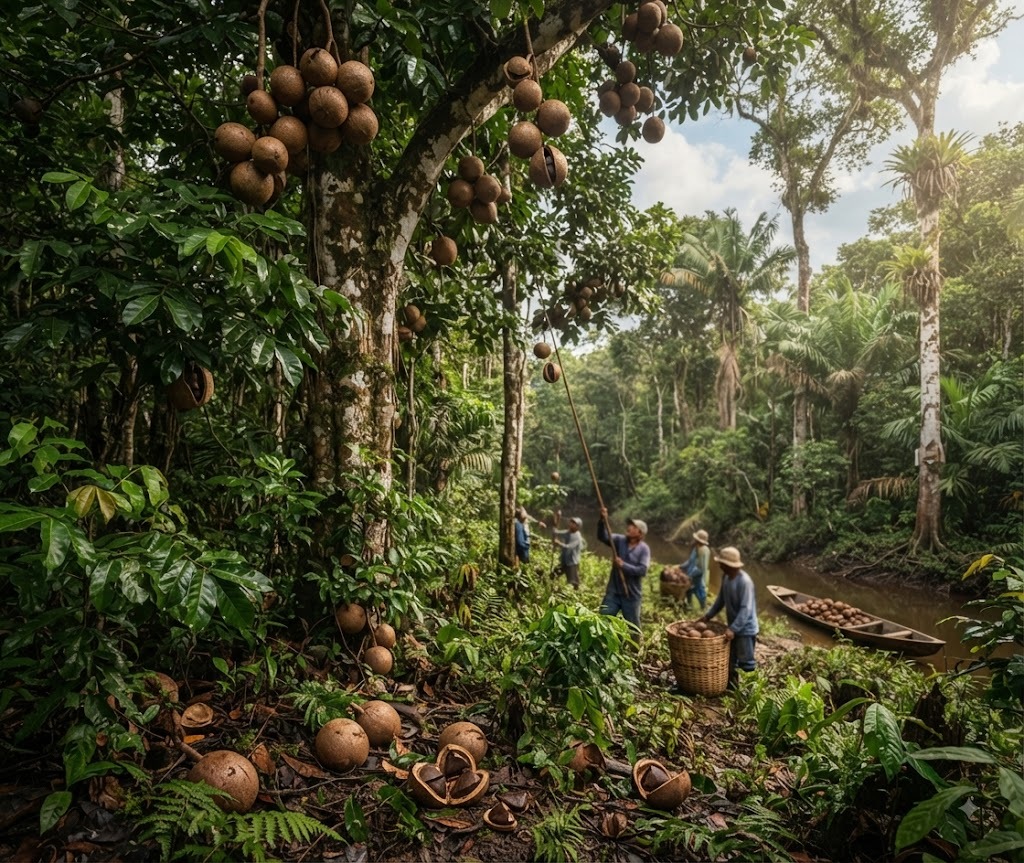
| Harvesting principle | The key is harvesting large, mature fruits after they naturally fall, rather than picking them directly from the tree. |
| Product separation | Pods, In-shell Nuts, Shelled Kernels, Whole/Broken, Roasted, Powder, and Oil are managed as separate products. |
| Separation of similar items | Separation of orchard-type nuts such as pecans, walnuts, and hazelnuts, as well as the plant and production systems. |
| Global production structure | The FAO identifies the major extraction and production regions as the Amazons of Brazil, Bolivia, and Peru, explaining that Brazil and Bolivia accounted for **91%** of global production in 2018. This figure is based on 2018 data. ( FAOHome ) |
| international trade | The FAO estimates the 2019 global export value of Brazil nuts, combining in-shell and shelled varieties, at $373 million . As this figure is based on 2019 data, it is not used directly as the current market size. ( FAOHome ) |
| Characteristics of natural forests | The FAO describes Brazil nuts as a key non-wood forest product harvested from the Amazon rainforest. ( FAOHome ) |
| Safety Core | The Codex places such importance on the management of mycotoxins during the harvesting, drying, and processing stages that it includes separate annex guidelines for the prevention and reduction of aflatoxins in Brazil nuts. ( FAO Home ) |
| Nutritional characteristics | The EFSA evaluates Brazil nuts as a highly selenium-rich food source, noting that their content varies significantly. Nutrition and health labeling requires separate verification under current domestic standards. ( European Food Safety Authority ) |
| Domestic production statistics | South Korea Commercial Brazil Nut Production Volume and Cultivation Area: To be entered after verification of official raw data. |
| Domestic import statistics | 2025/2026 Korea Import Volume, Value, and Share by Country: Input after verification of raw data from the Korea Customs Service |
| Supply and demand risk | Fluctuations in natural forest harvesting volume · Rainfall · Accessibility · Fruit drop season · Harvesting delay · Dryness · Mold · Aflatoxin · Shelling Yield · Logistics · Exchange rate |
| Operating Principles | Forest–Collector–Pod–In-shell Lot–Kernel–Safety Test–Importer–Buyer RFQ connection |
| Final goal | Building Forest-to-Market Supply Intelligence traceable from natural forest harvesting to buyer repurchase |
Basic fields | detail |
| Korean name | Brazil nuts |
| English name | Brazil Nut |
| Representative scientific name | Bertholletia excelsa Humb. & Bonpl. ( USDA Plant Database ) |
| classification | Lecythidaceae, Bertholletia |
| Edible parts | Kernel inside the shell of the nut of a large woody fruit |
| Non-edible · Separate management | Large external pods, shells, leaves, branches, wood, etc. |
| Major harvesting stages | Fruit ripening → Natural fruit drop → Harvesting → Pod opening → Separation of in-shell nuts |
| Basic product form | Whole Pod·In-shell Nut·Shelled Kernel·Whole/Broken·Roasted·Powder·Oil |
| Basic processing stage | Extraction · Pod Opening · Sorting · Drying · Shelling · Kernel Sorting · Roasting · Cutting · Grinding · Oiling |
| Basic use | Direct consumption · Nut mix · Confectionery · Bakery · Minced grains · Powder · Oil · PB |
| Principle of similar items | Separation from general orchard-type nuts, Bertholletia excelsa internal Collection Origin-centered management |
The USDA National Agricultural Library classifies Bertholletia excelsa as an independent species of the Lecythidaceae family and links Brazil nuts to a related food concept. ( NAL Agricultural Thesaurus )
Traditional FAO data describes a structure in which multiple angular nuts are contained within a single large fruit. Past technical figures, such as specific nut counts and pod weights, are not used as MarketHub standard fixed values because they vary by origin and sample. ( FAOHome )
Product Master
Product ID | Actual product form | Key Management Standards |
| BRAZILNUT-P01 | Natural Forest Fallen Pod | Forest Area · Collection Date · Soundness |
| BRAZILNUT-P02 | In-shell Nut immediately after opening the Pod | Collection Lot · Moisture · Contamination |
| BRAZILNUT-P03 | Dried In-shell Brazil Nut | Moisture · Shell · Mold · Crop/Collection Year |
| BRAZILNUT-P04 | Raw Shelled Kernel | Kernel Color, Size, Whole, Moisture |
| BRAZILNUT-P05 | Whole Kernel | Size, uniformity, defects, and flatoxin |
| BRAZILNUT-P06 | Broken Kernel | Piece Size · Color · Safety |
| BRAZILNUT-P07 | Roasted Brazil Nut | Roast Profile · Aroma · Color |
| BRAZILNUT-P08 | Seasoned Brazil Nut | Formulation, Labeling, Packaging |
| BRAZILNUT-P09 | Brazil Nut Granule | Particle size and roast status |
| BRAZILNUT-P10 | Brazil Nut Powder | Particle size, moisture, fat, rancidity |
| BRAZILNUT-P11 | Brazil Nut Paste | Viscosity, particle size, and oil separation |
| BRAZILNUT-P12 | Brazil Nut Oil | Pressing, Refining Status, and Oxidation Management |
| BRAZILNUT-P13 | Nut mix ingredients | Kernel Grade · Origin · Blending |
| BRAZILNUT-P14 | Confectionery and bakery ingredients | Whole/Broken · Grain |
| BRAZILNUT-P15 | PB · Finished Products | Ingredient Traceability, Labeling, and Use-by Date |
Classification criteria | Subdivision type | Management principles |
| Plant classification | Bertholletia excelsa | Plant Master |
| Supply method | Natural forest harvesting · Managed forest harvesting · Verification cultivation | Production Type Separation |
| Extracting country | Brazil, Bolivia, Peru, etc. | Origin Entity |
| Forest Area | Region, Concession, Community, etc. | Verified Location |
| Collection Year | Year of collection | essential |
| Harvesting stage | Fallen Pod·Opened Pod·In-shell·Kernel | Stage separation |
| Shell status | In-shell·Shelled | Trade/Product Separation |
| Kernel type | Whole Broken Granule | Buyer Grade |
| Processing form | Raw·Roasted·Powder·Paste·Oil | Product ID |
| Safety rating | Pre-inspection · Inspection Compliance · Hold · Rejected | Safety Status |
| Final use | Snack·Bakery·Mix Nut·Oil·Ingredient | Buyer Spec |
| Transaction type | Forest Procurement·Exporter·Import·Bulk·OEM/PB | Contract NDA |
The key to Brazil nut production lies in the structure of natural forest ecology, flowering and fruiting, large pod maturation, natural fruit drop, and forest collection, rather than the typical sowing, planting, and orchard harvesting process. The FAO describes Brazil nuts as a representative extractable non-wood forest product of the Amazon and indicates that harvesting from natural forests is an important source of income for local residents. ( FAOHome )
step | Essential Dataset | Management purpose |
| Forest Area Registration | Country · Region · Forest ID · Managing Entity | Origin Traceability |
| Production Outlook | Fruiting condition, weather, and harvestability | Supply Forecast |
| Fruit maturation | Fruit Development·Season | Collection Planning |
| Naturally fallen fruit | Fruit drop season and weather | Harvest Start |
| Collection of extraction areas | Previous season Pod/Nut separation | pollution prevention |
| Pod Collection | Collector · Date · Region | Collection Lot |
| Pod health screening | decay, damage, mold | Aflatoxin Risk |
| Pod release | Release Date · Method | Nut Recovery |
| In-shell Nut Separation | Weight, condition, and foreign matter | Raw Lot |
| 1st screening | Remove Rotten/Damaged | safety |
| purifying | The relevant city | Removal of soil and contaminants |
| dry | Moisture, Time, Method | Mold inhibition |
| In-shell save | Temperature, humidity, and period | Quality maintenance |
| transit | Forest→Collection Center | Traceability |
| Collection | Community/Supplier Lot | Consolidation |
| Re-selection | Defects, mold, foreign matter | Export Grade |
| peeling | Kernel retrieval/damage | Shelling Yield |
| Kernel screening | Whole/Broken · Color · Flaws | Buyer Grade |
| Aflatoxin test | Sampling·Result | Release/Hold |
| Other food inspections | pesticide residues, microorganisms, etc. | Import/Safety |
| stir-fry | Roast Profile | Snack |
| Cutting/Splitting | Island | Ingredient |
| smash | Powder/Paste | Processing |
| milking | Oil Yield | Oil Product |
| packaging | Blocking oxygen, moisture, and light | Zhejiang Province |
| export shipment | Exporter·Container | Trade |
| Import customs clearance | HS · Importer · Inspection | Import Lot |
| Domestic shipment | Buyer · Delivery Date | Delivery |
Quality items | In-shell | Shelled Kernel | processed goods | finished product | Public rating |
| Species | essential | succession | succession | tracking | Public |
| Extracting country | essential | succession | succession | tracking | Public |
| Forest Area | essential | succession | tracking | tracking | Verified |
| Collector/Community | ID | succession | tracking | - | Verified |
| Collection Year | essential | essential | succession | tracking | Verified |
| Lot | essential | new | new | new | Verified/NDA |
| Collection Date | essential | succession | tracking | - | Verified |
| Pod status | Source history | succession | - | - | Verified |
| Shell status | core | - | - | - | Member |
| Kernel exterior | Dog examination | core | core | Product Standards | Verified |
| Kernel color | Dog examination | core | core | Product Standards | Verified |
| weight | In-shell | Kernel | Input and Output | Display amount | Member |
| size | Nut Size | Kernel Size | Raw material specifications | Product Standards | Member |
| Whole ratio | - | core | Raw material specifications | Product Standards | NDA |
| Broken ratio | - | core | Product Branch | Product Standards | Verified |
| corruption | essential | essential | Non-conformity exclusion | disallowance | Verified |
| mold | essential | essential | core | Legal standards | Verified |
| alien substance | essential | essential | essential | essential | Verified |
| Shell contamination | - | essential | essential | Product Standards | Verified |
| moisture | core | core | By product | Product Standards | Verified |
| Aflatoxin | core | core | core | Legal standards | Verified/NDA |
| pesticide residues | If necessary | Compliant with standards | check | Legal standards | Verified/NDA |
| microorganism | If necessary | importance | core | Product Standards | Verified/NDA |
| Selenium | Origin/Lot Traits | Analysis if necessary | Labeling and Quality Review | Verification of laws and regulations | Verified |
| Roasting | - | corresponding | core | tracking | NDA |
| Island | - | Broken | Powder/Paste | Product Standards | Verified |
| Oxidation and rancidity | Storage Management | core | Powder/Paste/Oil | core | Verified/NDA |
| Processing history | - | essential | essential | essential | NDA |
| packaging | Bulk | B2B | By product | Labeling packaging | Member |
| save | dry | By product | By product | By product | Verified |
| Expiration date | The relevant city | By product | Test-based | mark | Verified |
| Shipment | record | record | record | record | Verified |
| Returns and Claims | record | record | record | record | NDA |
| Repurchase | connection | connection | connection | connection | NDA |
The Codex specifies that separate management measures for aflatoxin reduction are required for Brazil nuts due to their unique harvesting and processing environments . In particular, defect sorting and lot inspection management are crucial, as a correlation has been confirmed between spoiled kernels and shells and aflatoxin contamination. ( FAO Home )
The EFSA assesses that Brazil nuts have very high selenium concentrations and significant natural variability. Therefore, instead of using "high selenium content" as a mere marketing slogan, one must separately verify test results by origin and lot, as well as domestic labeling and nutritional standards . ( European Food Safety Authority )
Lot
Master Required Field
Lot ID · Item · Product Type · Species · Scientific Name · Country of Origin · Forest Area · Forest Management/Community · Collector · Collection Year · Collection Date · Pod Lot · Pod Condition · In-shell Weight · Moisture · Grade · Spoilage · Mold · Damage · Foreign Matter · Drying Date · Drying Method · Collection Center · Processor · Exporter · Importer · Shelling Date · Kernel Weight · Shelling Yield · Whole/Broken Ratio · Kernel Color · Defects · Aflatoxin · Pesticide Residues · Microorganisms · Selenium (if required) · Storage · Shipment History · Export Lot · Import Lot · Raw Material Lot · Roasting · Chopped · Powder · Paste · Extraction History · Packaging Date · Best Before Date · Origin · Returns · Claims · Repurchase
Customers | Purchase criteria | Cooperation opportunities |
| Nut importer | Country · Forest Origin · Collection Year | Global Procurement |
| Nut processing company | Whole · Broken · Moisture · Safety | Processing RFQ |
| Premium nut brand | Whole Kernel · Origin · Packaging | Premium Retail |
| Nut mix manufacturing | Size · Whole · Country of Origin · Unit Price | Mixed Nut Ingredients |
| Roasted nut company | Moisture · Roast suitability | Snack |
| Large-scale distribution | Country of origin, safety, inspection, and small packaging | Retail/PB |
| Online distribution | Kernel · Small Packaging · Inspection Information | Commerce |
| confectionery company | Broken Granule Powder | Ingredient |
| Bakery | Whole/Broken·Powder | B2B |
| granola and cereal | Broken·Roasted | Regular Supply |
| Hotels and Restaurants | Whole Piece | Foodservice |
| HMR manufacturing | Nut mix/crushed | Ingredient |
| PB·OEM | Snacks and Nut Mix | Manufacturing cooperation |
| Oil Processor | Kernel Oil Yield | Oil RFQ |
| Research and testing institutions | Aflatoxin·Selenium·Storage | Validation |
| ESG·Forestry Cooperation Agency | Forest Origin·Collector·Traceability | Sustainable Sourcing |
step | Key variables | Operational judgment |
| Natural forest production | Forest Area · Fruition · Weather | Supply Forecast |
| Naturally fallen fruit | Season · Accessibility | Collection Start |
| Forest Collection | Collector·Date·Pod Status | Traceability |
| Pod release | Nut Recovery | Raw Yield |
| dry | Moisture and time | Aflatoxin Risk |
| Collection | Community·Collection Center | Lot Consolidation |
| In-shell screening | Rot, Mold, Size | Raw Grade |
| peeling | Kernel Recovery · Broken | Processing Economics |
| Kernel Grade | Whole · Color · Flaws | Buyer Spec |
| Safety Test | Aflatoxin, etc. | Release/Hold |
| export contract | Origin·Grade·Collection Year | Procurement |
| shipment | Exporter·Freight·Transit | Landed Cost |
| Import customs clearance | HS · Importer · Inspection | Import Lot |
| Domestic storage | Moisture and rancidity | Inventory |
| Roasting and grinding | Yield · Scent · Color | Value-add |
| delivery | Test Report · Delivery Date | Buyer Evaluation |
| RFQ · Repurchase | Claim·Safety·Price | Supplier Ranking |
Import and export management
item | Management principles |
| In-shell Brazil Nut | Register after verifying the accurate item description and tariff code in the current Korea Customs Service HSK. |
| Shelled Brazil Nut | Separate HS management from in-shell |
| Stir-fried and prepared products | Can be classified differently from the raw material; current HSK must be verified separately. |
| Powder/Paste | Verification of item classification by degree of processing and formulation |
| Brazil Nut Oil | Separate HS review for oils and fats |
| Korea's import volume | Input after verification of raw data by the Korea Customs Service for 2025/2026 |
| Korean import value | Input after official verification of raw data |
| Major suppliers | Enter after verifying official data for country, HS, quantity, and amount. |
| FTA | Agreement Tariff Rates by Origin, HS, and Processing Status, and Rules of Origin |
| Food safety | Latest domestic standards for aflatoxin, pesticide residues, microorganisms, etc. |
| Customs clearance unit price | Separate calculation of In-shell and Shelled |
| Forest origin | Recommendation for traceability at the Forest/Community level, not just the national level. |
Products and processes | Key conditions | RFQ conversion |
| Fallen Pod | Forest·Collection Date | Forest Procurement |
| In-shell Raw Nut | Moisture, decay, mold | Export Raw RFQ |
| Dried In-shell | Moisture and safety | Trade RFQ |
| Raw Kernel | Whole · Color · Flaws | Kernel RFQ |
| Whole Kernel | Size · Safety | Premium Snack |
| Broken Kernel | Piece · Color · Safety | Bakery |
| Roasted Kernel | Roast · Aroma · Color | Snack |
| Granule | Grain size · Roast | Bakery/HMR |
| Powder | Particle size, moisture, rancidity | Ingredient |
| Paste | Viscosity and oil separation | Food Ingredient |
| Brazil Nut Oil | Extraction, Refining, Oxidation | Oil RFQ |
| Shell | Separation of food supply chains | Separate verification of material and fuel utilization |
| Pod Shell | Separation of food supply chains | Review of biomaterials and fuels |
| Defective Kernel | Safety assessment | Only suitable parts are converted to processing. |
| Mold/Aflatoxin Failure | Food supply chain exclusion | Disposal/Regulatory Treatment |
The FAO views Brazil nuts as an important extractable forest product in the Amazon economy. Therefore, regarding the utilization of by-products, instead of simply transitioning waste to material as is done with general nuts, Forest Sustainability, collection costs, regulations, and contamination risks must be verified first. ( FAOHome )
Product Research Profile (PRP)
PRP area | Key question |
| Forest Origin | What are the quality differences by country, region, and forest? |
| Collection Season | How does the time of collection affect moisture, decay, and mold? |
| Pod Condition | How to prevent contamination with previous season and corrupt Pods |
| Drying | What are the key management conditions for lowering aflatoxin risk? |
| Sorting | How much does removing defective and spoiled nuts contribute to safety? |
| Aflatoxin | Where does the risk increase among Collection, Drying, and Storage? |
| Shelling | What is the kernel recovery rate compared to the in-shell? |
| Whole Yield | How does the Whole Kernel ratio affect costs? |
| Selenium | What is the variation in content between the Origin and Lot? |
| Roast | How to manage changes in aroma, color, and rancidity by kernel size |
| Powder | What is the oxidation stability after grinding? |
| Paste | What are the viscosity, oil separation, and storage stability? |
| Oil | What are the actual milking yield and oxidation stability? |
| Buyer | How Safety Result, Origin, and Whole Yield Affect Repurchase |
first of all | Execution item | Performance indicators |
| 1 | Species·Forest Origin·Collector·Collection Date·Lot becomes mandatory | Required value completion rate |
| 2 | Pod·In-shell·Kernel·Roasted·Powder·Oil Product separation | Product identification rate |
| 3 | Linking weather, fallen fruit, harvesting, collection, and shipment data | Supply Forecast Accuracy |
| 4 | Data conversion of Aflatoxin, test reports, drying, storage, and processing history | Traceability rate |
| 5 | Collector–Processor–Exporter–Importer–Buyer RFQ connection | RFQ Match Rate |
| 6 | Video AI Pod·Nut Defect Detection | Defect detection accuracy |
| 7 | Kernel AI Whole/Broken · Discoloration Classification | Grade Accuracy |
| 8 | Mold/Aflatoxin Risk Scoring | Risk Lot Early Detection Rate |
| 9 | Forest Collection Volume Prediction | Error compared to actual |
| 10 | Collection Delay Risk Analysis | High-risk Lot Ratio |
| 11 | Predicting Drying Termination Conditions | Moisture standard compliance rate |
| 12 | Shelling Yield Prediction | Error compared to actual |
| 13 | Kernel Whole Yield Prediction | Error compared to actual |
| 14 | Inventory and Rancidity Risk Prediction | Quality claim rate |
| 15 | AI Supplier/Buyer Match | Sample→Contract Conversion Rate |
| 16 | Forest Traceability | Forest Area → Buyer Traceability Rate |
Problem group | Problem Definition | Required data |
| Fluctuations in natural forest supply | Natural fruiting and harvesting conditions have a greater influence than cultivation area. | Forest Production |
| Concentration in producing countries | Brazil, Bolivia, and Peru sensitive to changes in the supply environment | Origin |
| Forest Traceability | Difficulty tracing the actual sampling site in the final kernel | Forest ID |
| Collector dispersion | History interruption during the process of consolidating multiple extraction lots | Collector |
| Previous season mixing | Old Pods/Nuts increase safety risks | Collection Year |
| Delay in sampling | Risk of contamination if left unattended for a long time after falling | Collection Delay |
| Poor drying | Increased risk of mold and aflatoxin | Moisture |
| Corruption Kernel | Deterioration of safety and marketability | Defect |
| Aflatoxin | Food Safety Risk: A Core Issue in International Trade | Test Result |
| In-shell/Shelled mixture | Distortion in comparison of supply volume and customs clearance unit price | Product State |
| Shelling Yield deviation | Actual Cost Fluctuation of Edible Kernels | Yield |
| Whole/Broken deviation | Premium Product Yield Fluctuation | Grade |
| Selenium deviation | Nutritional content may vary by origin and lot. | Lab Result |
| rancidity | Deterioration of storage quality of high-fat kernels | Storage |
| Import logistics risk | Amazon Mountains → Port → Korea Lead Time | Logistics |
| Discontinuation of test reports | Lack of connection between Forest Lot and test results | Certificate |
| Lack of ESG verification | Verification of sustainable extraction claims is necessary | Forest Governance |
| Repurchase not reflected | Buyer Claim Not Feedback in Collector/Processor Selection | Evaluation·Reorder |
RFQ Type | Public Registration | Verify/NDA |
| Forest Collection Procurement | Country·Region·Collection Season | Community · Quantity · Unit Price |
| In-shell Brazil Nut | Origin · Collection Year · Moisture | Lot · Actual Price |
| Shelled Kernel | Whole/Broken · Color · Safety | MOQ · Test Report |
| Premium Whole Kernel | Size·Grade·Origin | Lot · Actual Unit Price |
| Broken Kernel | Standards and safety | Processing Price |
| Roasting ingredients | Kernel Size · Moisture | Roast Yield |
| Roasted Brazil Nut | Roast Level · Scent | MOQ · Delivery Time |
| Granule | Particle size and color | Bakery RFQ |
| Powder | Particle size, moisture, rancidity | Ingredient |
| Paste | Viscosity and particle size | B2B |
| Brazil Nut Oil | Extraction and refining | Oil RFQ |
| Nut mix | Whole/Broken·Origin | PB |
| Confectionery and Bakery | Kernel·Granule | Regular Supply |
| import | Origin · Collection Year · HS | Exporter · Freight · Unit Price |
| Aflatoxin verification | Lot · Inspection Status | Original test score report |
| Selenium Analysis | Origin·Lot | Analysis Report |
| Forest Traceability | Forest·Collector·Processor | Verified Chain |
| Sustainable procurement | Extraction Rights · Forest Governance | Related evidence |
| PB·OEM | Nut Mix · Roasted · Oil | Manufacturing conditions |
| Research cooperation | Aflatoxin·Storage·Forest Supply | Dataset·IP |
① Need Products & Materials
Companies and institutions seeking necessary products, agricultural products, raw materials, and processed goods register purchasing demands. Registered requests are utilized to review cooperation with potential suppliers and producers based on the RFQ Intelligence Library.
Process:
RFQ Registration → Supplier/Product Review → Collaboration Connection → Future AI Matching
Register
② We are looking for production and manufacturing partners. (Need Suppliers & Manufacturers)
Register a request to find necessary production and supply partners, ranging from farms and producer organizations to processing companies, OEM, ODM, and private label manufacturers.
Process:
RFQ Registration → Review of Production & Manufacturing Capabilities → Collaboration Connection → Future AI Partner Matching
Register
③ We are looking for domestic and international buyers. (Need Buyers)
Farmers, producer organizations, and manufacturing companies are requesting cooperation with new buyers, such as domestic and international distributors, importers, brand companies, and food service and catering businesses.
Process:
RFQ Registration → Product & Supply Capability Review → Market & Buyer Connection → Future AI Buyer Matching
Register
Contact : mail@markethub.org
Version | Main contents | situation |
| v1.0 | Plant Identity · Amazon Natural Forest Harvesting · Forest Origin · In-shell · Kernel · Aflatoxin · Processing · RFQ Basic Structure Registration | complete |
| v1.1 | Latest Global Production · Korea Import Volume · Current HSK · Forest Origin · Verification of Market Raw Data | expected |
| v2.0 | Collection Lot · Drying · Aflatoxin · Shelling Yield · Whole/Broken · Selenium · Roast · Powder · Oil Quality Standards Subdivision | expected |
| v3.0 | Combine Forest Area–Community–Collector–Collection Center–Processor–Exporter–Importer–Buyer Verified Container | expected |