

Judgment axis | Key judgment |
| Item Identity | According to FAO standards, the representative species for commercial pistachios is Pistacia vera L., a woody nut crop belonging to the Anacardiaceae family. ( FAOHome ) |
| Key role | Inshell Premium Snacks · Shelled Kernel · Confectionery · Bakery · Ice Cream · Paste · Powder Ingredients |
| Harvesting principle | Manage Hull Separability, Shell Spread, and Kernel Maturity as Core Datasets for Yield Evaluation |
| Product separation | In-shell·Open-shell·Closed-shell·Shelled·Whole Kernel·Pieces·Roasted·Powder·Paste separation |
| Separation of similar items | Although it belongs to the same family as cashews, it is distinct in species, fruit structure, processing, and market. |
| Domestic statistics | Domestic commercial cultivation area and production volume: To be entered later after verification of official raw data |
| World production | USDA FAS 2025/26 Outlook: Global production 1,092,682 tons, in-shell basis . Projected to decrease by approximately 8% from 1,186,052 tons in the previous year. |
| Made in the USA | USDA FAS 2025/26 forecast of 712,682 tons, in-shell basis , projected to increase by approximately 43% year-over-year. |
| Iranian production | USDA FAS 2025/26 forecast 200,000 tons, in-shell basis . High temperatures, drought, and irrigation interruptions are cited as factors reducing production. |
| Turkish production | USDA FAS 2025/26 forecast: 120,000 tons, in-shell basis . Major factors include the off-year of biennial cropping and the impact of frost and drought. |
| World exports | USDA FAS 2025/26 forecast of 683,000 tons, in-shell equivalent , projected to reach an all-time high due to increased U.S. supply. |
| HS structure | USDA FAS International Statistical Standard 080251 In-shell, 080252 Shelled; for Shelled, use a conversion factor of 2.0 when converting to In-shell. |
| Safety risks | Controlling mold and aflatoxins is key for pistachios. The FAO recommends rapid harvesting after maturity, hull removal, drying, and cold storage. ( FAOHome ) |
| Supply risk | Biennial crop · Frost · Drought · Irrigation · Concentration of producing countries · Aflatoxin · Shell change rate · Kernel Grade · Exchange rate · Ocean freight |
| Operating Principles | Species–Cultivar–Origin–Crop Year–Shell Opening–Aflatoxin–Grade–Import Lot–RFQ Connection |
| Final goal | Linking global production, safety, kernel grade, and buyer performance to recurring procurement decision-making |
Basic fields | detail |
| Korean name | pistachio |
| English name | Pistachio |
| Representative scientific name | Pistacia vera L. ( FAOHome ) |
| classification | Anacardiaceae, Pistacia genus |
| Edible parts | Green kernel inside the woody shell |
| Non-edible · Separate management | Hull, Shell, Leaf, Branch, Pruning Byproduct |
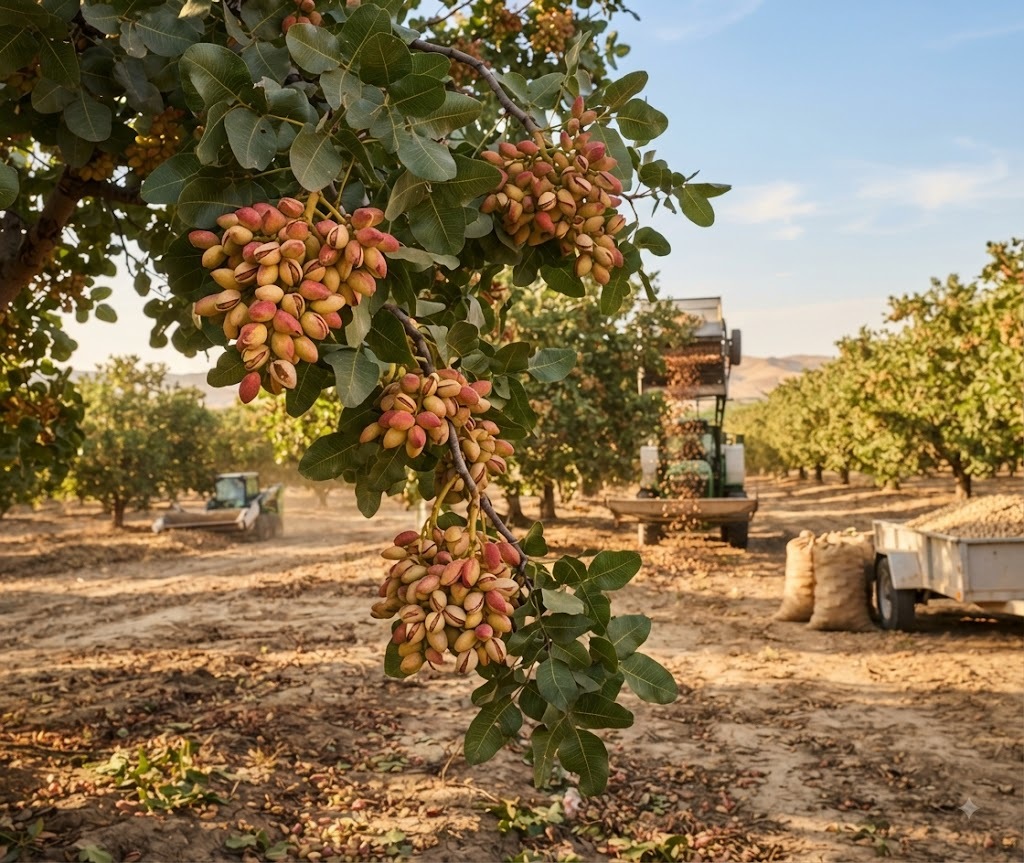
| Major harvesting stages | Immature fruit → Kernel maturation → Hull separation easy · Shell splitting → Harvest |
| Basic product form | In-shell · Shell · Unshell · Shell · Shell · Kernel · Whole · Piece · Roast · Powder · Paste |
| Basic processing stage | Hull removal, washing, drying, sorting, dehulling, roasting, cutting, grinding |
| Basic use | Snacks · Confectionery · Chocolate · Bakery · Ice Cream · Dessert · Paste · PB |
| Principle of similar items | Separation of Pistacia vera and other Pistacia species used for wild and rootstock use |
FAO EcoCrop describes the fruit of Pistacia vera as a drupe containing a single seed and explains that it is used in the food industry as an ingredient to provide flavor and color to cakes, ice cream, snacks, and confectionery. ( EcoCrop )
Product Master
Product ID | Actual product form | Key Management Standards |
| PISTACHIO-P01 | Fresh fruit immediately after harvest | Origin · Cultivar · Harvest Date · Hull Condition |
| PISTACHIO-P02 | Dry shell | Moisture · Shell color · Shell change rate · Defects |
| PISTACHIO-P03 | Open-shell Pistachio | Natural shelling rate, size, and kernel fidelity |
| PISTACHIO-P04 | Closed-shell Pistachio | Non-reshuffle rate and mechanical cabinet reshuffle |
| PISTACHIO-P05 | Raw Shelled Kernel | Color, Size, Whole Ratio, Test Report |
| PISTACHIO-P06 | Whole Kernel | Greenness, Size, Damage, Moisture |
| PISTACHIO-P07 | Kernel Pieces | Particle size, color, shell contamination |
| PISTACHIO-P08 | Roasted pistachios | Roast Profile · Moisture · Scent |
| PISTACHIO-P09 | Salt and seasoned pistachios | Seasoning, Sodium, Packaging |
| PISTACHIO-P10 | Pistachios | Particle size, color, and roasting status |
| PISTACHIO-P11 | pistachio powder | Particle size, moisture, color, fat |
| PISTACHIO-P12 | pistachio paste | Kernel ratio, particle size, color, viscosity |
| PISTACHIO-P13 | Pistachio cream ingredients | Paste · Mixture · Sugars · Oils |
| PISTACHIO-P14 | Ice cream and dessert ingredients | Greenness, Scent, and Paste Specifications |
| PISTACHIO-P15 | PB · Finished Products | Ingredient Traceability, Labeling, and Use-by Date |
Classification criteria | Subdivision type | Management principles |
| Plant classification | Pistacia vera | Plant Master |
| Other Species | Pistacia atlantica et al. | Rootstocks and wild species are separate entities |
| Cultivar | Actual commercial varieties such as Kerman, Akbari, and Ahmad-Aghaei | Cultivar ID |
| production site | US, Iran, Turkey, EU, Syria, etc. | Origin Entity |
| Crop Year | 2025/26 etc. | essential |
| Harvesting stage | Immature, Maturity, Hull Separation, Cabinet Reshuffle | Harvest Stage |
| Shell status | Open·Closed·Shelled | Product Separation |
| Kernel type | Whole/Half/Piece Powder | Buyer Spec |
| color | Green intensity · Kernel color | Key ingredients for confectionery and desserts |
| Processing form | Raw·Roasted·Salted·Powder·Paste | Product ID |
| Final use | Snack·Bakery·Chocolate·Gelato·Paste | Buyer-specific management |
| Transaction type | In-shell Import·Kernel Import·Bulk·OEM·PB | Contract NDA |
As pistachios are perennial woody plants, not only the harvest year but also alternate bearing must be reflected in the Supply Runtime. The USDA FAS explains the increase in U.S. production and the sharp decline in Turkish production for 2025/26 by linking them to on-year and off-year crop cycles, respectively.
The FAO recommends harvesting as soon as possible immediately after maturity to prevent aflatoxin exposure, and advises using factors such as whether the hull separates easily from the shell, whether fruit detachment ability has decreased, and the dryness of the hull and kernel to determine the optimal harvest time. ( FAOHome )
step | Essential Dataset | Management purpose |
| Cultivation plan | Cultivar · Rootstock · Area · Crop Cycle | Long-term supply forecast |
| Seedlings and grafts | Cultivar·Rootstock·Nursery | breed tracking |
| formula | Official Year · Orchard | production base |
| dormancy | Low temperature · Dormancy | Flowering prediction |
| flowering | Flowering date of male and female flowers | Moisture management |
| moisture | Pollination, wind, weather | Fruit set |
| Fruit set | Fruit set and fallen fruit | Yield Forecast |
| rising | Frost, high temperature, drought, rainfall | Production risk |
| Watering | Irrigation amount · Irrigation cessation | Yield |
| dispute | Input amount and timing | Production history |
| pests | Occurrence and Control | Quality · Aflatoxin Risk |
| Kernel hypertrophy | Growth and vigor | Marketability |
| Shell cabinet reshuffle | Open-shell ratio | Grade Forecast |
| Hull maturity | Color and ease of separation | Harvest judgment |
| harvest | Harvest date and method | Harvest Lot |
| Hull removal | Harvest → Removal Time | Risk of mold and discoloration |
| purifying | Foreign matter/Hull residue | hygiene |
| 1st screening | Immaturity, damage, or foreign matter | Raw Grade |
| dry | Moisture, time, temperature | Storage stability |
| In-shell selection | Open/Closed · Size · Stain | Product Branch |
| peeling | Kernel recovery | Shelled Product |
| Kernel screening | Whole Piece Color Flaws | Buyer Grade |
| stir-fry | Time and temperature | Snack |
| Buntae | Island | Bakery |
| smash | Powder·Paste | Ingredient |
| save | Temperature, humidity, oxygen | Mold and rancidity |
| packaging | Vacuum/N₂ etc. | Quality maintenance |
| shipment | Export Lot·Container | Trade |
| Incoming inspection | HS, Origin, Aflatoxin, etc. | Import Lot |
| shipment | Buyer · Delivery Date | Delivery |
Quality items | In-shell raw material | Kernel | processed goods | finished product | Public rating |
| Species | essential | succession | succession | tracking | Public |
| Cultivar | essential | succession | Raw material standards | tracking | Verified |
| Origin | essential | succession | succession | tracking | Public |
| Crop Year | essential | essential | succession | tracking | Verified |
| Producer/Processor | ID | succession | tracking | tracking | Verified |
| Lot | essential | new | new | new | Verified/NDA |
| Harvest day | essential | succession | succession | tracking | Verified |
| Hull removal history | essential | succession | tracking | - | Verified |
| Shell cabinet reshuffle rate | core | - | Raw Material Evaluation | - | Verified/NDA |
| Closed-shell ratio | core | - | Cost linkage | - | NDA |
| Shell stain | core | - | - | - | Verified |
| size | core | Kernel Size | Raw material specifications | Product Standards | Member |
| weight | Inshell | Kernel | Input and Output | Display amount | Member |
| Kernel color | After the cabinet reshuffle | core | core | Product Standards | Verified |
| Green | The relevant city | core | Paste and Powder Core | Product Standards | Verified |
| Whole ratio | - | core | Raw material specifications | Product Standards | NDA |
| Broken/Piece | - | core | Product Branch | Product Standards | Verified |
| Empty/Part-filled | core | eliminate | - | - | Verified |
| mold | essential | essential | essential | Product Standards | Verified |
| alien substance | essential | essential | essential | essential | Verified |
| Shell contamination | - | essential | essential | Product Standards | Verified |
| moisture | Drying core | core | By product | Product Standards | Verified |
| pesticide residues | Legal standards | succession | check | Legal standards | Verified/NDA |
| Aflatoxin | core | core | core | Legal standards | Verified/NDA |
| microorganism | If necessary | core | core | Product Standards | Verified/NDA |
| Roasting | - | corresponding | core | tracking | NDA |
| Island | - | Piece | Powder/Paste Key Points | Product Standards | Verified |
| rancidity | save | core | Paste Core | Product Standards | Verified |
| Processing history | - | essential | essential | essential | NDA |
| packaging | Bulk | B2B | Oxygen and moisture blockage | Labeling packaging | Member |
| save | Drying and low temperatures | By product | By product | By product | Verified |
| Expiration date | By Product | Test-based | Test-based | mark | Verified |
| Shipment | record | record | record | record | Verified |
| Returns and Claims | record | record | record | record | NDA |
| Repurchase | connection | connection | connection | connection | NDA |
The FAO explains that premature shell splitting, hull damage, and damage by birds and insects can increase the risk of mold and aflatoxin contamination, emphasizing the need for management at every stage from production to harvest, drying, storage, and processing. ( FAOHome )
Lot Master Required Field
Lot ID · Item · Product Type · Species · Scientific Name · Cultivar · Rootstock · Crop Year · Country of Origin · Production Region · Orchard · Producer · Processor · Exporter · Importer · Flowering · Fruit Set Information · Harvest Date · Hull Condition · Hull Removal Date · Shell Opening Rate · Closed-Shell Ratio · Size · Weight · Grade · Kernel Color · Greenness · Whole/Piece Ratio · Empty/Part-filled · Stains · Mold · Foreign Matter · Pesticide Use History · Pesticide Residues · Aflatoxin · Microbiological Report · Drying · Storage · Shipment History · Export Lot · Import Lot · Raw Material Lot · Shelling · Roasting · Minced · Powder · Paste Processing History · Packaging Date · Best Before Date · Shipper · Returns · Claims · Repurchase
Customers | Purchase criteria | Cooperation opportunities |
| Nut importer | Origin·Crop Year·In-shell/Kernel | Global RFQ |
| Nut expert processing | Open-shell · Size · Moisture · Grade | Processing RFQ |
| Stir-fry and seasoning companies | Size, Moisture, Roast Suitability | Snack Supply |
| Large-scale distribution | Country of origin, specifications, safety, packaging | Retail/PB |
| Online distribution | In-shell · Roast · Small packaging | Commerce |
| confectionery company | Kernel·Piece·Powder | Ingredient |
| Chocolate manufacturing | Whole Piece Paste | B2B |
| Bakery | Powder, paste | Regular supply |
| Ice cream · Gelato | Kernel Color, Paste Ratio, Flavor | Premium Ingredient |
| Dessert making | Powder, Paste, Cream | Product Development |
| cafe | Paste · Cream · Powder | Beverage/Dessert |
| plant-based foods | Kernel·Paste | Plant-based |
| Hotels and Restaurants | Whole Piece Paste | Foodservice |
| PB·OEM | Snack · Cream · Dessert | Manufacturing cooperation |
| Import and export companies | HS·Origin·FTA·Safety | Trade RFQ |
| Research and testing institutions | Aflatoxin Grade Storage | Verification cooperation |
step | Key variables | Operational judgment |
| Overseas production | Country · Cultivar · Crop Cycle | Supply Forecast |
| harvest | Shell Cabinet Reshuffle · Hull Maturity | Grade Forecast |
| Hull removal and drying | Time and moisture | Aflatoxin Risk |
| In-shell selection | Open/Closed · Size · Stain | Product Branch |
| peeling | Kernel Yield | Shelled Supply |
| Kernel Grading | Whole Piece Color | Buyer Grade |
| Contracts and Procurement | Crop Year·Grade·Origin | Procurement |
| export shipment | Freight·Lead Time | Landed Cost |
| Import and Customs Clearance | HS · Origin · Inspection | Import Lot |
| save | Temperature and humidity · Rancidity · Aflatoxin | Inventory |
| Stir-fry/Seasoning | Yield, Color, Scent | Value-add |
| Powder/Paste | Color, particle size, and yield | Premium Ingredient |
| Distribution and supply | Quality and Delivery | Buyer Evaluation |
| RFQ · Repurchase | Claim · Price · Grade | Supplier Ranking |
Import and export management
item | Management principles |
| In-shell HS | USDA FAS International Statistical Standard 080251 Pistachios, In-shell |
| Shelled HS | USDA FAS International Statistical Standard 080252 Pistachios, Shelled |
| Conversion | USDA FAS converts to an in-shell standard using a 2.0 conversion factor on shelled weight. |
| Stir-fried and prepared products | Possible HS code different from Raw Product; current Korea Customs Service HSK verification separate |
| Paste/Cream | Verification of separate item classification based on raw material ratio and blending |
| Korea's import volume | Input after verification of raw data from the 2025/2026 Korea Customs Service Import/Export Trade Statistics |
| Korean import value | Input after official verification of raw data |
| Major suppliers | Enter after verifying country, quantity, and amount by HS code |
| FTA | Agreement Tariff Rates by Origin, HS, and Processing Status, and Rules of Origin |
| Incoming inspection | Check the latest standards for aflatoxin, pesticide residues, microorganisms, and foreign substances. |
| Customs clearance unit price | Calculate In-shell and Shelled separately |
| distribution | Crop Year·Packing·Container·Transit·Warehouse connection |
Products and processes | Key conditions | RFQ conversion |
| Harvested fresh fruit | Hull·Shell·Cultivar | Raw Supply |
| Dry In-shell | Moisture and Open-shell Ratio | In-shell RFQ |
| Open-shell | Faithful to Size, Stain, and Kernel | Premium Snack |
| Closed-shell | Shelling and peeling materials | Processor RFQ |
| Shelled Kernel | Whole · Color · Moisture | Kernel RFQ |
| Whole Kernel | Greenness · Size | Premium Ingredient |
| Kernel Pieces | Particle size and color | Bakery |
| Roasted pistachios | Roast Level · Scent | Snack |
| Seasoned pistachios | Salt/Seasoning | PB/OEM |
| Buntae | Particle size and color | Chocolate/Bakery |
| powder | Particle size, moisture, color | Dessert |
| Paste | Kernel Ratio, Viscosity, Greenness | Gelato/Premium Bakery |
| cream | Paste, sugar, and oil mixture | PB/Dessert |
| Shell | Separated from Food Products | Review of non-food materials |
| Hull | Separated from the Food Kernel | Separate verification for compost, extraction, etc. |
| Broken Kernel | When safety is compliant | Powder/Paste |
| Mold/Contaminated | Food supply chain exclusion | dispose |
Product Research Profile (PRP)
PRP area | Key question |
| Cultivar | How do open-shell and kernel colors, sizes, and quantities differ? |
| biennial harvest | How does On-year/Off-year affect price and contract supply? |
| harvest | When are Hull splitting and Kernel maturation points? |
| Open-shell | How does the natural rate of deterioration affect product value? |
| Closed-shell | How much can unshelled fruit be utilized as shelling raw material? |
| dry | How to reduce the risk of moisture and mold |
| Aflatoxin | What are the risk factors among Orchard, Harvest, Drying, and Storage? |
| Kernel Color | What level of greenness do confectionery and gelato buyers want? |
| Whole Yield | What is the whole kernel recovery rate after dehulling? |
| Roast | Does it achieve the proper roast while maintaining color and aroma? |
| Powder | How is the stability of particle size and greenness? |
| Paste | What are the kernel ratio, viscosity, color, scent, and oil stability? |
| Buyer | How Origin, Crop Year, and Grade Affect Repurchase |
first of all | Execution item | Performance indicators |
| 1 | Species·Cultivar·Origin·Crop Year·Lot become mandatory values | Required value completion rate |
| 2 | Open-shell·Closed-shell·Kernel·Powder·Paste Product separation | Product identification rate |
| 3 | Linking weather, flowering, biennial fruiting, harvest, and shipment data | Supply Forecast Accuracy |
| 4 | Data conversion of Aflatoxin, test reports, drying, storage, and processing history | Traceability rate |
| 5 | Producer–Processor–Exporter–Importer–Buyer RFQ connection | RFQ Match Rate |
| 6 | Video AI Open/Closed-Shell Automatic Classification | Accuracy |
| 7 | Shell Stain · Defect AI Screening | defect detection rate |
| 8 | Kernel Color/Greenness AI Grade | Grade Accuracy |
| 9 | On/Off-year production forecast | Error compared to actual |
| 10 | Harvest timing prediction | Harvest Error |
| 11 | Aflatoxin Risk Scoring | High-risk Lot Early Detection Rate |
| 12 | Inventory, Price, and Revenue Lead Time Forecast | Out of stock rate |
| 13 | Powder/Paste Processing Yield Prediction | Yield Error |
| 14 | AI Supplier/Buyer Match | Sample→Contract Conversion Rate |
| 15 | Traceability | Orchard → Finished Product Traceability |
Problem group | Problem Definition | Required data |
| dependence on overseas production | Domestic supply depends on global producing countries | Country Production |
| Concentration in producing countries | Impact on crop conditions in the US, Iran, and Turkey | Origin |
| biennial harvest | Increase in the volatility of annual production volume | Crop Cycle |
| Frost risk | Damage to flowering and fruit set | Temperature |
| High temperatures and drought | Kernel enlargement and reduced yield | Climate·Irrigation |
| Irrigation risk | Water and electricity constraints | Irrigation |
| Harvest time error | Increased risk of quality issues and mold | Maturity |
| Open-shell deviation | Fluctuation in Premium Product Yield | Split Rate |
| Closed-shell excess | Increase in processing and peeling costs | Closed Rate |
| Shell stain | Deterioration of appearance grade | Stain |
| Empty Nut | Decline in edible yield | Fill Rate |
| mold | Deterioration of storage and production quality | Moisture |
| Aflatoxin | Key Risks in International Trade and Food Safety | Test Result |
| Kernel color deviation | Differences in marketability between confectionery and paste | Color |
| Whole/Piece deviation | Yield difference of high-priced products | Kernel Yield |
| Storage rancidity | Long-term inventory quality degradation | Storage |
| HS Mixed | Confusion regarding In-shell, Shelled, and Prepared statistics | HS |
| Repurchase not reflected | Supplier quality performance not linked to next purchase | Evaluation·Reorder |
RFQ Type | Public Registration | Verify/NDA |
| Overseas In-shell Procurement | Country · Crop Year · Open-shell | Producer · Quantity · Price |
| Open-shell Premium | Size·Cabinet Reshuffle Rate·Color | MOQ · Actual Unit Price |
| Closed-shell material | Size·Ratio | Descarburization yield · price |
| Shelled Kernel | Whole · Color · Grade | Test Report/Unit Price |
| Whole Kernel | Greenness · Size | MOQ · Price |
| Kernel Pieces | Particle size and color | Unit price of processed raw materials |
| Roasted pistachios | Roast · Packaging | Delivery Time · MOQ |
| Seasoned pistachios | Seasoning · Packaging | OEM conditions |
| Buntae | Particle size and color | Bakery Contract |
| powder | Greenness and Grain Size | Confectionery Buyer Spec |
| Pistachio Paste | Kernel ratio, color, and viscosity | Actual Raw Material Cost · MOQ |
| Pistachio Cream | Blending, Sugars, Oils | OEM/PB |
| Ice cream · Gelato | Paste/Powder | Premium B2B |
| Chocolate and confectionery | Whole/Piece/Paste | Regular supply |
| Bakery | Powder · Paste | Regular Supply |
| import | HS·Origin·Crop Year | Exporter·Freight·Price |
| Safety verification | Aflatoxin · Pesticide residue | Original text of the test report |
| PB·OEM | Snack · Cream · Dessert | Manufacturing conditions |
| Research cooperation | Open-shell · Aflatoxin · Grade | Dataset·IP |
① Need Products & Materials
Companies and institutions seeking necessary products, agricultural products, raw materials, and processed goods register purchasing demands. Registered requests are utilized to review cooperation with potential suppliers and producers based on the RFQ Intelligence Library.
Process:
RFQ Registration → Supplier/Product Review → Collaboration Connection → Future AI Matching
Register
② We are looking for production and manufacturing partners. (Need Suppliers & Manufacturers)
Register a request to find necessary production and supply partners, ranging from farms and producer organizations to processing companies, OEM, ODM, and private label manufacturers.
Process:
RFQ Registration → Review of Production & Manufacturing Capabilities → Collaboration Connection → Future AI Partner Matching
Register
③ We are looking for domestic and international buyers. (Need Buyers)
Farmers, producer organizations, and manufacturing companies are requesting cooperation with new buyers, such as domestic and international distributors, importers, brand companies, and food service and catering businesses.
Process:
RFQ Registration → Product & Supply Capability Review → Market & Buyer Connection → Future AI Buyer Matching
Register
Contact : mail@markethub.org
Version | Main contents | situation |
| v1.0 | Plant Identity · Global Production · Biennial Fruiting · Open/Closed-shell · Kernel · Aflatoxin · Processing · RFQ Basic Structure Registration | complete |
| v1.1 | Domestic Production Status · 2025/2026 Korea Import Volume · Cultivar · HS · FTA · Market Official Raw Data Verification | expected |
| v2.0 | Cultivar · Crop Cycle · Shelling Rate · Kernel Grade · Aflatoxin · Roasting · Powder · Paste Quality Standard Subdivision | expected |
| v3.0 | Orchard–Producer–Processor–Exporter–Importer–Manufacturer–Gelato/Bakery/Buyer Verified Container combination | expected |