


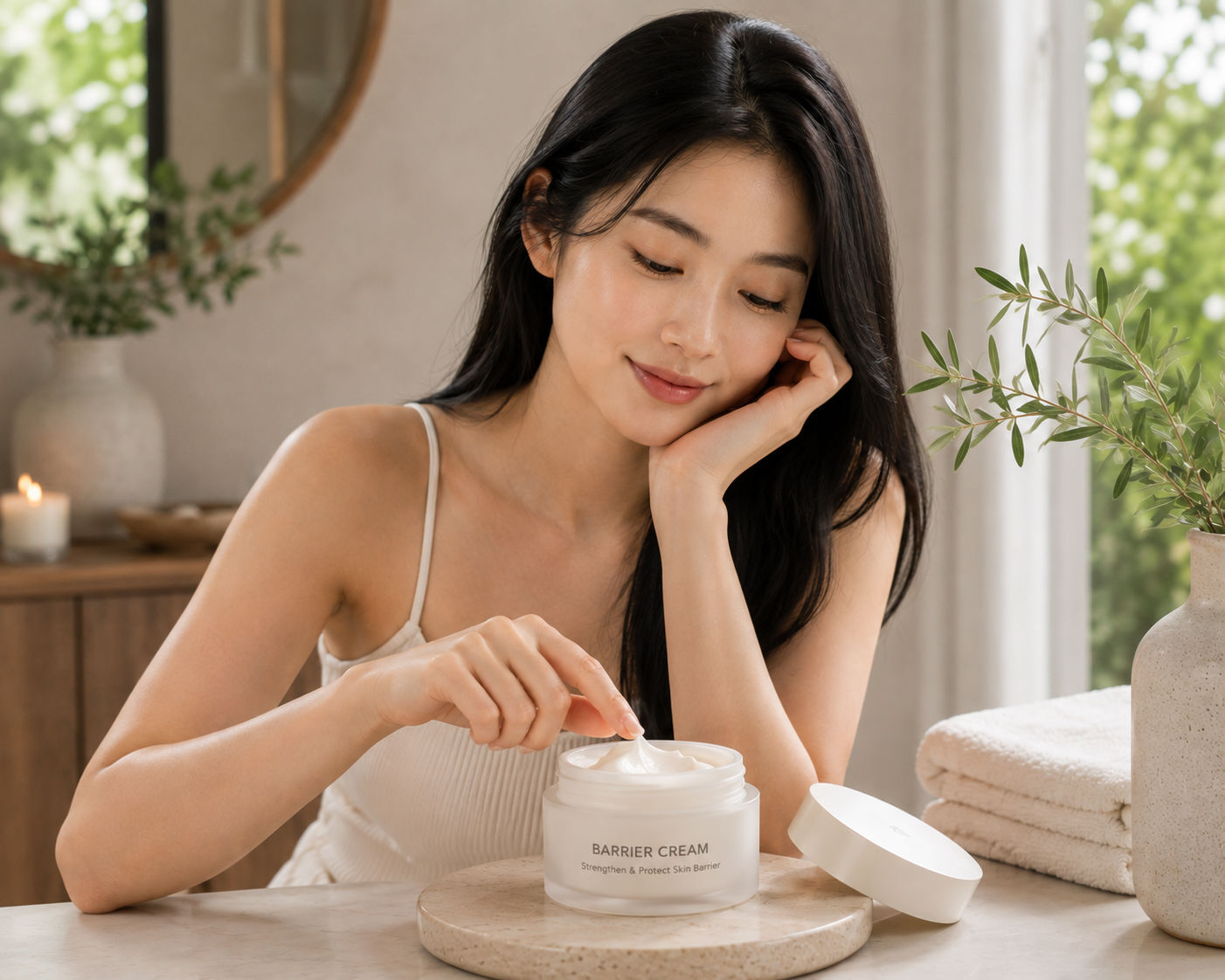
Barrier cream is a highly protective moisturizer designed not only to supply moisture and oil to the skin surface but also to reduce moisture evaporation and maintain the protective function of the stratum corneum, which has become dry due to external stimuli. While rich moisturizing cream focuses on rich hydration and long-lasting effects, the identity of barrier cream is determined by TEWL alleviation, suitability for sensitive skin, barrier retention, and usability during the recovery phase .
It must also be distinguished from No. 041 Ceramide Cream. While Ceramide Cream features ceramide or multi-lipid technology as its representative ingredients, No. 040 is a comprehensive barrier solution that combines a wide range of ingredients including panthenol, moisturizers, emollients, occlusives, and film-forming agents. Therefore, it is not necessary to apply a high concentration of ceramide, and the moisture loss mitigation performance of the finished product takes precedence over the raw material story.
Key consumers are those with dry or sensitive skin who experience tightness after washing, recurring dryness, flaking, seasonal sensitivity, or discomfort from wearing masks, air conditioning/heating, or using retinoids or exfoliating products. Products that can be used not only on the entire face but also on localized dry areas such as the mouth, cheeks, neck, and hands also have high commercial potential.
Consumers desire mild protective creams for daily use rather than strong treatments, but they avoid formulations that are excessively heavy, sticky, or cause makeup to smudge. Product satisfaction is determined by the balance between “immediate comfort upon application” and “protection maintained until the next cleansing.” Uses intended for use immediately after procedures or for improving skin conditions must not be extended to general cosmetic applications without separate conformity assessments and market-specific regulatory reviews.
The global barrier care market is located at the intersection of sensitive skincare, dermacosmetics, skin cycling, and high-performance moisturizing categories. In North America and Europe, fragrance-free, dermatologist-tested, and skin barrier support are key purchasing terms, while in the Korean and Asian markets, daily creams combining panthenol, ceramide, and squalane with a hypoallergenic image are strong.
The major customer groups are summarized as follows.
- Consumers with dry or sensitive skin: Fragrance-free protective cream for daily use on the entire face
- Active skincare users: Restorative moisturizer between days of using retinol-acid ingredients
- Combination skin consumers: Topical barrier cream for use only on necessary areas, such as the cheeks and corners of the mouth.
- Family & Multi-use Demand: A tube-type cream that cares for dry areas of both the face and body.
The most stable market position for Buyers is not a product that claims to “treat damaged barriers” like a pharmaceutical, but a fragrance-free daily cream that supports the moisture barrier of skin weakened by dryness .
The performance of barrier creams stems not from a single hero ingredient, but from a balance of moisture-attracting humectants, emollients that enhance flexibility, occlusives that reduce evaporation, and soothing auxiliary ingredients. Panthenol is well-suited as a representative component of global OEM/ODM products due to its high consumer recognition and ease of combination with glycerin, squalane, and dimethicone.
| Formula Route | Key Components and User Experience | Buyer's judgment |
|---|---|---|
| Protective Panthenol Barrier | A medium-concentration cream centered on glycerin, panthenol, squalane, and dimethicone | Applicable to the widest range of skin types and markets, recommended route |
| Multi-Lipid Barrier | Ceramide, cholesterol, fatty acid, or lipid-like system | Technological differentiation is possible, but position overlap with No. 041 is possible. |
| Occlusive Balm-Cream | Strengthening the proportion of protective layers such as petrolatum, dimethicone, and wax | Suitable for extremely dry, localized, and night use, but requires management regarding heaviness and makeup smudging. |
Panthenol-Lipid Protective Barrier Cream , excluding fragrances and essential oils, is suitable for NoChemiLife. It can be distinguished from No.041 by combining protective ingredients such as squalane, light esters, and dimethicone, centered on panthenol and moisturizers, and selecting ceramides at an auxiliary level.
The finished product should be thick but spread smoothly at skin temperature, leaving a thin protective film without white residue or pilling. It is more advantageous to persuade buyers by ensuring suitability for sensitive skin, preservation stability, and long-term usability rather than excessively increasing the amount of plant extracts.
It is relatively easy to design products within the scope of cosmetics that "support the skin barrier" or "alleviate discomfort caused by dryness." On the other hand, expressions such as "treat damaged skin," "restore cracked skin," or those that could be interpreted as a skin protectant in the U.S. market can exceed the scope of general cosmetics depending on the ingredients and labeling methods, so prior review by country of launch is required.
| Confirmation area | Key materials the Buyer will request | Go/Hold criteria |
|---|---|---|
| Performance Validation | Comparison of Skin Moisture Content and TEWL, Usage Period, Control Conditions, and Statistical Summary | Moisture retention and moisture loss mitigation confirmed based on the finished product. |
| Sensitivity suitability | Repeated use or dermatological evaluation, summary of adverse reactions | Fragrance-free formulation and good tolerability of the actual finished product |
| Quality and stability | Stability, microbiological, preservation, and container suitability data | High-temperature separation, low-temperature crystallization, discoloration, and off-odor are within the permissible range. |
| Claims·Export | Review of INCI, labeling, and claim basis by country | Hold when using medical expressions or unfounded “barrier repair” |
The barrier performance of a finished product cannot be determined solely by data on panthenol or ceramide ingredients. The key validation involves verifying changes in moisture content and TEWL after using the finished product. To add claims such as non-comedogenic, immediate redness relief, or long-lasting hydration, separate evidence for the finished product corresponding to each claim is required.
50mL airless pumps are suitable for ensuring hygiene and a premium image, while 50–75mL laminated tubes are efficient for dispensing thick formulations and in terms of cost and portability. 75–100mL tubes are also possible for multi-use or family use, but this may weaken the premium positioning for facial use. Jars, which are repeatedly touched by hands, have relatively low consistency with the sensitivity and protection concept.
Prior to export, pump dispensing, tube resilience, content residue, high-temperature oil-phase separation, and low-temperature lipid crystallization must be verified in the actual sales container. The standard shelf life is determined based on the manufacturer's stability data, and the use-by period after opening and storage labeling must also comply with the standards of the destination country.
Since barrier creams are expected to perform better than regular moisturizing creams, a mid-to-high price point can be justified if clinical summaries and a sensitive skin positioning are secured.
- Entry: US$18–25 — Basic unscented moisturizing and protective cream
- Core: US$25–38 — Daily barrier cream based on panthenol, lipid systems, and TEWL
- Premium: US$40–65 — Proprietary lipid technology, dermatological brand image, or premium packaging
- NoChemiLife Recommended: 50–75mL, US$28–36
The price premium is formed based on the finished product's grounds, non-sticky protective sensation, suitability for sensitivities, and container convenience, rather than the number of ceramides or extracts.
**La Roche-Posay Cicaplast Balm B5+** is a prime example of a panthenol-based multi-use balm for dry and rough facial and body skin. While its strengths lie in its strong protective image and reliability in pharmacy and dermatological distribution, buyers must distinguish by country whether claims regarding skin protection and crack prevention fall within the scope of cosmetics.
AESTURA ATOBARRIER365 Cream is a benchmark K-Beauty barrier cream that features high-density ceramide capsules and long-lasting hydration. Its strength lies in connecting proprietary delivery technology with the sensory experience of capsules that consumers can recognize, rather than simply naming the ingredients.
Skinfix Barrier+ Triple Lipid-Peptide Cream is a North American premium barrier care product that combines ceramide, lipids, and peptides. While it demonstrates a high-performance, high-price positioning, if a new brand chooses a similar combination system, it must consider both the increased cost and the basis for differentiation.
It is more effective to distinguish NoChemiLife as a panthenol-centered protective cream that is easy to use every day, rather than entering the same ceramide competition as these products.
Korean OEM/ODMs possess extensive experience with panthenol, ceramide, and squalane-based sensitive creams, as well as a wide range of airless and tube packaging options. However, since simply adding ingredients to a manufacturer's existing base can result in a texture similar to competing products, the target skin texture and verification level must be clearly specified during the RFQ stage.
| RFQ Item | Recommended specifications | Manufacturer verification |
|---|---|---|
| Product Concept | Fragrance-Free Panthenol-Lipid Protective Barrier Cream | Whether it is a modification of an existing base or a new prescription |
| Formulation and volume | Medium to high concentration, 50 mL airless or 50–75 mL tubes | Smudging, stickiness, low-temperature crystallization, and discharge properties |
| Key ingredient | Panthenol, Glycerin, Squalane, Protective Barrier Components, Selective Ceramide | Actual Input Quantity · Raw Material Specifications · INCI |
| Validation | Moisture/TEWL, sensitivity evaluation, stability/preservative power | Scope of use for testing institutions, control conditions, and claims |
| Commercial conditions | MOQ, unit price range, sample, trial, and mass production schedule | Whether mold and auxiliary material costs and export documents are included |
Contact to: mail@markethub.org
When making an inquiry, rather than making a general request such as “cream for sensitive skin,” you must provide the target market, volume, exclusion of fragrance, skin sensation immediately after application and 10 minutes later, whether a TEWL claim is necessary, target retail price, and differentiation of position from No. 041 to receive a comparable quote.
The Go condition is when a fragrance-free finished product, a clear positioning for daily barrier protection, evidence regarding moisture and TEWL, sensitivity evaluation, long-term stability, and actual container suitability are ensured. The Panthenol-based Route is suitable as the first barrier care SKU because raw material procurement and consumer communication are relatively easy.
The hold conditions are when the medicinal “repair” expression is used without regulatory review, when only raw material test data is submitted, when it is excessively waxy or causes makeup to rub off, or when the role of the SKU is not distinguished from that of ceramide cream.
In RFQ comparisons, vendors should not be selected based solely on the stated concentrations of panthenol or ceramide; instead, the finished product TEWL results, control products, test period, sample usability, unit price per MOQ, and auxiliary material conditions must be evaluated together. Since differences in skin sensation directly influence repurchase for barrier creams, at least two rounds of sensory sample comparison are required following the document evaluation.
KB-RFQ-040 Final Decision
Global Core: A+
OEM/ODM Priority: A+
NoChemiLife Hero Product: Candidate
Recommended Route: Fragrance-Free Panthenol-Lipid Protective Barrier Cream
Barrier cream is a core SKU that can simultaneously target the sensitive, derma, and high-moisture markets, and allows for the management of OEM/ODM implementation difficulty. However, due to fierce competition, productization standards should be based on a protective sensation suitable for daily use, evidence of TEWL for the finished product, a fragrance-free design for sensitive skin, and a clear division of roles with No.041 Ceramide Cream, rather than being a “cream with many ingredients. ”
Core Evidence
- La Roche-Posay — Cicaplast Balm B5+ — Global Product Benchmark of Panthenol-Based Multi-Use Protective Balm
- AESTURA — ATOBARRIER365 Cream — A K-Beauty example combining ceramide capsules and long-lasting hydration
- Skinfix — Barrier+ Triple Lipid-Peptide Cream — A Case Study of a Premium Multi-Lipid Barrier Cream in North America
- Clinical study — Panthenol and ceramide-containing formulation — Barrier and tolerability evaluation data of a specific finished product on sensitive skin
- Clinical study — Ceramide-containing cream and TEWL — Data evaluating changes in skin moisture and TEWL after using a specific ceramide cream
Runtime: 2026-09-01
