


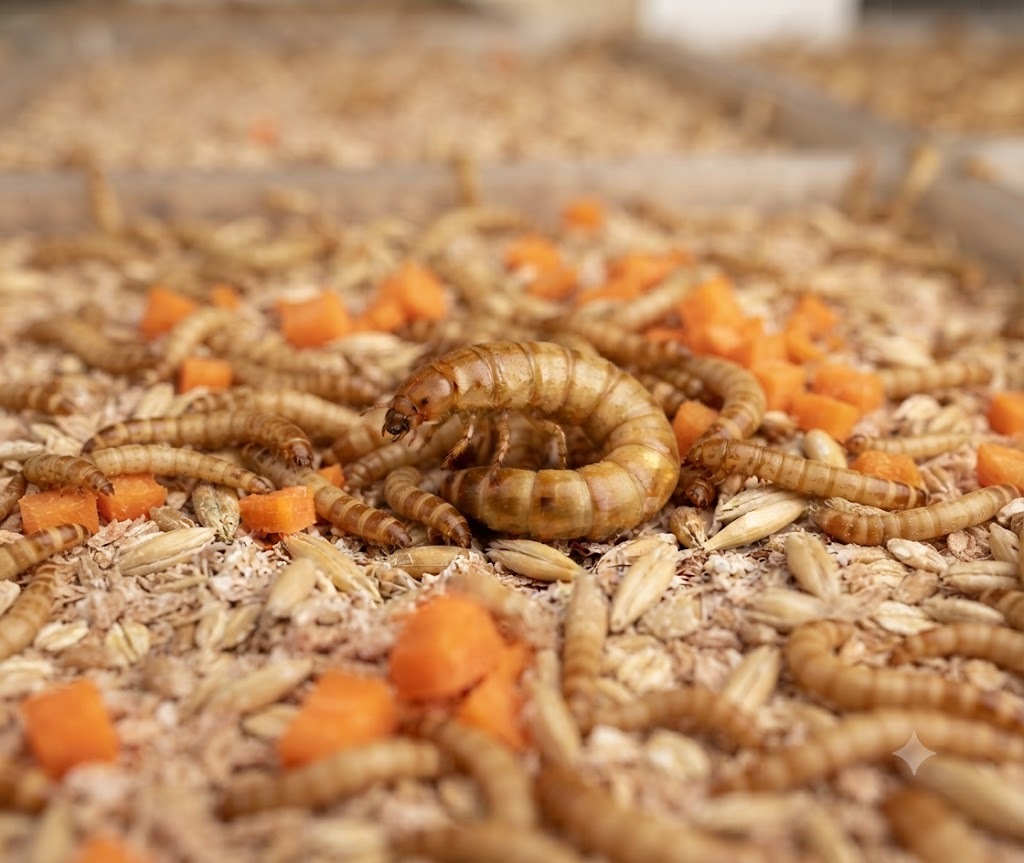
The brown mealworm is a representative insect used for food and animal feed , where the larvae (yellow mealworm larvae), rather than the adults , form the core of actual industrial raw materials. In Korea, brown mealworm larvae are already included among edible insects recognized as general food ingredients, and they are confirmed as one of the 10 official food ingredients in the list of edible insects released by the Rural Development Administration in 2026. ( Rural Development Administration )
Industrially, it is important to expand beyond the simple sale of dried mealworms to a process that spans production → pretreatment → drying → powdering → defatting → protein and lipid separation → and finally to buyers for food, feed, and functional materials . The FAO also views mealworms as one of the insects with high potential for industrialization in food and feed, explaining that insects can be utilized directly as a protein source or in the form of extracted proteins. ( FAOHome )
Judgment axis | Key points |
| Key production stage | larva |
| Main purpose | Food, feed, protein, functional materials |
| Main Products | Live larvae, dried larvae, powder, defatted powder, protein |
| production core | Parent insects, egg laying, larval growth, food, density, environment |
| Quality Core | Moisture, Protein, Fat, Hygiene, Raw Material History |
| Major risks | Microorganisms, Allergies, Feed/Substrate Contamination |
| AX | Temperature, Humidity, Feed, Biomass, Growth, and Yield Prediction |
| RFQ | Larvae, Powder, Protein, Feed, Raw Materials Buyer |
| Final goal | Conversion from bulk insects to standardized industrial raw materials |
In other words, the key question regarding mealworms is not “how many kilograms were raised?” but “how many kilograms can be reliably supplied with the ingredients and specifications required by a buyer?”
The brown mealworm (Tenebrio molitor) is an insect belonging to the family Tenebrionidae of the order Coleoptera, undergoing a process of complete metamorphosis from egg to larva to pupa to adult. The stage primarily utilized in the food and feed industries is the larva; for this reason, MarketHub distinguishes between brown mealworms and brown mealworm larva products.
Even for the same larvae, the transaction price with the buyer varies depending on whether they are live, dried, powdered, defatted powder, or protein fraction. Therefore, instead of registering the product under the single name "mealworm," it is broken down into Product Entities based on the processing stage.
division | Main purpose | Product Entity |
| Jongchung | breeding | Adults and breeding insects |
| egg | multiplication | Egg Lot |
| larva | raw material | Fresh Larvae |
| dry larva | Food and Feed | Dried Mealworm |
| powder | Food and Feed | Mealworm Powder |
| Degreased powder | Protein source | Defatted Powder |
| Protein fraction | Food and Feed | Protein Ingredient |
| Geological fractions | subject matter | Insect Oil |
The basic structure is Mealworm → Life Stage → Processing Stage → Product → Buyer .
For mealworms, it is more important to distinguish production uses and processing standards than to differentiate between the numerous commercial breeds, as is the case with other livestock . Even within the same species, standards for raw materials, rearing substrates, processing, and safety management may differ depending on whether they are intended for food, animal feed, or functional materials.
For food use, food ingredient standards and hygiene and labeling regulations must be met, while for animal feed use, standards for target animals and feed ingredients must be verified. Furthermore, for functional materials, raw materials must be produced based on desired components such as protein, lipids, and chitin.
Production type | Key criteria | Major Buyers |
| For food use | Hygiene, Ingredients, and Labeling | food companies |
| for animal feed | Nutrition, Safety, Unit Price | feed company |
| For protein | Protein content and processability | raw material companies |
| functional materials | Ingredients, Extraction, and Specifications | biotech companies |
| breeding insect | spawning, survival, and reproductive capacity | production farms |
At MarketHub, production is reverse engineered in the order of Use → Specification → Production → Processing .
The brown mealworm system operates by having adult beetles lay eggs, raising the hatched larvae for a certain period, and then harvesting them. Productivity must be assessed not only by the number of eggs laid and hatching, but also by the larval growth rate, survival rate, rearing density, feed efficiency, and the timing of harvest.
Since insects are poikilotherms, they can be significantly affected by environmental conditions. Therefore, by recording temperature, humidity, rearing density, and feed quantity for each production batch, it is possible to compare under which conditions larval biomass and yields are highest.
Management area | Things to see at a farm |
| Jongchung | spawning and survival |
| egg | Hatching rate |
| larva | Growth and uniformity |
| prey | Type, Input Quantity, Price |
| environment | Temperature and humidity |
| density | Individuals per breeding box |
| harvest | Timing · Live weight |
| expense | feed, electricity, and labor costs |
While the FAO assesses that insects generally have high feed conversion efficiency and potential as a protein source, the actual efficiency of a specific farm varies depending on rearing conditions and product form. Therefore, actual batch data is prioritized rather than using general insect FCR figures as confirmed farm values. ( FAOHome )
Since mealworms are used as ingredients for food and animal feed, raw material hygiene and processing safety are key management areas rather than disease. The safety and quality of the final product can vary depending on the type of feed and substrate used, as well as how they were fasted, washed, heated, frozen, and dried after harvest.
The EFSA conducted safety assessments on yellow mealworm larvae in freeze-dried, dried, and powder forms, and dried yellow mealworms have been approved as a novel food in the EU. In addition, allergic risks, such as the possibility of reactions in individuals allergic to shellfish or house dust mites, must also be considered. ( European Food Safety Authority )
step | Key Management |
| Jongchung | Colony/Batch |
| prey | Feed/Substrate Lot |
| breeding | Environment and Density |
| harvest | Date · Larva weight |
| Preprocessing | Fasting, washing, etc. |
| Sterilization/Inactivation | Heating and freezing |
| dry | Moisture and temperature |
| Grinding and processing | Powder Lot |
| circulation | Product Lot · Buyer |
The representative traceability structure is Feed/Substrate → Rearing Batch → Harvest Lot → Kill/Dry Process → Powder/Protein Lot → Buyer .
In Korea, since mealworm larvae are already recognized as edible insects, there is an institutional foundation for their entry into the food ingredient market. In the list of edible insects released by the Rural Development Administration and the Ministry of Food and Drug Safety in 2026, mealworm larvae are one of the 10 species recognized as general food ingredients. ( Rural Development Administration )
However, edibility and high marketability are separate issues. In actual business, rather than focusing on the dried larvae themselves, one must first identify which buyers will make repeated purchases—such as for powder, protein, pet food ingredients, and processed foods.
Participants | Things needed | RFQ |
| Insect farm | Breeder, Feed, and Sales Channels | Producer |
| food companies | Powder/Protein | Food RFQ |
| feed company | Protein source | Feed RFQ |
| Pet food company | Larvae and powder | Pet Feed |
| raw material companies | Defatted powder · Protein | Ingredient |
| biotech companies | Extracted and functional materials | Bio-material |
| processing company | Drying, Powder, Extraction | Processing |
| Research Institute | Nutritional and functional | R&D |
MarketHub places greater value on expanding the number of buyers for industrial processed raw materials than on the live larva market .
In the international trade of mealworms, live insects, dried food products, feed ingredients, and protein products must be distinguished from one another. Since food and feed may be subject to different regulatory systems and labeling and safety standards, the same HS and import/export conditions must not be applied.
While there are instances in the EU where yellow mealworms have been approved under the Novel Food system, this does not mean that Korean products can be automatically exported to Europe. In actual transactions, product form, processing methods, facilities, and regulations of both the exporting and destination countries must be re-verified. ( European Food Safety Authority )
Breeder → Rearing → Larvae Harvesting → Inactivation/Drying → Powder/Protein → Inspection/Packaging → Import/Export → Buyer
Confirmation area | Main contents |
| Bio | Species, Stages, and Quarantine |
| dried product | Food/Feed Purpose |
| powder | Ingredients, moisture, hygiene |
| protein | Extraction method and content |
| mark | Ingredients · Allergens |
| trade | HS · Customs · Country of Origin |
| certification | Food, feed, and facilities |
| Buyer | Specifications, Quantity, Delivery Time |
In the actual RFQ, the Product Form + Intended Use + Regulatory Status + HS + Buyer Specification are reconfirmed at the time of transaction.
The industrial value of mealworms can be greater in how they are converted into various raw materials after processing than in the live larvae . They can be used as a protein source after drying and grinding, and proteins and lipids can be separated through additional processes such as degreasing and hydrolysis.
A review published in FAO AGRIS also concludes that T. molitor larvae are evaluated as an alternative protein source for food and feed, and that processing methods such as defatting and hydrolysis, as well as drying and grinding, are utilized. ( AGRIS )
Product Entity | Main uses |
| Fresh Larvae | Biomaterials |
| Dried Mealworm | Food and Feed |
| Powder | Food and feed formulation |
| Defatted Powder | High-protein ingredients |
| Protein Fraction | Food and Feed |
| Insect Oil | lipid raw materials |
| Chitin-rich Fraction | Materials Research |
| Hydrolysate | Research on functional materials |
Key questions regarding PRP include whether selling whole larvae or powder is more advantageous, whether to increase protein content after defatting, what protein, fat, and moisture specifications the buyer requires, and which product form offers the highest margin, including processing costs .
The brown mealworm is an industrial insect with high AX application efficiency because it can be reared in multi-tiered indoors. By linking temperature, humidity, feed input, larval biomass, growth rate, and harvest date for each rearing box, differences in productivity per batch can be compared.
In the future, it will be possible to estimate larval density and growth status using video, or to apply automatic feeding, automatic separation, and harvest prediction. However, the first thing required is to accurately record input and output in kilogram units .
Apply AX | Expected effects |
| environmental sensor | Temperature and humidity stabilization |
| Automatic feeder | Labor reduction and input management |
| Video analysis | Growth and density estimation |
| Automatic weight | Biomass verification |
| Batch Management | Productivity Comparison |
| Harvest forecasting | Schedule and Manpower Planning |
| Cost Analysis | production cost per kg |
| Buyer Matching | Planned production by specification |
The core structure is Input Feed → Rearing Environment → Biomass → Harvest → Processing Yield → Buyer Price .
The primary problem facing the mealworm industry lies not in whether production is possible, but in determining at what price and where to continuously sell the produced insects . Even if an edible insect market exists, relying solely on raw material sales may limit processing and distribution margins, so product forms and buyers must be designed together.
Furthermore, if breeding substrates and hygiene and processing standards vary from farm to farm, it is difficult to supply the uniform raw materials required by large food and feed companies. Therefore, at the industrialization stage, standardized production, joint processing, and lot management become more important than individual farms.
problem | Data to verify |
| Growth deviation | Temperature, humidity, density, and food |
| Dead | Environment and hygiene |
| feed costs | Substrate price and input amount |
| production cost | Cost per kg |
| Moisture variation | Drying process |
| Protein deviation | Feed, Larvae, Processing |
| hygiene | Microorganisms and Processes |
| Selling price | By Product Form |
| Buyer shortage | Corporate/Monthly Demand |
| Market expansion | Food, feed, and materials |
The basic solution structure is Problem Discovery → Batch Data → Standard Rearing → Processing Standard → Buyer Test → Contract Production .
The Request for Quotation (RFQ) for mealworms must not be limited to the sale of live larvae. Since food companies may request dried powder, feed companies protein raw materials, and bio-companies extracted or fractionated materials, production farms, processing companies, and buyers must be connected into a single supply chain.
In particular, it may be more economical for farms to collaborate with local or specialized processing companies for joint processing, rather than equipping themselves with all drying, powdering, and extraction facilities. MarketHub evaluates Producer Capability and Processor Capability separately.
RFQ Type | Collaboration Examples |
| Jongchung | production troops |
| larva | Bio-supply |
| dry larva | Food and Feed |
| powder | food ingredients |
| Degreased powder | Protein source |
| protein | Food and Feed |
| process | Drying, grinding, and extraction |
| OEM·ODM | Insect food |
| feedstuff | For pets and livestock/aquaculture |
| AX Pilot | Automated breeding and cost analysis |
Component analysis, contract price, processing yield, and Buyer Specification are managed at the Verified/NDA stage.
Mealworms are an industrial insect where RFQ (Request First) is very important . Rather than farmers raising a large number of larvae first and then looking for a market, it is more efficient to produce after first confirming the product type, protein, moisture, particle size, and monthly supply volume required by the buyer.
In particular, it is difficult to conduct an accurate transaction based solely on a request for "1 ton of mealworms." First, it is necessary to distinguish whether they are for food or feed, live or dried, and powder or protein raw material.
① Find products/raw materials.
Need Products & Materials
Companies and institutions seeking live larvae, dried mealworms, powder, defatted powder, protein raw materials, etc., register their purchase demands. MarketHub reviews producers and companies capable of supplying these items by verifying their intended use, ingredients, processing form, quantity, delivery time, and safety conditions.
RFQ Submission → Product Specification Review → Connecting Producers and Companies → AI Matching
Register
② We are looking for production and processing partners.
Need Suppliers & Manufacturers
We are seeking necessary production and processing partners, including insect farms, dryers, grinders, degreasing companies, extractors, OEMs, and ODM firms. We evaluate not only production scale but also raw material traceability, processing yield, and quality standardization capabilities.
RFQ Submission → Review of Production/Processing Capabilities → Partner Connection → AI Partner Matching
Register
③ We are looking for domestic and international buyers.
Need Buyers
Production farms and processing companies seek new buyers, including food, animal feed, pet food, and bio-raw material companies. We verify product type, ingredients, supply volume, and price to connect them with suitable buyers.
RFQ Submission → Product & Supply Capability Review → Buyer Connection → AI Buyer Matching
Register
Contact : mail@markethub.org
In the mealworm dataset, the rearing batch and product lot are the core entities, rather than individual specimens. To analyze productivity and quality simultaneously, it is necessary to link the eggs produced from a specific breeding larva to the substrate and environment in which they were raised, the point at which they were harvested, and the type of processed product they became.
In particular, since the live weight and final product weight change significantly after processing, the processing yield must be recorded. This allows for a comparison of which is actually more profitable: selling live larvae or selling dried powder and protein.
Dataset | Simply put |
| Master | Growth stage, product, and use standards |
| Entity | Farm · Batch · Processing Company · Buyer |
| Relationship | Connecting feed, rearing, processing, and products |
| Runtime | Biomass, moisture, price, yield |
The representative structure is as follows.
Breeder → Egg Lot → Larval Batch → Feed/Substrate → Environment → Harvest → Drying → Powder/Protein → Buyer
Economic feasibility is:
Feed Cost + Energy + Labor + Mortality → Live Larvae kg → Dry Yield → Protein Yield → Product Price → Margin
Analyze as.
Since the mealworm can be utilized simultaneously as food, animal feed, and a protein source, regulations and safety must be managed separately according to its intended use. In Korea, as of 2026, mealworm larvae are included in the list of edible insects recognized as ingredients for general food. ( Rural Development Administration )
Globally, the FAO regards mealworms as insects with high potential as a protein source for food and feed, and in the EU, there is a case where dried yellow mealworms were approved as a Novel Food following an EFSA evaluation. While these data serve as evidence of industrial potential, they do not imply automatic export authorization for each country. ( FAO Home )
Evidence | source |
| A | Ministry of Food and Drug Safety, Rural Development Administration, FAO, EFSA |
| B | Papers · National Research Institutes |
| C | Insect Industry Association · Verified Industry Data |
| D | Farm, Business, and Transaction Data |
| E | Additional verification needed |
Key factual basis
- As of 2026, among the 10 species of edible insects in Korea, mealworm larvae are included as an ingredient in general food products. ( Rural Development Administration )
- The FAO evaluates edible insects as a source of protein, vitamins, and amino acids, and suggests their potential as a protein resource for food and animal feed. ( FAOHome )
- The FAO classifies mealworms as a promising species among insects for industrial feed. ( FAOHome )
- The EFSA conducted a safety assessment of freeze-dried forms of Tenebrio molitor larvae, and dried yellow mealworms have been approved as a novel food in the EU. ( European Food Safety Authority )
- Yellow mealworms are dried and ground for food and feed, and can be utilized as a protein source through additional processing such as defatting and hydrolysis as needed. ( AGRIS )
- Insect foods must be managed not only for their protein value but also for their potential allergens, microorganisms, raw material safety, and processing methods. ( European Food Safety Authority )
Version History
Version | Main contents | situation |
| v1.0 | First Registration of RFQ Structures for Food, Feed, Protein, and Functional Materials | complete |
| v1.1 | Reinforcement of official statistics on Korean production farms, prices, production volume, and markets | expected |
| v2.0 | Batch·Feed·Growth·Processing Yield·PRP Runtime connection | expected |
| v3.0 | Insect Farms · Processing Companies · Food · Feed Buyer Verified Matching | expected |